Eye Area Energy Treatments: How to Check Eye Protection and Treatment Scope
What to confirm at consultation for eye area energy treatments: eye protection, tips and treatment scope, pain and recovery, results and cost, and how ATTITUDE Clinic runs the process.
Written by ATTITUDE Clinic Editorial Team
When the eye area starts to sag and fine lines multiply, your hand goes to the outer corner every time you look in the mirror. Once you start looking into lifting, these questions come up naturally: how are my eyes protected during the procedure, does it go above the eyelid too, how much does it hurt, and what does the cost include? This article walks through how eye area energy treatments work, what determines results and recovery, and what questions to ask at consultation.
The bottom line first
Eye area energy treatments are a group of procedures that deliver heat energy to the skin around the eyes to stimulate collagen renewal. What shapes your results is not the device name but what you confirm at consultation: the treatment area and depth, how the eyes are protected, risks and recovery, and cost. The American Academy of Dermatology advises asking about expected results, risks, alternatives, the practitioner's experience, recovery time, and cost before any cosmetic procedure (AAD questions to ask). Whether a protective device like an eye shield is required, or how well an eye-specific tip performs, cannot be judged from general information alone. That is why the starting point is hearing directly from the practitioner how the eyes are covered and how far the treatment extends.
How do eye area energy treatments work?
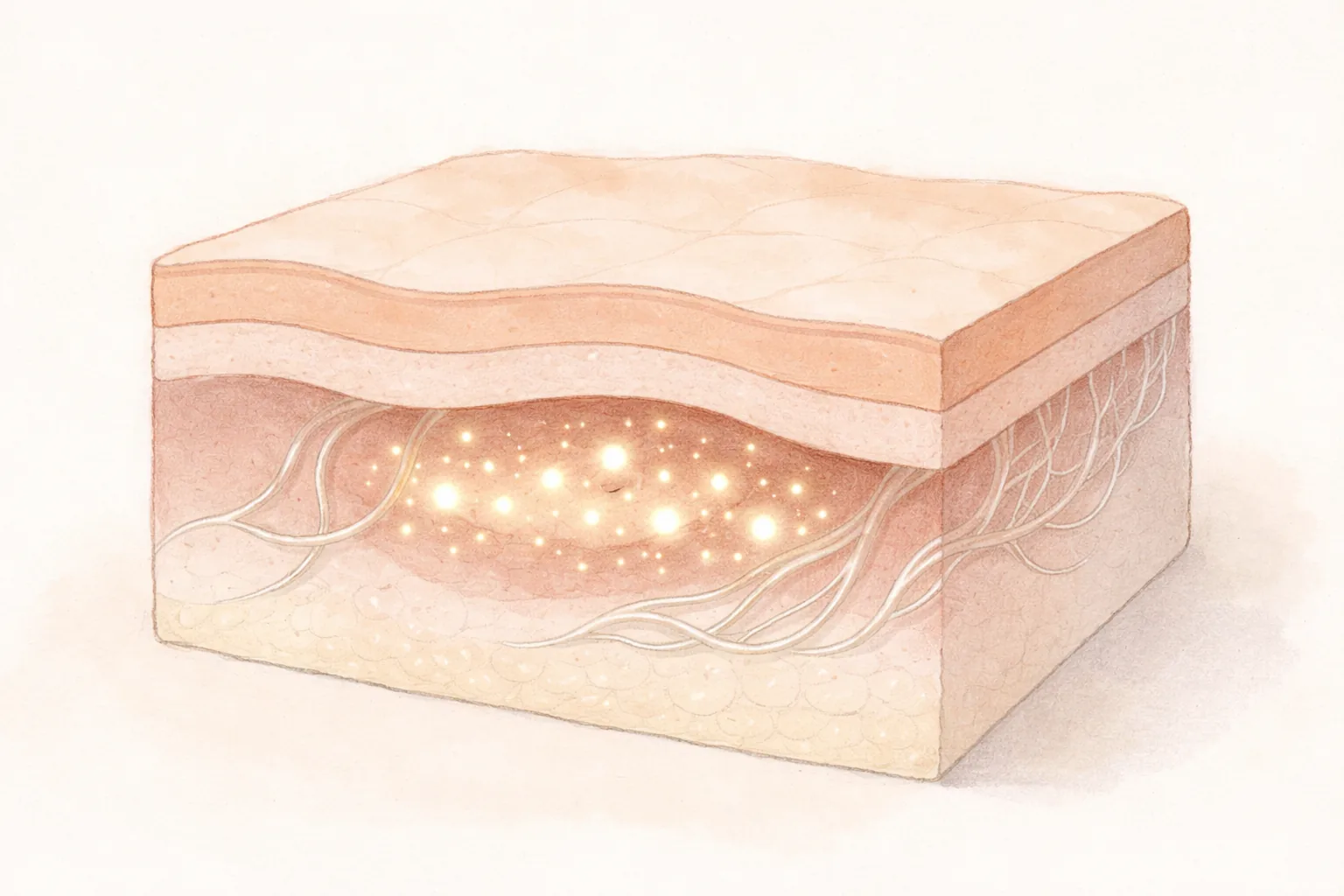
Energy treatments are divided by how they deliver heat to the skin. Ultrasound (HIFU, high-intensity focused ultrasound) focuses energy on a single point, passing through the skin surface to create a thermal point in deeper tissue, while radiofrequency presses a treatment tip against the skin to heat the tissue beneath it. Some lasers also send heat deeper without peeling the surface. According to AAD guidance, this delivered heat can stimulate collagen production (AAD firming treatment guide).
In tissue reached by heat, a process of new collagen formation follows, so changes appear gradually over months rather than right after the procedure. The eye area is where skin is thinnest on the face and expression muscles move often, so even with the same method, depth and scope are set differently. That is why tips used for the whole face and tips used for the eye area are separate. ATTITUDE Clinic's price list also lists eye area items separately, such as Eye Ultherapy, Eye Thermage, and Eye XERF (treatments and pricing).
What should you check about eye protection during the procedure, tips, and scope?
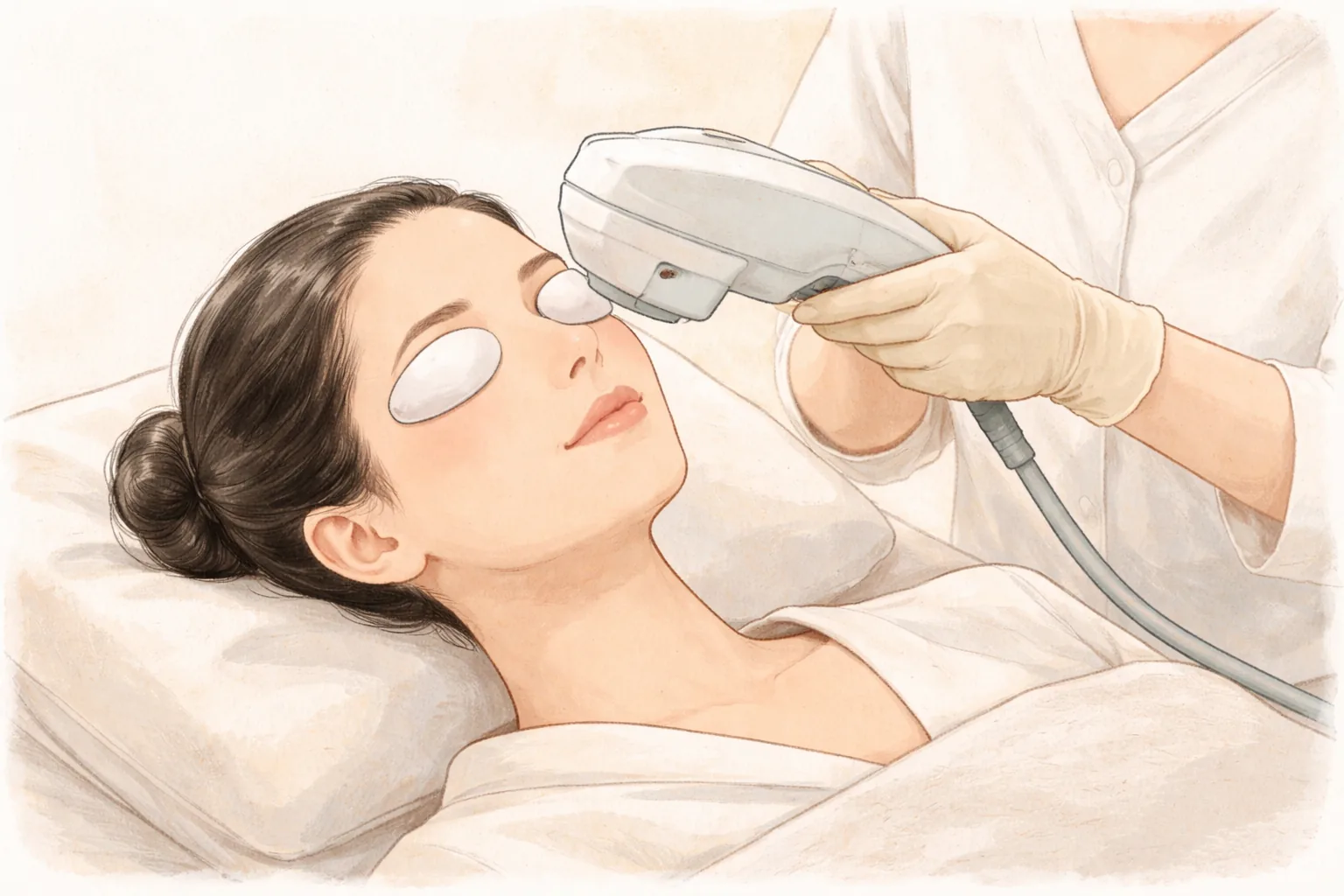
At consultation, eye protection is the first item to confirm. Asking whether the procedure is done with eyes closed, what covers the cornea, what principle a protective device works on if one is used, and how they respond if vision blurs or a stinging sensation occurs will give you a sense of how prepared the procedure is. AAD materials advise asking about risks, alternatives, recovery, and the number and length of sessions before treatment (AAD questions to ask). That guidance is about what to ask at consultation; it does not judge for you how a specific protective device or eye-specific tip works. That part is something the practitioner should be able to explain in their own words.
Tips and scope follow the same logic. Eye area tips differ from face tips in size and energy delivery depth, and shot count becomes the unit that sets treatment area and density. In the price list too, the same device is divided by shot count, such as Eye Thermage 225 shots and 450 shots, and Eye XERF 225 shots and 450 shots (treatments and pricing). A bigger number does not automatically mean better; the natural order is to first decide how far your eye area needs to be treated, then choose the unit that matches.
Table 1 What should you check about eye protection during the procedure, tips, and scope?
Category
Energy method
Unit shown on the price list
What to confirm at consultation
Eye Ultherapy
Lifting using HIFU ultrasound
100 shots
Whether an eye-specific tip is used, treatment scope
Eye Thermage
Monopolar RF
225 shots · 450 shots
Which scope fits, whether combined with a face treatment
Eye XERF
Lifting using radiofrequency
225 shots · 450 shots
Explanation of differences between devices, anesthesia method
Thermage (Thermage FLX, face)
Monopolar RF
600 shots · 900 shots
Overlapping areas with eye treatment, order and interval
Swipe sideways to see the whole table.
In short What you decide first in eye area treatment is not the device name but the treatment scope and depth, and how the eyes are protected. Even with the same device, the areas treated differ by tip and shot count, and that plan carries through to recovery and cost. Whether eye protection and scope can be confirmed through explanation is the most practical criterion before treatment.
What determines pain, recovery, and when results appear?
Non-invasive treatments do not cut the skin. According to AAD guidance, temporary redness and swelling are usually the only marks after these procedures, there is little to no downtime, and most take under an hour (AAD firming treatment guide). There may be discomfort during the procedure, and asking about anesthesia at consultation is also advised (AAD questions to ask).
The degree of pain varies with energy intensity, skin thickness at the treatment site, and anesthesia method. You cannot conclude that stronger treatment produces bigger results; what matters more is whether energy was delivered stably at a certain depth. It is also hard to judge that mild pain means small results. If pain becomes hard to bear, the approach is to lower intensity or adjust anesthesia.
When results appear differs by method. AAD general guidance says non-invasive ultrasound treatment usually produces gradual lifting and tightening over 2–6 months from a single session, non-invasive radiofrequency treatment shows its best results around 6 months, and laser methods require 3–5 sessions with results rising gradually between 2–6 months after the last session (AAD firming treatment guide). This describes treatment types and does not transfer directly to the timing of a specific device using an eye-specific tip.
How should you view cost and how long results last?
ATTITUDE Clinic's price list divides eye area lifting by item and shows the unit alongside. All amounts exclude VAT, and the same prices are shown on every language page (treatments and pricing). Checking before booking whether VAT is added on top of the listed amount and whether consultation, anesthesia, and aftercare are separate will keep the total from shifting.
How long results last is not determined by the procedure alone. AAD notes that results of non-invasive radiofrequency treatment can last up to 2–3 years with proper skin care, and explains that maintaining a healthy weight, not smoking, limiting alcohol, and sun protection are conditions that preserve results (AAD firming treatment guide). This is also why experiences differ even with the same procedure: starting skin condition and regeneration speed vary (Why do results differ even with the same procedure?).
In these situations
When a ceremony or shoot is only weeks away
Non-invasive treatments have little to no downtime, but redness and swelling may remain for a few days. Leaving a few days between the procedure and an important date helps you avoid attending with redness still visible. If the shoot focuses heavily on the eye area, narrowing the treatment scope is better.
When you want consistent management
Eye area changes do not complete at once but appear over months. Even with the same device, units are divided by shot count, so rather than starting broad from the beginning, it is easier to observe the response and plan the next step. Recording the device and shot count, the date, and the response at that time speeds up judgment at the next consultation (Why do results differ even with the same procedure?).
When your skin is sensitive or easily reddened
How skin reacts to the same stimulus and how fast it recovers differ by skin type (Why do results differ even with the same procedure?). If you recently used strong exfoliation or retinoid ingredients, it is better to mention that at consultation too. Starting one level lower in intensity and adjusting while observing the response is reasonable.
When you are a visitor on a short stay
Prices are the same on every language page, and VAT is shown separately (treatments and pricing). A booking request and a confirmed booking are different, and it is confirmed after the clinic contacts you. Same-day bookings can be requested for a time slot from 1 hour after the current time, and the last reception is at 17:30 (consultation booking). If your stay is short, it is better to decide in advance whether consultation and treatment can be completed in one day and when to check progress.
Please tell us before consultation Recent sun exposure and tanning, medications you are taking and active ingredients you apply to the skin, previous energy or injection treatment experience and how you responded then, whether you are pregnant, infection or inflammation at the treatment site, and fixed dates such as a ceremony or shoot. AAD notes that firming treatments may not be suitable if you are pregnant, have an infection at the treatment site, or take certain medications (AAD firming treatment guide).
How ATTITUDE Clinic proceeds
AI skin analysis record — Skin condition is recorded and organized so you and the doctor view the same information. The analysis tool is reference material that organizes information to support consultation and does not make a medical diagnosis (Why do results differ even with the same procedure?).
Consultation with the director — Concerns, lifestyle habits, and previous treatment experience are added to the analysis record to decide together what is needed and what is not, and in what order and intensity.
Treatment performed by the director — The director performs the procedure according to the plan set at consultation, adjusting intensity and scope while observing skin response during treatment.
Recovery and care — Aftercare precautions and when to check progress are explained, and if a next plan is needed, you consult again based on the record.
Eye area treatments include Eye Ultherapy (Ultherapy Eye), Eye Thermage (Thermage Eye), and Eye XERF (XERF Eye), and they are sometimes planned together with full-face lifting. Prices are disclosed by item and unit, with the same amounts on every language page, excluding VAT (treatments and pricing).
Aftercare and side effects
Soothing — On the day of treatment, avoid situations that heat the skin so that redness and warmth left right after the procedure can settle.
Moisturizing — Maintain moisture so the skin barrier stays comfortable.
Sun protection — Sun protection is explained as one of the conditions that preserve results (AAD firming treatment guide).
Side effects, from common ones, include redness, swelling, tenderness when pressed, and bruising. They usually settle within a few days. Rarely, temporary darkening or lightening of skin pigment, blisters, burns, or scars may occur (Why do results differ even with the same procedure?). If there are changes different from what you expected, such as pain that does not improve and keeps worsening, it needs to be checked without waiting. Recovery time and when you can return to daily life are advised to be confirmed at consultation (AAD questions to ask).
Frequently asked questions
Does it hurt a lot during the procedure?
Pain varies with energy intensity, skin thickness at the treatment site, and anesthesia method. AAD notes there may be discomfort during the procedure and advises asking at consultation whether anesthesia is used (AAD questions to ask). The degree of pain and the degree of results are not the same value, so it is hard to see stronger treatment as better. If pain is severe during the procedure, intensity can be lowered or anesthesia adjusted, so it is better to speak up rather than just endure it.
How do you check eye protection such as an eye shield?
Eye protection is the first item to ask about at consultation. This includes whether the eyes are closed during the procedure, what covers the cornea, what principle a protective device works on if one is used, and how they respond when vision blurs or a stinging sensation occurs. AAD materials advise asking about risks, alternatives, and recovery before treatment, but they do not judge the performance of a specific protective device for you (AAD questions to ask). If the explanation is not specific, it is better not to rush the procedure.
When do effects appear and how long do they last?
Non-invasive ultrasound treatment usually produces gradual changes over 2–6 months from a single session, non-invasive radiofrequency treatment shows its best results around 6 months and can last up to 2–3 years with proper skin care (AAD firming treatment guide). Laser methods require several sessions, with results rising between 2–6 months after the last session. This describes treatment types and does not transfer directly to the timing of a specific device using an eye-specific tip. Actual timing and how long results last vary with treatment scope and the skin's regenerative capacity, so confirm the plan at consultation.
What is the difference between Eye Thermage 225 shots and 450 shots?
The price list shows Eye Thermage 225 shots and 450 shots, and Eye XERF 225 shots and 450 shots, each at different amounts (excluding VAT) (treatments and pricing). Shot count is the unit that sets treatment scope and density, and the plan differs depending on whether a full-face treatment is done together. Rather than choosing by number alone, it is better to first hear an explanation of how far your eye area needs to be treated. Also check together whether there are overlapping areas between the face treatment and the eye area treatment.
What should you look at when choosing a clinic?
AAD explains that results depend heavily on the practitioner's skill and experience, and advises asking how many times they have performed the procedure and how much experience they have with your skin type and age group (AAD questions to ask). In Korea, qualification titles differ, so rather than translating names directly, it is more realistic to check who performs the consultation and treatment, whether previous treatment records are reviewed, and whether prices are disclosed by item and unit. ATTITUDE Clinic proceeds as one flow of analysis record, consultation with the director, and treatment performed by the director (Why do results differ even with the same procedure?).
At a glance
Table 2 At a glance
Item
Key point
What to decide first
Treatment scope and depth, and eye protection, rather than the device name
Eye protection
Confirm at consultation how the eyes are covered during the procedure
Scope and unit
Divided into Eye Ultherapy 100 shots, Eye Thermage and Eye XERF 225 shots · 450 shots, etc.
같은 시술을 받아도 왜 결과는 다를까요?https://theattitudeclinic.com/column/doctor-column/why-results-differ/
This article offers general health information. It is not a substitute for diagnosis or treatment based on your own condition, so please talk through your situation with a doctor.