Juvelook Skin, Volume and Eye: How to Discuss Dosage and Nodule Concerns
Considering Juvelook Skin, Volume or Eye? Here's what to confirm about injection depth and dosage, sessions and intervals, nodule concerns, when to call the clinic, and aftercare.
Written by ATTITUDE Clinic Editorial Team
Many people wonder which of Juvelook Skin, Volume or Eye they should get, and what happens if a nodule forms. The names sound similar, yet the dosage units on the price list differ, and the reported onset times seem to vary from review to review, so it is hard to know what to ask at the consultation. This article walks through what injectable treatments do in the skin, the conditions that decide the outcome, what to confirm at the consultation including nodules, and aftercare and evaluation points.
The Bottom Line First
Before the product name, it is the location and depth of your concern that must be decided. Whether your concern is surface texture, pores and fine lines, or hollow cheeks and deep wrinkles determines the product used, the injection layer and the dosage needed. At the consultation, confirm the exact product name and dosage, the injection layer, the total number of sessions and intervals, the risks including nodules and when to contact the clinic, recovery restrictions, and what the cost includes. The American Academy of Dermatology advises patients to ask about expected results and risks, alternatives, the number of sessions and time required, recovery and return to daily life, preparation and aftercare, and cost (AAD consultation guidance). Skin thickness and elasticity, the degree of hollowness and how fast you recover differ from person to person, so the same plan can produce different results.
What Do Collagen Booster Injections Do in the Skin?
Injectable treatments for the skin fall into two broad groups: inducers, which signal the skin to make its own collagen, and volumizers, which fill in the structure itself. According to the collagen injection column from ATTITUDE Clinic, PN and HA skin boosters activate cell regeneration signals to help fibroblasts (the cells that make collagen) produce collagen on their own, while hyaluronic acid attracts water to add volume and hydration (collagen injection column). Once the stimulation ends, the effect gradually fades, so several sessions are usually given at 2–4 week intervals, followed by maintenance treatments.
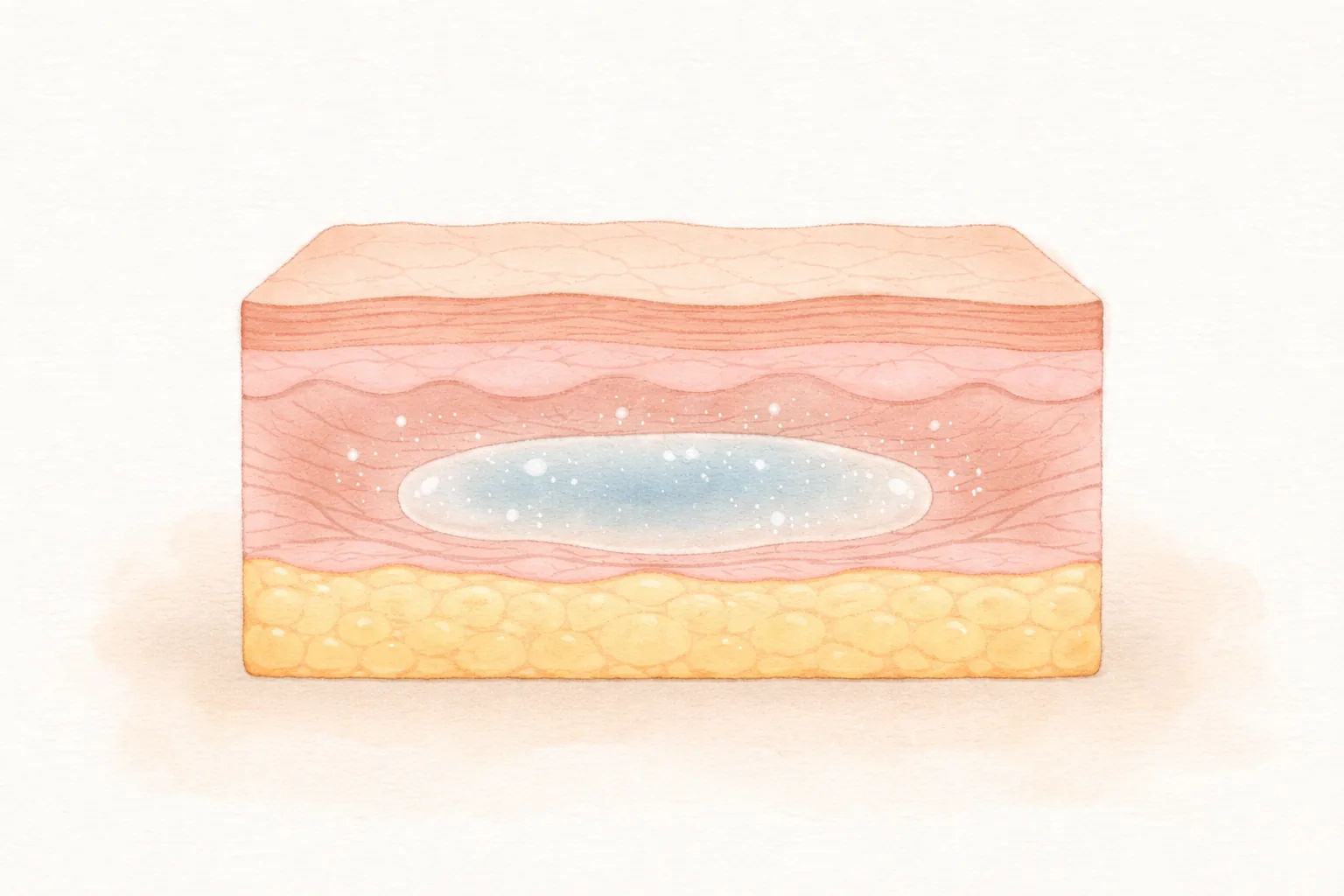
What an ingredient does once it reaches the dermis (the layer where collagen and elastin reside) depends on the layer. Placed in a shallow layer, it affects surface texture, pores and fine lines; placed in a deeper layer, it affects volume in hollow cheeks and deep wrinkles. Some treatments, like hyaluronic acid filler, fill the space themselves and are later broken down and absorbed, while others break down gradually and stimulate collagen formation. The AAD filler guidance distinguishes hyaluronic acid gel, which shows results immediately, from polylactic acid, which shows results over 2–3 weeks (AAD filler guidance).
"It Plumps Up Right Away" — How True Is That?
The saying that it plumps up right away has a reason behind it. Right after injection, swelling makes the area look fuller than it really is, and many different treatments get grouped together under the broad term "filler" in searches. The ATTITUDE Clinic column likewise explains that the full feeling right after injection is partly swelling that subsides over a few days, and that any change appears gradually over several weeks.
For the group that breaks down gradually and stimulates collagen formation, the aftercare is a little different. According to AAD guidance, polylactic acid fillers may require gently massaging the injection site for 1–2 weeks, several times a day for 5 minutes each. If no massage is instructed, on the other hand, it is recommended not to touch the injection site for 3 days after the procedure. Whether to massage, and how often, is decided by the practitioner.
That is why judging results by how the area looks right after treatment leads to misunderstandings. It is far more accurate to wait for the swelling to subside, then compare photos taken at a pre-set time under the same lighting and from the same angle.
What Conditions Decide the Outcome?
The first is the injection layer and depth. Even the same ingredient addresses different concerns depending on which layer it reaches, and if it is placed too shallow or too deep, the expected change may not appear or may show through the skin surface. The AAD explains that the procedure varies with the product used, the treatment area and the individual's medical history.
The second is dosage, number of sessions and intervals. The total amount and number of sessions needed depend on your skin condition and goals, so it is better to confirm in numbers at the consultation how many cc go to which area, how they are divided, and when the next session is scheduled. The AAD also advises asking about procedure time, the number of sessions needed, and whether anesthesia is used.
The third is skin condition, age and health. Even with the same product and dosage, different skin thickness, elasticity and degree of hollowness produce different results. The AAD explains that a board-certified dermatologist can assess your skin, age and health to judge whether the results you want are achievable. Daily habits such as sun protection and hydration also affect how long changes last.
The fourth is who performs the procedure. The AAD notes that results depend greatly on the practitioner's skill and experience, and recommends asking how many patients with skin types and ages similar to yours they have treated.
If Nodules Worry You, What Should You Ask at the Consultation?
A nodule (a firm lump felt under the skin) is one of the reactions that can occur after injectable treatments. The AAD describes filler injection as a medical procedure and notes that reports of serious side effects such as lumps, bumps, overfilling and infection have risen sharply in non-medical settings or with inexperienced practitioners. The same resource lists redness, swelling, tenderness when pressed, and bruising as common reactions.
The ATTITUDE Clinic column notes that an uneven feeling at the injection site can persist for a while as the product settles, and advises contacting the clinic if it continues. Common reactions are redness, stinging, swelling, tenderness when pressed, and bruising; less commonly, infection, allergic reaction or small lumps can occur.
At the consultation, ask in which cases nodules occur, when and through which channel to make contact if one appears, what checks follow, and how long to observe versus when treatment is needed. Nodules can also appear late, so the rule is to report anything you can feel, regardless of timing. These criteria vary with the product, the area and your individual condition, so hearing directly from your practitioner is the most accurate approach.
When Do Results Show, and How Should They Be Evaluated?
Setting evaluation points in advance keeps your judgment steady. According to AAD guidance, collagen, hyaluronic acid gel and calcium hydroxylapatite show results immediately, while polylactic acid takes 2–3 weeks. Duration is also classified differently: 4–12 months for hyaluronic acid gel and 1–3 years for polylactic acid.
This classification is general guidance for the filler family, so the onset and duration of Juvelook Skin, Volume and Eye cannot simply be copied from it. Skin thickness and elasticity, the area and the number of sessions all interact in the result. There are three things to confirm at the consultation: when photos will be taken, when to re-evaluate, and by what criteria the next plan is set if the effect is judged insufficient.
The AAD advises asking the practitioner how long the product lasts in the area you want treated. It also notes that temporary fillers can be topped up when signs of aging reappear. When scheduling the next session, review this guidance together with your own progress.
Table 1 When Do Results Show, and How Should They Be Evaluated?
Type
What it does in the skin
When changes appear
What to confirm at the consultation
Collagen-inducing skin boosters (PN and HA)
Stimulate cell regeneration signals to support collagen production; hyaluronic acid attracts water
Gradually, while stimulation continues, usually several sessions at 2–4 week intervals
How many sessions at what intervals, and the maintenance treatment plan
Polylactic acid injectables
Break down gradually and stimulate collagen formation; some products require massage
The injected ingredient itself fills the space, then breaks down and is absorbed over time
Immediately
Duration, additional volume by area
Swipe sideways to see the whole table.
In summary what you get is decided by the location and depth of your concern, and how long it lasts is decided jointly by the injection layer, dosage, intervals and your skin condition. At the consultation, it is better to confirm in numbers — rather than by product name — the exact product and dosage, the injection layer, the number of sessions and intervals, the risks including nodules and contact criteria, and what the cost includes.
In These Situations
If You Have a Ceremony or Shoot Coming Up
Swelling and bruising can linger for a few days after injectable treatments. The AAD explains that most people can return to daily activities after filler treatment, but not pressing or rubbing the injection site for the instructed period comes first. If you have a fixed date, count backwards from it and allow a few days of buffer when choosing the timing.
If You Want Steady Maintenance
Inducing injectables are generally not a one-off; several sessions are stacked at set intervals and followed by maintenance treatments. If the intervals are too short or too long, the accumulation is thrown off, so it is better to map out the full session plan and maintenance plan at the first consultation.
If Your Skin Is Sensitive or Prone to Redness
Redness and stinging right after treatment are common reactions. The AAD explains that these reactions usually subside within 7–14 days. If your skin reddens easily or cosmetics sting, telling the practitioner beforehand so the intensity and timing can be adjusted is safer.
If You Are an International Visitor on a Short Stay
A short stay changes the plan for stacking sessions. If you tell us your return date and when you could next visit, we can decide together at the consultation how far to go in one visit and what aftercare to leave you with.
Please tell us before your consultation
How much sun exposure you have had recently
Medications you take (including aspirin and anticoagulants) and skincare ingredients you use
Any past experience of swelling, bruising or allergic reaction after previous treatments
Fixed dates such as ceremonies, shoots or business trips
Pregnancy or breastfeeding status, and medical history such as autoimmune disease
How ATTITUDE Clinic Proceeds
AI skin analysis record — Current skin condition, including pigmentation, redness, texture and pores, is recorded with an analysis tool. This record organizes information to support the consultation and is not a medical diagnosis; it serves as reference for the doctor in judging the cause of your concern (laser column).
Direction set in a doctor consultation — Your schedule, pain sensitivity and skin history are added to the analysis record to decide the product, area, dosage and timing together. Juvelook Skin, Volume and Eye are distinguished by dosage unit on the clinic price list, so after deciding the dosage and number of sessions needed, confirm the total and whether tax is included (treatments and pricing).
Procedure performed by the doctor — Topical anesthesia is used as needed to reduce discomfort, and the doctor performs the procedure personally. Following the principle of genuine product, exact dosage and fair price, only what was agreed at the consultation is performed, and treatments beyond what is needed are not recommended.
Recovery and aftercare guidance — You are told what to watch for after the procedure, when to contact the clinic, and when to check your progress. The channel for getting things rechecked if discomfort arises is also set out at this stage.
Aftercare and Side Effects
Soothing — The AAD advises cooling the injection site for about 15–20 minutes after treatment to reduce redness and swelling. Washing your face can start lightly after the instructed time has passed.
Moisturizing and sun protection — Skin is temporarily sensitive after treatment. Apply sunscreen, and avoid saunas, strong exfoliation and harsh scrubs for the instructed period.
Following massage instructions — If you were told to massage, keep to the set time and frequency; if there was no instruction, do not touch the injection site for 3 days.
Checking progress — If redness or pain lasts longer than expected, or the injection site turns white, mottled or bluish, contact the clinic right away rather than waiting.
Common reactions are redness, swelling, tenderness when pressed, and bruising. The AAD explains that these reactions usually subside within 7–14 days. Less commonly, nodules, infection, allergic reaction, skin discoloration or severe swelling can occur, and reports of serious side effects increase when the practitioner lacks training and experience (AAD filler guidance).
If swelling has not gone down after the instructed period, if something you can feel persists, or if pain or heat worsens, do not wait — come in to have it checked.
Frequently Asked Questions
What Is the Difference Between Juvelook Skin and Volume?
On the clinic price list, Skin, Volume and Eye are distinguished by different dosage units: Skin in 4cc and 8cc, Volume in 1cc, 4cc and 8cc, and Eye Juvelook in 1 vial (treatments and pricing). This means that even products under the same name are offered differently depending on the area to be treated and the amount needed. Which product suits your concern is decided at the consultation. If you describe whether your concern is surface texture, pores and fine lines, or hollow cheeks and deep wrinkles, you can review the actual product, the injection layer and the dosage plan together.
When Do Results Appear and How Long Do They Last?
It depends on the family. In AAD guidance, hyaluronic acid gel shows results immediately and polylactic acid from 2–3 weeks, with durations classified as 4–12 months and 1–3 years respectively. Collagen-inducing skin boosters are usually given several times at 2–4 week intervals, followed by maintenance treatments. Even with the same product, the timing you notice and how long it lasts vary with skin thickness and elasticity, the area and the number of sessions, so it is better to set the photo dates and re-evaluation points in advance at the consultation.
What Should I Do If I Feel a Nodule?
Regardless of timing, telling the clinic where you were treated comes first. An uneven feeling at the injection site can persist for a while as the product settles, and if it continues, a check is needed. The AAD includes nodules in its list of serious side effects, but how long to observe and what treatment to use depend on the product and area. Recording the size, location and when it appeared helps with the consultation and the check.
How Painful Is It?
The treatment area, injection method and your individual sensitivity all play a part. The AAD explains that filler injection may cause a stinging or burning sensation, and that the anesthesia method varies by area. The waiting time after applying numbing cream also differs by procedure, so ask at the consultation. If a previous treatment was unusually hard for you, telling us in advance lets us adjust the intensity and method.
What Should I Look For When Choosing Where to Get Treated?
The AAD notes that results depend greatly on the practitioner's skill and experience, and recommends checking how many times they have performed the procedure, whether they have treated skin types and ages similar to yours, and whether you can see before-and-after photos of similar patients. It also classifies filler injection as a medical procedure and advises against having it done in non-medical settings (AAD filler guidance). In Korea, it helps to look at whether the practitioner is a specialist, their experience, and whether they explain the risks, alternatives and aftercare contact criteria at the consultation. How they verify the authenticity of the product and the dosage used is another thing to ask.
At a Glance
Table 2 At a Glance
Item
Key Point
What your concern is
First decide: surface texture, pores and fine lines, or hollow cheeks and deep wrinkles
What decides the result
Injection layer and depth, dosage, number of sessions and intervals, skin condition, practitioner experience
When changes appear
From immediately to 2–3 weeks depending on the family; right after injection, swelling adds to any fullness
Nodules
Can occur rarely; the rule is to report anything you can feel, regardless of timing
Aftercare
Soothing, moisturizing, sun protection, massage instructions, progress checks
What to confirm at the consultation
Exact product name and dosage, injection layer, number of sessions, risks and contact criteria, what the cost includes
This article offers general health information. It is not a substitute for diagnosis or treatment based on your own condition, so please talk through your situation with a doctor.