LDM Consultation in Seoul: Which Device Details Should You Check?
What to check in an LDM consultation in Seoul — device name and units, treatment goals, timing with lasers or injections, when to assess results, cost, and when to contact the clinic during recovery.
Written by ATTITUDE Clinic Editorial Team
People often say they've looked up a device name beforehand, yet still feel stuck about what to actually ask at the consultation. Under the single name "LDM" there are devices from several manufacturers, and even devices with the same name may use different energy, target different layers of skin, and take different amounts of time per session. This article lays out, in order, what to check at a consultation — instead of memorizing device names — so you can make a judgment that fits your skin.
The short answer first
An LDM consultation is about confirming the goal, the treatment area, how many minutes, how many sessions, and what the cost covers — not about which device it is. On the ATTITUDE Clinic price list, LDM is listed not like other energy-based treatments but as a treatment divided into 6-minute and 12-minute sessions, so time is the unit (Treatments and Pricing). The American Academy of Dermatology (AAD) advises asking about expected results and risks, alternatives, the practitioner's experience, the number of sessions needed and how long they take, recovery and aftercare, and cost at a cosmetic consultation (AAD guidance). Prepare your questions in that order, and after the consultation you'll be able to sort out for yourself what to expect and what to be careful about.
Why does the target matter more than the device name?
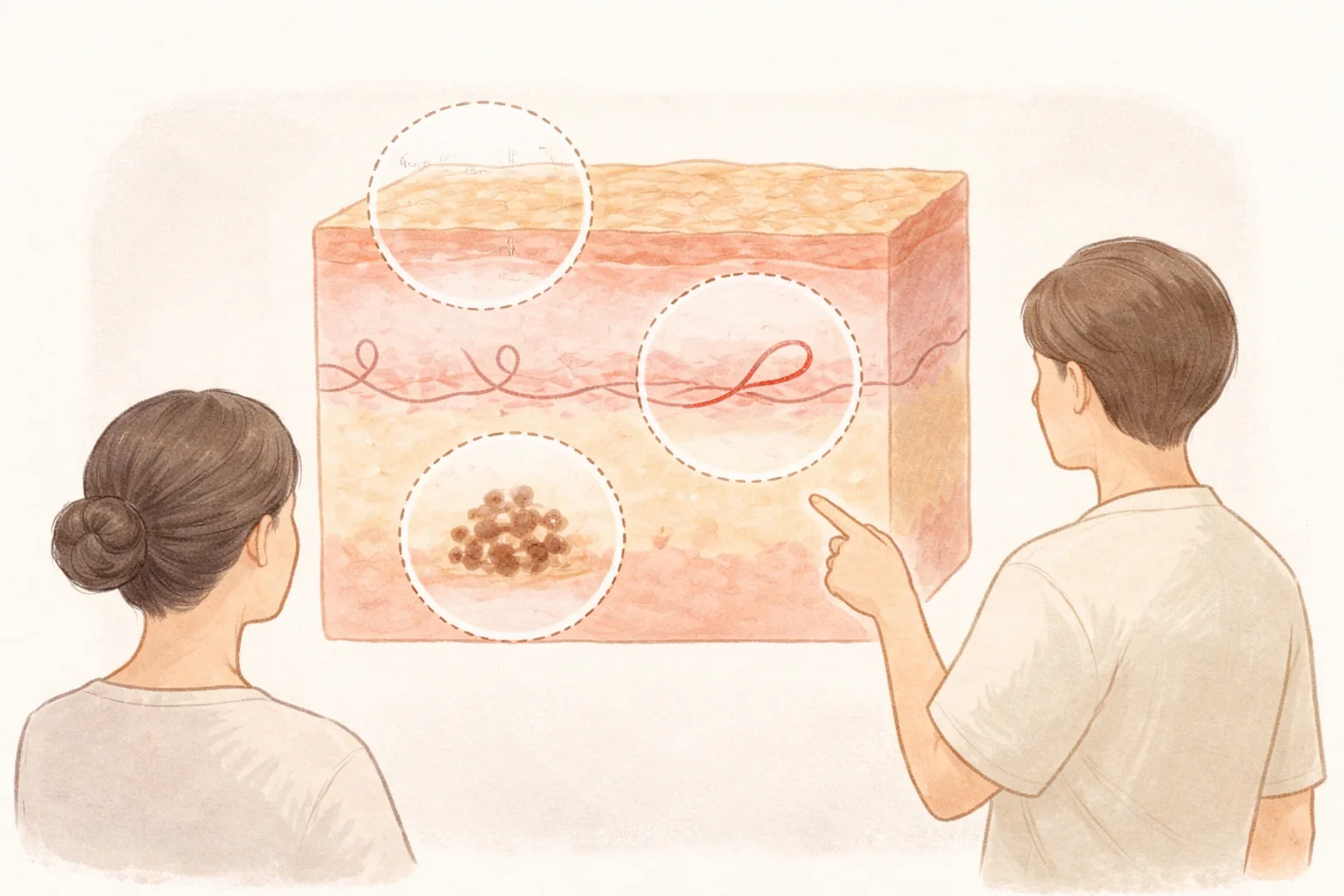
Dermatology devices are distinguished less by name than by what they target. ATTITUDE Clinic applies the same principle when explaining lasers: PicoPlus targets pigment, Vbeam targets shallow blood vessels, and the erbium YAG laser works on the skin surface (Laser column). Spots, redness, and rough texture have different causes, so the first step is confirming where your concern comes from rather than which device is better.
So why do device names matter at an LDM consultation? Not so you can memorize the name, but so you can confirm what energy and settings sit behind it. Don't stop at "What device is it?" — ask about the official device name, the type of energy used, the layer it targets, the treatment area and time per session, and whether the mode or intensity can be adjusted. That makes your consultation notes far more concrete for comparison.
The same logic applies to combining treatments. Because devices target different layers and use different energy, you can't carry one device's explanation over to another device's effects or risks. What a specific device does to your skin is best confirmed in a consultation with the practitioner who uses it.
Reading the units on a price list makes consultation questions easier
One thing that makes consultations confusing is units, because "one session" means different things for different treatments. Even on the price list, LDM is measured in minutes, pigment and redness lasers in sessions, lifting in shots and kJ, and injections in cc and vials (Treatments and Pricing). kJ stands for kilojoules, a measure of energy; cc is a measure of volume; and a vial is one bottle of product.
Table 1 Reading the units on a price list makes consultation questions easier
Category
Unit on the price list
What that unit tells you
What to check alongside in the consultation
LDM treatment
6 min · 12 min
A treatment listed by treatment time
Treatment area, goal, time per session
Pigment · redness lasers
1 session · 5 sessions · 10 sessions
A session-based unit of planning
Recovery period and sun protection
Lifting (ultrasound · RF · microwave)
Shots · kJ
A unit defined by number of shots and energy amount
Intensity, area, pain, spacing
Skin boosters · injections
cc · vial
Injection volume and one bottle of product
Number of sessions, spacing, timing with other treatments
Swipe sideways to see the whole table.
In short even for the same "one session," LDM is measured in time, lifting in shots or kJ, and injections in cc. Confirming which unit you're buying first reduces the back-and-forth where "how many sessions" means different things to different people.
If you're combining LDM with a laser, what should you ask?
Right after a laser treatment, skin becomes temporarily sensitive, so sun protection and moisturizing matter especially, and saunas, strong exfoliation, and harsh scrubs are best avoided for the period you're advised (Laser column). Repeatedly irritating the same area before recovery is complete can stress the skin barrier, so when to add a treatment after a laser depends on the laser type, intensity, and how quickly you recover.
At the consultation, mention the type and date of any recent treatment first, then ask whether it can be done the same day, how many days later would be better, and how intensity would be adjusted if done together. Overlapping a strong laser and a treatment on the same day needs to be tuned to your skin condition, so it's safer to decide in the consultation.
If you're also having an injection, the order matters too. The collagen injection column advises against pressing hard on or massaging the injection site right after treatment (Collagen injection column). When a treatment involving pressure or vibration overlaps with an injection on the same day, it's best to decide in the consultation which comes first and how much time to leave between them.
When and how should you assess results?
Setting the evaluation points in advance makes judgment easier. If you agree in the consultation on what to observe and when — how redness and dryness change after the first session, how hydration and texture feel after a few sessions — you'll have a basis for adjusting the intensity at your next session. The AAD also advises confirming realistic expectations at the consultation and asking how much experience the practitioner has with skin types and ages similar to yours (AAD guidance).
The size and duration of the effect vary with the device and your individual skin condition, so leaving yourself checkpoints is more practical than expecting a number as a guarantee. Recovery time and when you can return to daily life are also things to confirm in the consultation. The AAD advises asking when you can return to exercise, work, and social commitments, how to prepare and handle aftercare, and whether anesthesia is used during the procedure.
What determines pain and your day's schedule?
Pain varies with the device, intensity, treatment area, and your individual sensitivity. Even at the same setting, thin-skinned areas can sting more, so if you're usually sensitive to pain or had a hard time during a previous treatment, it's better to say so at the consultation. During the procedure, too, telling the practitioner right away if the sensation becomes hard to bear is the fastest way to adjust intensity.
If you have an important date coming up, mention it first. Working backward from a wedding, photo shoot, or business trip lets you adjust when to start and at what intensity. A first-time treatment right before an event risks redness or sensitized skin overlapping with that day, so the more buffer you leave, the more options you have.
If this sounds like your situation
If you have a wedding or photo shoot coming up
Mentioning the date first at the consultation is best. Working backward while accounting for recovery time lets you adjust the treatment type, intensity, and when to start. Cramming a first-time treatment right before an event raises the risk that redness overlaps with that day.
If you want consistent, ongoing care
Rather than going strong all at once, keeping the interval your skin needs to recover and treating regularly puts less strain on your skin. For time-based options like LDM, decide how many minutes to start with, then increase or decrease based on your response. Writing down your goal and re-evaluation points together keeps the plan steady.
If your skin reddens easily or is sensitive
If redness is your concern, the first step is seeing which layer's blood vessels are the issue. Ask at the consultation whether the device targets shallow vessels, and how the day's treatments would be sequenced. If cosmetics sting or your skin feels unusually sensitive at that time, it's best to mention that state first.
If you're visiting on a short stay
If your stay is fixed, redness or dryness right after treatment can affect your plans. Let the clinic know your return date and upcoming schedule in advance, and the intensity and type can be discussed around it. Also agree on how to get in touch if you need to check something during recovery.
Tell the clinic before your consultation
Whether you've had a lot of sun exposure recently
Medications and skincare products you take or apply
Any experience of sensitive skin after a previous treatment
Commitments you absolutely can't miss
If you're considering an injection: autoimmune conditions, past reactions to tissue-derived products, other allergies, use of blood-thinning medication, and pregnancy or breastfeeding (Collagen injection column)
How ATTITUDE Clinic handles it
AI skin analysis record — Current skin condition such as pigment, redness, texture, and pores is recorded with AI skin analysis, and based on that record the doctor judges the cause of your concern. The analysis tool records and organizes information to support the consultation; it is not a medical diagnosis.
Consultation with the doctor to set the direction — Your schedule, pain sensitivity, and skin history are added to the analysis record to decide the treatment type, intensity, and timing together. For time-based options like LDM, this is also where you decide how many minutes to start with and how to sequence it with other treatments.
Treatment performed directly by the doctor — Discomfort is reduced with topical anesthesia and similar measures as needed, and the doctor performs the procedure directly. Unnecessary treatments are not recommended, and genuine products, full doses, and set prices are the principle.
Recovery and follow-up — Guidance centers on sun protection and moisturizing, and any symptom that lasts longer than expected is checked. A booking request is not a confirmed appointment; it is confirmed after the clinic's confirmation contact (Consultation and Booking).
Items that commonly come up alongside this topic in consultations are LDM treatment (6 min · 12 min) and, when considering combining treatments, PicoPlus for pigment, Vbeam for shallow blood vessels, and the erbium YAG laser for the surface. Which combination fits you depends on the cause of your concern and your skin condition.
Aftercare and side effects
Calming — Right after treatment, avoid saunas, intense exercise, and alcohol, and let your skin rest.
Moisturizing — Dryness worsens redness and stinging, so apply the advised moisturizer regularly.
Sun protection — Apply sunscreen diligently throughout the recovery period. It's the most basic step in reducing pigmentation.
Checking progress — Watch when redness, heat, and swelling subside, and adjust the timing and intensity of the next session to that progress.
Knowing the common side effects in advance puts your mind at ease. On a day when you also had a laser, that laser's typical reactions set the baseline. Redness, heat, swelling, and stinging are common, and surface-treating lasers can leave thin crusts. Temporary pigmentation can occur, and lasers targeting blood vessels can cause bruising. Rarely, blisters, hypopigmented patches, infection, scars, or pigment rebound can occur (Laser column). The price list also notes that side effects can occur and advises consulting a doctor before treatment (Treatments and Pricing).
There are also signals you shouldn't wait on. If redness or heat lasts longer than expected or pain worsens, don't tough it out — get it checked. If you also had an injection, seek care right away for pain that is unusual or worsening, skin at the injection site turning white, mottled, bluish-gray, or black, or any change in vision (Collagen injection column).
Frequently asked questions
What kind of treatment is LDM?
On the ATTITUDE Clinic price list, LDM is listed as a skin treatment in two options, 6 minutes and 12 minutes. Unlike lifting, where intensity is set by the number of shots, or injections, where it's set by volume, this means it's a treatment planned in units of time. At the consultation, check the treatment area, time per session, the type of energy used, and how many minutes you'll start with. The same device name can refer to several units, so noting the official device name makes comparison easier.
Can I have it right after a laser treatment?
Skin is temporarily sensitive right after a laser, so whether to overlap on the same day or wait a few days depends on the laser type, intensity, and how quickly you recover. It's safer to tell the practitioner the type and date of your recent laser at the consultation and decide together on same-day timing, spacing, and intensity adjustment. During recovery, keep up sun protection and moisturizing, and avoid saunas and strong exfoliation for the advised period. If redness or heat lasts longer than expected, get it checked before planning the next step.
How many sessions should I have, and how far apart?
The number and spacing of sessions depend on your skin condition and goal, so rather than fixing them in advance, they're adjusted as your progress is reviewed. The basis of repeat treatments is leaving room for recovery; toning, for example, usually leaves at least 1 week between sessions (Laser column). Time-based treatments like LDM are gentlest when you start with a short session and decide whether to increase or decrease based on your response. Writing down what to observe and when to re-evaluate at the first consultation makes the next session's decision easier.
How much does it hurt, and can I go about my day afterward?
Pain varies with the device, intensity, area, and your individual sensitivity. Whether anesthesia is used is also something to confirm at the consultation, and if it becomes hard to bear during the procedure, telling the practitioner right away allows the intensity to be adjusted. Recovery and when you can return to daily life differ by treatment type, so ask in advance when you can exercise, work, and attend social commitments. If you have an important date, giving the date and working backward is safer.
What should I look for when choosing a clinic?
The AAD explains that results depend heavily on the practitioner's skill and experience, and advises checking the practitioner's experience and how much they've worked with skin tones, types, and ages similar to yours (AAD guidance). Add to your question list whether you can see cases with skin similar to yours. In Korea, it's also practical to check whether the clinic first identifies whether your concern comes from pigment, blood vessels, or the skin surface, recommends only the treatments you need without locking in an excessive number of sessions, and is somewhere you can get checked if you're uncomfortable during recovery.
At a glance
Table 2 At a glance
Item
Key point
First question at the consultation
Goal, treatment area, time per session, number of sessions, and cost before device name
Reading units
LDM in minutes, lasers in sessions, lifting in shots · kJ, injections in cc · vial
Combining after a laser
Leave a recovery interval; same-day timing is decided in the consultation
Assessing results
Agree on what to observe and when to re-evaluate at the consultation
Aftercare
Calming, moisturizing, sun protection, checking progress
When to get checked
Don't delay if redness or heat lingers or pain worsens
This article offers general health information. It is not a substitute for diagnosis or treatment based on your own condition, so please talk through your situation with a doctor.