
Once you've booked a Radiesse consultation, it's easy to feel unsure where to start. You may wonder whether checking the ingredient name is enough, how maintenance duration is judged, and when to make contact if a side effect appears. This article lays out the axes to confirm at a consultation, a question list, when to judge results, cost and recovery, and contact criteria.
The short answer first
At a Radiesse consultation, rather than fixating on a single ingredient name, it's best to confirm the product name and manufacturer, main ingredient, whether it is diluted and the total volume, treatment area and goal, recommended number of sessions and when to judge results, recovery and contact criteria, and the cost range including whether VAT is included. Radiesse's main ingredient, calcium hydroxylapatite (CaHA), is an ingredient the American Academy of Dermatology (AAD) includes and describes in its filler list, and this family of fillers is described as showing immediate effect and lasting roughly 6 months to 1 year. However, that general guidance does not guarantee approval or recovery time for any specific product, so it should be rechecked for the product and area you will use.
What kind of treatment is Radiesse, and what gets decided at a consultation?
Radiesse is a filler-type treatment injected into the skin. According to AAD materials, filler injection is a medical procedure and results depend heavily on the injector's technique and experience (AAD Filler FAQs). The procedure varies with the filler used, the treatment area, and medical history, and usually takes about 15–30 minutes. You may feel a stinging or burning sensation during injection, and whether a numbing cream or nerve block injection is used together depends on the product and area.
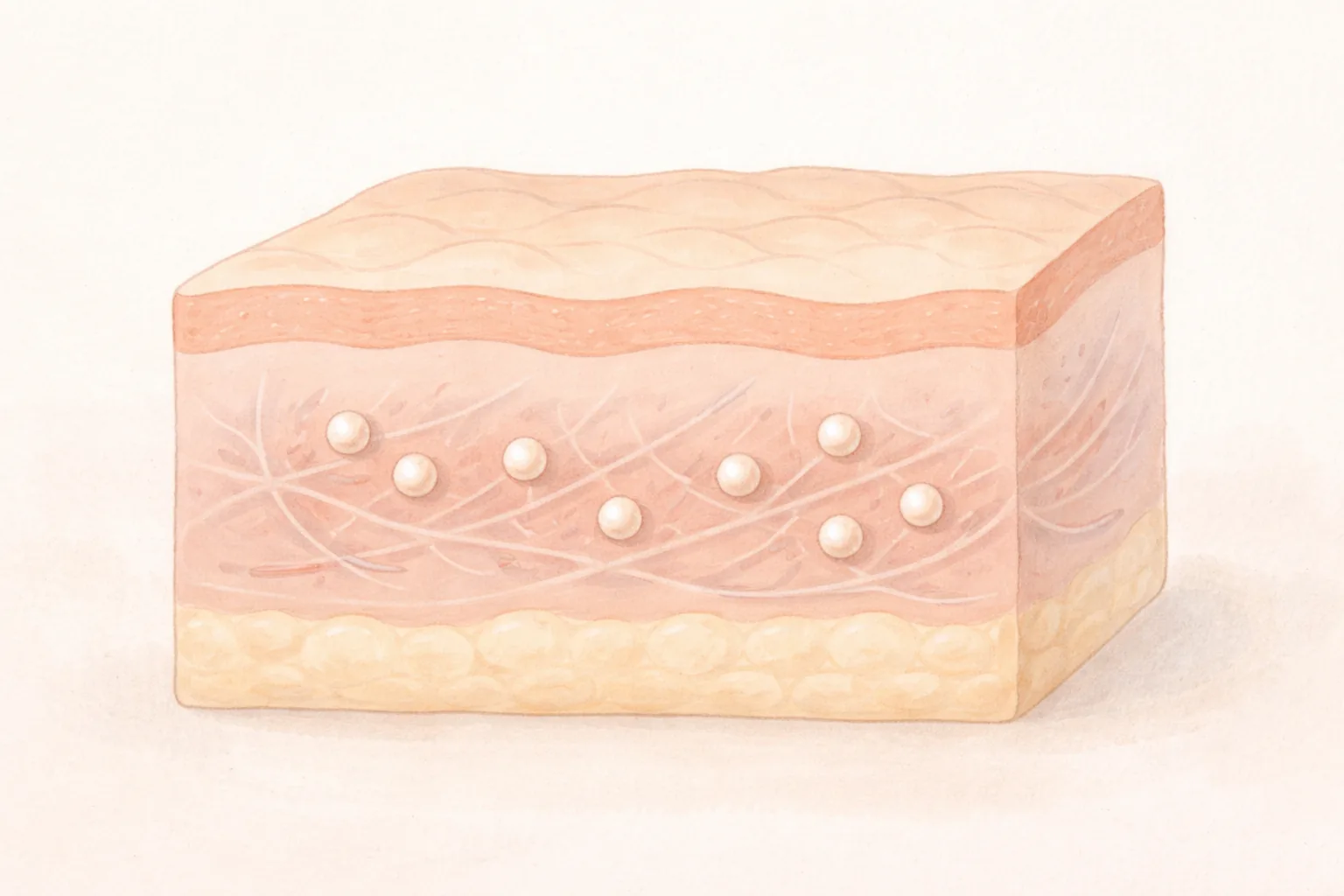
Fillers can produce an immediate filling effect while also producing a time-dependent collagen-stimulating effect (AAD Filler FAQs). So at a consultation, 'where to fill' and 'whether to target skin texture and elasticity' are decided separately. The ATTITUDE Clinic column also divides injectable treatments into 'directly replenishing' and 'inducing collagen production' approaches (Collagen Injection Column).
What determines results is not the product name but the depth of the injected layer, the total volume per session, the treatment interval, and current skin condition.
Is checking the ingredient name enough?
Even with the same ingredient name, calcium hydroxylapatite, particle size, gel composition, and dilution ratio can differ from product to product. Even with the same product, results and risks differ depending on which layer and how much is injected. According to AAD guidance, the procedure varies with the filler used, the area, and medical history, and you should ask the doctor how long that filler lasts in the area you want (AAD Filler FAQs). So your consultation question list should include the product name and manufacturer, main ingredient, whether it is diluted and total volume, and the layer to be injected.
General filler guidance covers fillers as a whole, so each product's approved indications and recovery time must be checked separately in the product materials. Asking at the consultation where you can see this product's approval information and instructions for use is one approach.
What determines results: area, volume, number of sessions?
Radiesse approaches differ by area such as the cheeks, nasolabial folds, jawline, neck, and back of the hands. Just as AAD explains that hands usually need no anesthesia while lips often use a nerve block, each area has a different distribution of nerves and blood vessels and structures to be careful of (AAD Filler FAQs). Thin-skinned areas like under the eyes and thicker areas like the cheeks differ in the layers and amounts that can be injected.
The total volume per session and the interval also influence results. Too little produces minimal change, and too much at once can cause lumpiness or overcorrection. According to AAD's description, a conservative approach that does not overfill produces natural results (AAD Filler FAQs). The recommended number of sessions and interval vary with skin condition and goals, so rather than fixing a number of sessions first, it is more realistic to decide how much change by when, and work backward to the number of sessions.
When and by what criteria are results judged?
AAD guidance states that calcium hydroxylapatite filler shows immediate effect and lasts roughly 6 months to 1 year (AAD Filler FAQs). The volume right after injection includes moisture and some swelling, which subsides over several days, and any change after that appears gradually over several weeks (Collagen Injection Column).
So at a consultation, it is good to set when to review again and what will count as improvement. According to AAD guidance, the timing and pattern of results differ by filler, so agree with the doctor on when and how to judge in your area. For temporary fillers, AAD explains that re-treatment can be considered when signs of aging reappear.
How are pain, recovery, and side effects checked?
You may feel a stinging or burning sensation during injection, and the degree of pain varies with area and individual sensitivity. According to AAD guidance, most filler procedures take 15–30 minutes, are completed in a single visit, and most people can return to daily activities afterward (AAD Filler FAQs).
Common reactions are redness, swelling, tenderness when pressed, and occasionally bruising. AAD explains that these mild reactions usually disappear within 7–14 days (AAD Filler FAQs). Rarely, nodules, uneven lines, overcorrection, allergic reactions, skin color changes, infection, and severe swelling can occur, and these serious side effects are reported more often when the injector lacks medical training and experience. That is why AAD strongly advises against getting fillers in non-medical settings.
The ATTITUDE Clinic column advises that after an injectable treatment, if you have pain that is unusual or worsening, if the skin at the injection site turns white, mottled, bluish-gray, or black, or if there is a change in vision, do not wait and seek care immediately (Collagen Injection Column). These signs are not something to wait out during recovery but signals that need checking.
Effect onset and maintenance by filler type (AAD guidance)
| Injection type | Effect timing | Approximate maintenance | What to check at consultation |
|---|---|---|---|
| Hyaluronic acid gel | Immediate | 4–12 months | Product and area to be used, bruising and swelling course |
| Calcium hydroxylapatite | Immediate | 6 months–1 year | Injection layer and volume, nodules and lumpiness |
| Poly-L-lactic acid | 2–3 weeks | 1–3 years | Whether massage is instructed, when to judge results |
| Autologous fat | Immediate | 1–3 years | Harvest site and absorption |
Swipe sideways to see the whole table.
In short The core of a Radiesse consultation is not the ingredient name but which area, which layer, how much, and at what interval. Effect timing and maintenance vary by product, area, and individual differences, so it is good to set your own criteria for when to judge and when to make contact at the consultation.
If this applies to you

If you have a fixed date like a wedding or photo shoot
If a wedding or shoot date is fixed, work backward from that date to set the treatment timing. Right after injection, swelling and bruising can occur, so getting a first treatment just before an event is a burden. If you tell us the date at the consultation, the timing and volume can be adjusted with recovery time in mind.
If you want to maintain steadily
Rather than injecting strongly at once, it is better to plan while keeping recovery intervals. Calcium hydroxylapatite filler shows immediate effect and lasts roughly 6 months to 1 year, so use that cycle as a reference and set the re-treatment timing at the consultation. Deciding the goal first and placing only as much as needed reduces skin burden.

If your skin is sensitive or tends to redden
If your skin is usually sensitive or redness lingers long after procedures, please mention it at the consultation. AAD advises asking the doctor how many patients with your skin tone and type, and age group, they have treated (AAD Questions to Ask). Even with the same product, the plan changes with skin condition.

If you are an international visitor on a short stay
If your stay is short, tell us your return date and next schedule in advance. Swelling or bruising right after treatment can affect your plans, so it is better to set a point before departure to check the course. Booking is confirmed after you apply and receive a confirmation contact from the clinic, so it is safer to inquire with some time to spare (Consultation Booking).
Please tell us before your consultation Whether you have had a lot of recent UV exposure; any medications or cosmetics you take or apply (including blood thinners); any experience of sensitive skin after previous treatments; any history of autoimmune disease or allergies; whether you are pregnant or breastfeeding; and whether you have any important schedule. Even for the same treatment, the plan changes with this information.
How ATTITUDE Clinic proceeds

AI skin analysis record — Current skin condition such as pigment, redness, texture, and pores is recorded with an analysis tool. This record organizes information to support the consultation and is not a medical diagnosis. The director judges the cause of your concern based on this record (Laser Column).
Direction designed in director consultation — Schedule, pain sensitivity, and skin history are added to the analysis record to decide treatment type, intensity, and timing together. For Radiesse, the consultation decides which area, which layer, how much, and how many sessions to plan.
Treatment performed directly by the director — If needed, topical anesthesia reduces discomfort, and the director performs the treatment directly. The principle is not to recommend more treatment than necessary (Laser Column).

Recovery and care — We guide you on the post-treatment course and care methods, and make sure any discomfort can be checked. ATTITUDE Clinic follows the principle of genuine product, exact quantity, fair price (Laser Column).
Related to this topic, the ATTITUDE Clinic price list includes Radiesse (Merz) under injectable items, and all amounts exclude VAT (Treatments and Pricing).
Post-treatment care and side effects
Soothing — On the day of treatment, do not press hard or massage the injection site. According to AAD guidance, if you were not given massage instructions, do not touch the treated area for 3 days (AAD Filler FAQs). It is better to avoid strenuous exercise, alcohol, and saunas on the same day (Collagen Injection Column).

Moisturizing — Skin can become dry after treatment, so apply moisturizer generously (Collagen Injection Column).

Sun protection — Apply sunscreen carefully throughout the recovery period and avoid sunlight and indoor tanning. According to AAD guidance, avoid sunlight after treatment and do not use tanning beds (AAD Filler FAQs).

Checking the course — Watch changes in swelling, bruising, and pain, and contact the clinic if symptoms are unusual or worsening.
Side effects, from common ones: redness, swelling, tenderness when pressed, and occasionally bruising. AAD explains that these reactions usually disappear within 7–14 days (AAD Filler FAQs). Rarely, nodules, uneven lines, overcorrection, allergic reactions, skin color changes, infection, and severe swelling can occur, and these side effects are reported more often when the injector lacks medical training and experience.
There are cases that should be checked without waiting. If you have pain that is unusual or worsening, if the skin at the injection site turns white, mottled, bluish-gray, or black, or if there is a change in vision, you should seek care immediately (Collagen Injection Column). If swelling, pain, or heat persists, contact the clinic as well.
Frequently asked questions
Is Radiesse a filler or a collagen stimulator?
Calcium hydroxylapatite is an injectable product that AAD includes and describes in its filler list. AAD explains that fillers can produce an immediate filling effect while also producing a time-dependent collagen-stimulating effect (AAD Filler FAQs). Which purpose is emphasized more depends on the area, dilution level, and volume, so it is decided at the consultation.
When do results appear and how long do they last?
AAD guidance states that calcium hydroxylapatite filler shows immediate effect and lasts roughly 6 months to 1 year (AAD Filler FAQs). The volume right after injection includes swelling, which subsides over several days, and any change after that appears gradually over several weeks (Collagen Injection Column). There are differences by individual metabolism and area, so set your own criteria for when to judge at the consultation.
What side effects can occur after treatment, and when should I make contact?
Redness, swelling, tenderness when pressed, and occasionally bruising are common and usually disappear within 7–14 days (AAD Filler FAQs). Rarely, nodules or uneven lines, overcorrection, allergic reactions, skin color changes, infection, and severe swelling can occur. If you have pain that is unusual or worsening, if the skin at the injection site turns white, mottled, bluish-gray, or black, or if there is a change in vision, do not wait and make contact immediately (Collagen Injection Column).
How much pain and recovery time is involved?
You may feel a stinging or burning sensation during injection, and pain varies with area and sensitivity. According to AAD guidance, most filler procedures take 15–30 minutes, are completed in a single visit, and most people can return to daily activities (AAD Filler FAQs). However, if bruising occurs it can take more than 1 week to fade, so if you have an important schedule it is better to allow some leeway in timing.
What should I check when choosing a clinic?
Check a few things rather than a device list. AAD explains that results depend heavily on the injector's technique and experience, and advises asking the doctor how many times they have performed this treatment and how many patients with your skin tone, type, and age group they have treated (AAD Questions to Ask). Also check whether they sufficiently explain expected results and risks, alternatives, necessary number of sessions and recovery, and cost before treatment. It is safer not to receive filler treatment in non-medical settings (AAD Filler FAQs).
At a glance
| Item | Key point |
|---|---|
| First things to confirm at consultation | Product name, manufacturer, main ingredient, dilution, total volume, injection layer |
| Effect onset and maintenance | Calcium hydroxylapatite filler shows immediate effect, roughly 6 months–1 year (AAD guidance) |
| Factors determining results | Skin thickness by area, injection layer, volume per session, treatment interval |
| Common reactions | Redness, swelling, tenderness, bruising; usually improve within 7–14 days |
| Signs to contact immediately | Worsening pain, skin color changes, vision changes |
| Cost check | Whether VAT is included and which items are included or excluded, check the latest price list |