Ultherapy vs Thermage FLX: How to Compare by Skin Condition and Treatment Area
How Ultherapy and Thermage FLX differ in the way they deliver heat and the layers they target, what to compare in a consultation, and how to judge pain, recovery, combining treatments, and cost.
Written by ATTITUDE Clinic Editorial Team
When you start looking into lifting treatments, most people get stuck at the same point. The names feel familiar, but which one suits your face, which is more painful, and whether you can have both at once all pile up at the same time. This article walks through how Ultherapy and Thermage FLX differ in what they do inside the skin, and what to compare during a consultation so you can actually make a decision.
The Bottom Line First
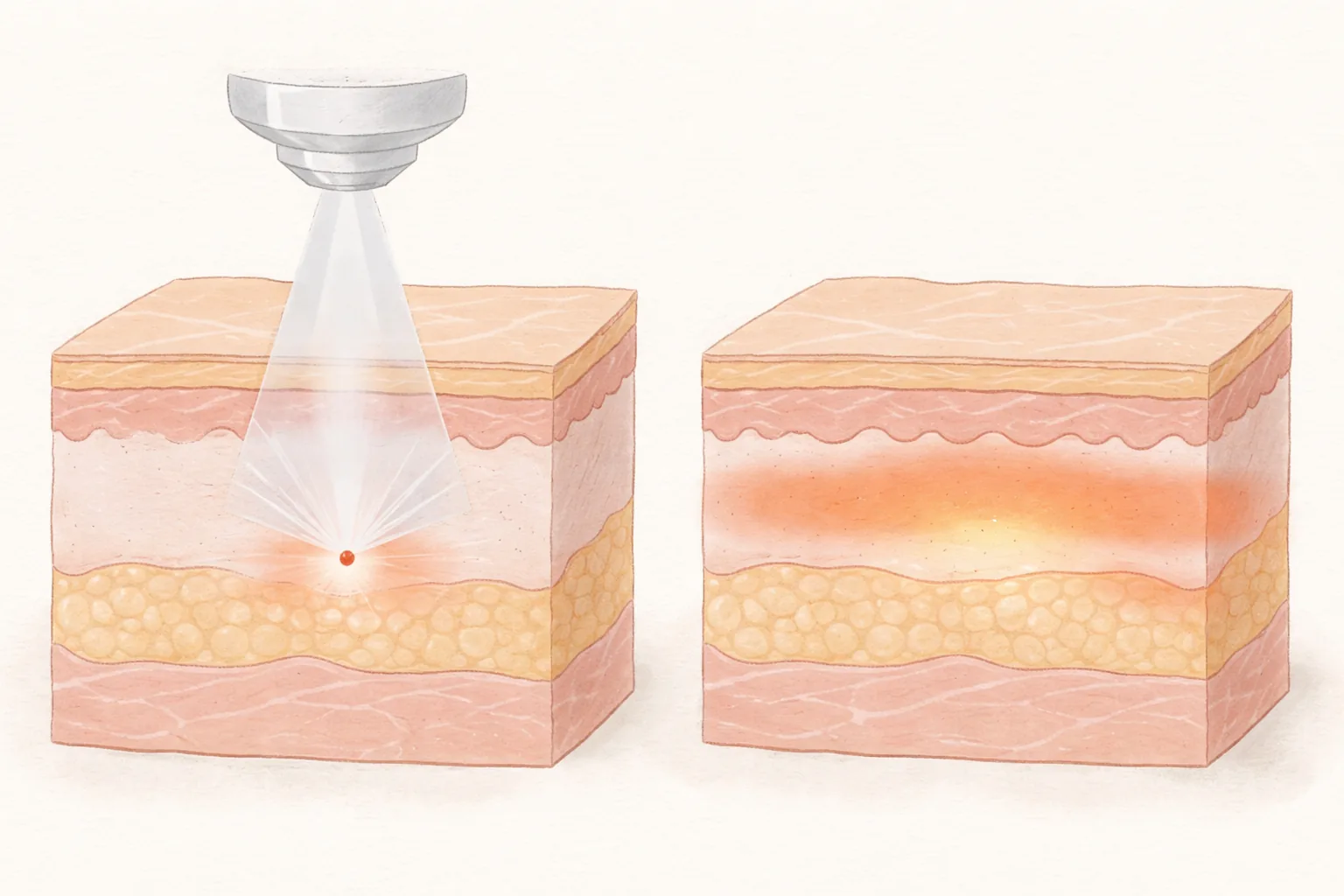
Ultherapy and Thermage FLX aren't a ranking — they're two families with different energy types. Ultherapy and Shurink Universe (HIFU) focus high-intensity ultrasound (HIFU, which concentrates ultrasound waves into a single point to create thermal points) into small thermal points at a set depth, while Thermage FLX uses radiofrequency (RF, where electrical energy passes through tissue and generates heat like friction) to heat broadly from the dermis into the subcutaneous fat. So rather than "which is better," what splits the choice is whether your standout concern right now is deep-layer sagging or elasticity and skin texture across a wider area. For repeat timing, both approaches generally use around 1 year as a baseline, and the doctor decides based on how things progress.
How Do Ultrasound and Radiofrequency Differ Inside the Skin?
First, the shape of the heat is different. HIFU concentrates ultrasound into a single point inside the skin, like a lens focusing light, creating small thermal points at a depth set per cartridge. It's the same principle as a magnifying glass focusing sunlight to heat just one spot on paper. Thermage FLX, by contrast, works by electrical energy passing through tissue and heating it, so rather than drilling into one point, it heats a broad area from the dermis to the subcutaneous fat layer all at once. Whether heat is gathered into a point or spread as a plane — this difference splits every characteristic that follows.
What both approaches are ultimately after is collagen. Skin that receives heat triggers its own repair response, and that process replenishes collagen (the protein that keeps skin firm and supported). According to American Academy of Dermatology information, ultrasound sends heat deep into the skin, radiofrequency heats tissue beneath the skin, and this heat may prompt the body to make more collagen. The same source adds that results from non-invasive firming treatments usually appear gradually, and right after the procedure there is often only temporary redness and swelling.
One thing worth noting here. This American Academy of Dermatology explanation isn't a verdict on the superiority of a specific brand or device — it describes the broad categories of ultrasound and radiofrequency. So pulling device-specific timelines out of this general guidance, like "with ultrasound you'll see this at this many months," isn't right. Device-specific evidence and your personal plan are better confirmed in a consultation.
Sagging vs Elasticity: How Do You Tell Which Concern Stands Out?
Skin is layered as epidermis, dermis, subcutaneous fat, and the fascial (SMAS) layer, and the fascial layer is a thin membrane that supports the facial muscles and skin, like a lining inside a garment. As we age, this membrane stretching is cited as one of the main causes of sagging, and when collagen decreases, the surface thins and loses strength. So even with the same "my face feels like it's sinking" feeling, the approach splits depending on whether the cause is in a deep layer or at the surface.
ATTITUDE Clinic column breaks it down this way. If you want to intensively improve locally and deeply sagging areas like the jawline and cheeks, the HIFU family is relatively suitable, and if your concern is reduced elasticity or skin texture across a broad area from cheeks to neck, Thermage FLX is relatively suitable. When both concerns are present, a combination is considered — one aimed at the deep layer, the other at a shallow, broad layer.
So why do different people get different results from the same treatment? Because the skin they start with is different. How thick your skin is, how much collagen-producing capacity remains, and what your recovery speed is like aren't visible in the mirror. Even with the same analysis record, which device to use first and how far to raise the intensity should differ based on your concerns and how much room you have for recovery.
How Should You Look at Shot Count and Price?
Shot count is one component of the design, and the number itself doesn't guarantee results. ATTITUDE Clinic price list shows lifting items divided by treatment type, shot count, area (face and eyes), and volume units, with VAT separate on all amounts. Even for a treatment with the same name, the composition differs depending on whether it's the whole face or a focused area, and whether eye items are included — so comparing amounts side by side easily mismatches the conditions.
American Academy of Dermatology recommends asking about expected results and risks, other alternatives, the number of sessions needed and how long they take, whether anesthesia is used, recovery and when you can return to daily life, and cost during a pre-treatment consultation. This list can be seen as the minimum set of questions so you don't judge by shot count alone. Looking at whether you're comparing under the same conditions, how many sessions the total plan involves, and whether aftercare is included will reveal the differences behind the numbers.
What Drives Pain and Recovery?
Lifting tends to have especially wide pain variation during the procedure, for two main reasons. One is the energy level and the number of shots delivered to one area, and the other is nerve density by area. Areas close to bone with dense nerves, like the jawline, cheekbones, forehead, and eye area, feel relatively sensitive, while thicker areas like the cheeks feel less even at the same energy. HIFU is often described as penetrating instantly to a set depth with a deep, hot sensation, while Thermage FLX is often described as heating broadly near the surface with a warm sensation that lingers.
Recovery is light for both since neither involves incisions. The ATTITUDE Clinic column views downtime as about 1–2 days, and explains that for a day or two right after the procedure, mild redness and a slight feeling of heat from thermal stimulation may remain. American Academy of Dermatology information also notes that non-invasive treatments have little or no downtime, and that temporary redness and swelling usually appear afterward. Most people can return to daily life, including makeup, from the next day.
Table 1 What Drives Pain and Recovery?
Item
Ultherapy · Shurink Universe (HIFU)
Thermage FLX (RF)
What to Check in Consultation
Energy type
Ultrasound focused into small thermal points
Electrical energy generating broad heat
Which family the design uses
Range where heat is placed
Set depth per cartridge, dermis to SMAS
Broadly from dermis to subcutaneous fat
Depth and range by area
Relatively suitable concerns
Localized deep sagging like jawline and cheeks
Elasticity and skin texture across broad areas from cheeks to neck
Which of the two concerns stands out more
Sensation during treatment
Deep, hot sensation
Warm heat that lingers
Energy level and anesthesia method
Recovery
Downtime 1–2 days, possible redness and slight heat
Same
Schedule buffer and recovery guidance
Repeat timing
Around 1 year as a baseline, doctor decides based on progress
Same
Guidance on next visit timing
Swipe sideways to see the whole table.
In short — The two treatments differ in the layers they target and the way they deliver heat, so it comes down not to which is superior but to which layer your current concern sits in. Shot count and price are only part of the design, so you should look at whether conditions are the same, how many sessions the total plan involves, and whether pain management and recovery guidance are specific. Whether to combine them and in what order is decided after seeing your skin condition.
If This Applies to You
When a ceremony or shoot is a few months away
It takes time for collagen to replenish, so changes appear gradually. It's better to plan a few months ahead rather than right before the shoot, and to set your schedule accounting for how much redness and swelling may remain. Downtime is viewed as about 1–2 days, but how long redness lingers varies with the energy level.
When your skin is sensitive or prone to redness
Since this is a heat-based treatment, redness and a slight feeling of heat may remain. Telling the clinic during consultation whether your redness usually lasts long and whether you've had other treatments recently gives a basis for setting the energy level. The anesthesia method is decided together as well.
When jawline and cheek elasticity are concerns at the same time
A combination that uses a deep layer and a broad layer separately is considered. Whether to do them the same day or with an interval, and how many total sessions to split into, depends on your skin condition, so it's better to set the overall plan first. Asking whether one alone would be enough also makes the decision easier.
For international visitors on a short stay
If your stay is short, it's hard to adjust while watching progress. Consultation bookings are not the same as confirmation and are only confirmed after the clinic contacts you, so it's safer to inquire with some buffer in your schedule.
Please tell us before your consultation — Recent UV exposure and outdoor activity, medications you're taking and skincare ingredients you're using (retinol, acids, etc.), prior treatments and filler history, any past reactions after procedures, and fixed dates like ceremonies or shoots — sharing these helps us adjust the plan.
How ATTITUDE Clinic Proceeds
AI skin analysis record — Your skin condition is recorded and organized so you and the doctor view the same information together. The analysis tool only records and organizes information and does not make medical diagnoses; judgments are made by the doctor.
Doctor consultation — Your concerns, lifestyle habits, and prior treatment experience are added to the analysis record to decide together what is needed and what isn't, and which combination, order, and intensity to use. This is where plans differ even with the same analysis results.
Treatment performed directly by the doctor — The doctor performs the treatment directly so the plan set in consultation and the actual procedure don't diverge, adjusting while watching your skin's response during the procedure.
Progress check and guidance on next timing — Repeat timing is generally based on around 1 year, decided by looking at progress. The next visit timing is set together based on the record.
Lifting items related to this topic are listed separately on the price list as Ultherapy (Merz), eye Ultherapy, Shurink Universe (Classys), Thermage FLX (Solta), eye Thermage FLX, XERF, and Onda. Items are disclosed divided by treatment, area, and volume and shot count units, with VAT separate on all amounts. Which family to use in what order is decided after seeing your skin, and what's needed and what isn't is sorted out together.
Aftercare and Side Effects
Soothing — For a day or two right after the procedure, redness and a slight feeling of heat may remain. Cold compresses may help with swelling, and you can confirm the method with the medical staff.
Moisturizing — Skin that has received thermal stimulation loses moisture quickly, so replenish more diligently than usual.
Sun protection — During this period your skin's barrier is temporarily weakened, so paying more attention to sun protection than usual helps you recover without pigmentation.
Progress check — Avoid saunas, intense exercise, and alcohol on the day, and compare skin texture and contour a few days later.
Common reactions include redness, swelling, tenderness when pressing along the jawline, small bruises, and temporary numbness and reduced sensation, which usually subside within a few days. Rarely, burns, blisters, small scars, temporary facial muscle weakness, and unwanted fat-layer volume loss can occur. If there are changes different from what you expected, such as blisters forming or pain gradually worsening, it's safer not to wait and to receive care.
Frequently Asked Questions
Which is more painful, Ultherapy or Thermage FLX?
It's hard to name one as more painful. Pain varies widely with the energy level and nerve density by area, so what you feel differs greatly between cases where strong energy is needed due to significant sagging and cases where low energy is used preventively. By approach, the HIFU family is often described as penetrating instantly to a set depth with a deep, hot sensation, while Thermage FLX is often described as heating broadly near the surface with a warm sensation that lingers. Areas close to bone — jawline, cheekbones, forehead, eye area — are more sensitive, while thicker areas like the cheeks feel less even at the same energy. If you're sensitive to pain, telling the clinic during consultation helps decide the anesthesia method together.
Can I have both on the same day?
Since they act on different layers, a combination is sometimes considered. However, whether to do both the same day, split them with an interval, or divide them into how many total sessions depends on your skin condition, so it's better to set the overall plan in consultation first. Overlapping the two increases the stimulation your skin receives by that much. Designing only as much as needed is also advantageous for the recovery process.
When do results show, and how often should I have it done?
It takes time for collagen to replenish, so changes appear gradually. By ATTITUDE Clinic's clinical standards, with the HIFU family it's hard to feel a big change right after the procedure, and if there is change it usually appears gradually over 2–3 months, while Thermage FLX tends to have an initial firm feeling (swelling in some cases) that subsides, with additional changes appearing over 2–6 months. The American Academy of Dermatology's general guidance also explains that results from non-invasive firming treatments are gradual. Repeat timing is generally based on around 1 year, decided by the doctor looking at progress. The reason maintenance periods differ from person to person is that the rate at which collagen is synthesized and broken down differs with the degree of fascial-layer elasticity loss, age, and usual UV exposure and lifestyle habits.
Does a higher shot count mean better? Why are prices quoted differently?
Shot count is one design element, and it's hard to compare effectiveness by that number alone. Cost differences arise not only from shot count but from whether the treatment range is the whole face or by area, whether face and eye items are done together, which device and cartridge are used, and whether aftercare is included. The ATTITUDE Clinic price list also separates items, areas, and volume units, with VAT separate on all amounts. Rather than comparing amounts alone, looking at whether conditions are the same and how many sessions the total plan involves helps your judgment.
What should I look at when choosing a clinic?
The first thing is whether the clinic explains based on your current skin condition rather than your age or trends. In consultation, asking which is more prominent between sagging and reduced elasticity, why that treatment is recommended and what the alternatives are, how the dosage and range were designed, the recovery period and when you can return to daily life, the interval until the next treatment, and how to contact them if something seems wrong all help your judgment. The American Academy of Dermatology also includes similar items in its pre-consultation question list. If only one method is strongly recommended, ask for the basis. If the reasoning is clear, the explanation itself becomes your standard.
At a Glance
Table 2 At a Glance
Item
Key Point
Energy type
Ultherapy · Shurink Universe use HIFU focused into points; Thermage FLX uses RF broadly
Relatively suitable concerns
Localized deep sagging suits the HIFU family; broad-area elasticity and skin texture suit Thermage FLX
Pain
Varies with energy level and nerve density by area; areas close to bone are more sensitive
Recovery
Downtime 1–2 days; redness and slight heat usually fade on their own
When results show
Gradually; repeat timing is generally based on around 1 year, decided by looking at progress
Design elements
Not shot count alone but range and area, device, intensity, and aftercare
This article offers general health information. It is not a substitute for diagnosis or treatment based on your own condition, so please talk through your situation with a doctor.