Exosome Facial and Other Skin Boosters: What Actually Goes Into Your Skin?
A skin booster isn't a product name — it's a category of injections that place ingredients into the dermis. Here's how PN·PDRN, hyaluronic acid, hADM allogeneic collagen and exosomes differ in what they do in the skin, and what to compare when choosing.
Written by ATTITUDE Clinic Editorial Team
Search for "exosome facial" or "skin booster" and a screenful of differently named treatments pours out — Rejuran, Juvelook, Re2O, exosomes, "water glow" injections. Many people wonder how the names differ, how the results differ, and why prices spread so widely. This article looks at how what you inject changes what happens in the skin, and what to ask about in consultation.
The short answer first
A skin booster is not a specific product name but an umbrella term for treatments that inject ingredients into the dermis. The ATTITUDE Clinic column also describes skin boosters as PN·HA–based injection treatments. So rather than "which booster is better," it's easier to predict results by first separating what your skin needs now — moisture, a collagen-production signal, or structural support. PN (polynucleotide), the ingredient behind Rejuran, and PDRN (polydeoxyribonucleotide), the "salmon DNA" injection, work by helping the skin produce collagen on its own, while hyaluronic acid (HA) attracts water to add hydration and volume. On top of that come approaches like human acellular dermal matrix (hADM), which replenishes the extracellular matrix (ECM) structure itself, and exosomes, which use only the signals cells send. It's not that one is superior — the purposes differ.
What sits under the name "skin booster"?
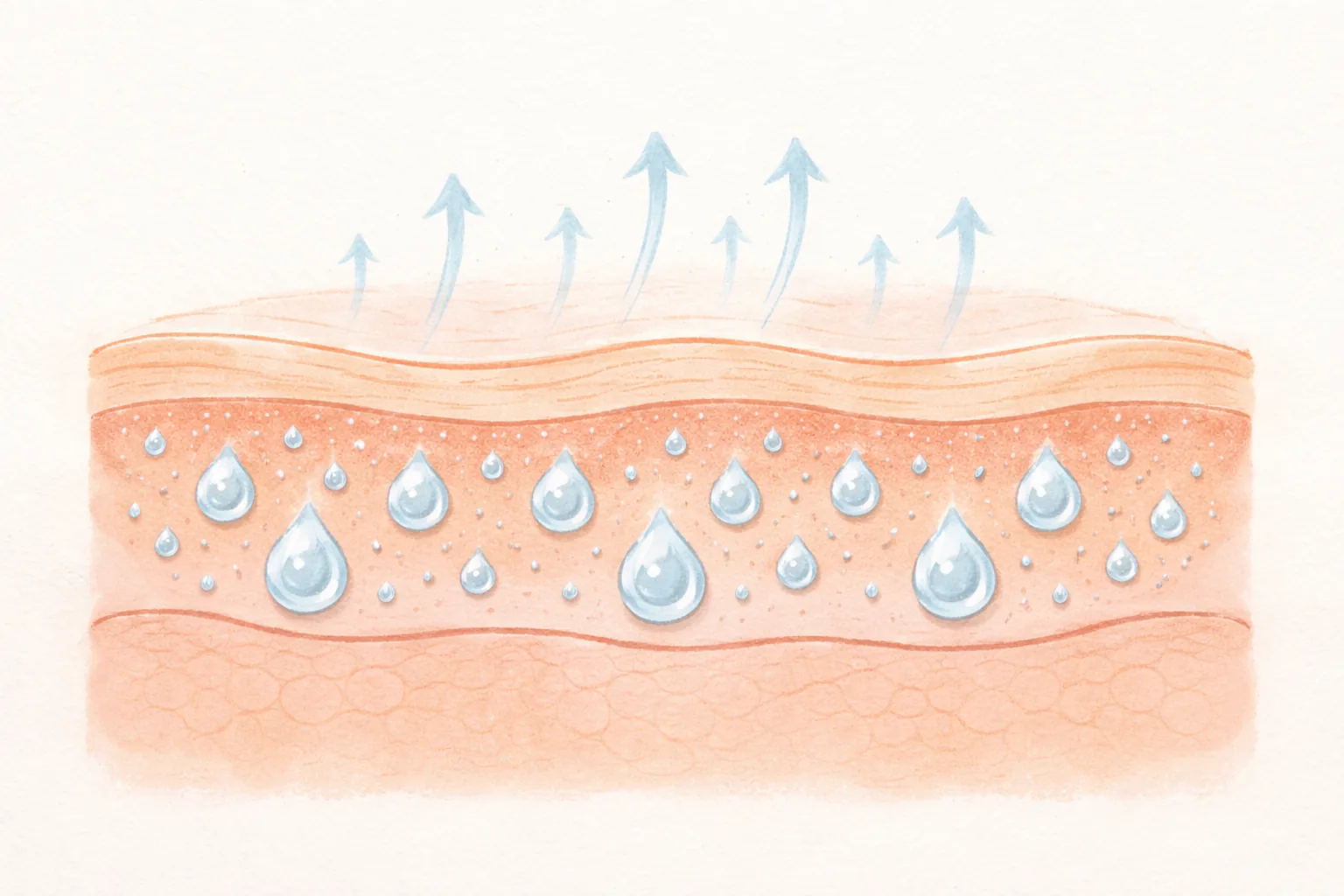
A skin booster is an umbrella term for treatments that place ingredients directly into the dermis — the layer beneath the skin's surface where collagen and elastic fibers sit. Cosmetics applied on the surface struggle to cross the stratum corneum barrier, so even with the same ingredient, injection and topical application differ in how much and how deep the skin receives.
Even similar names contain quite different things. PN (polynucleotide) is the ingredient known as the Rejuran family, and PDRN (polydeoxyribonucleotide) is derived from salmon DNA and called the salmon injection. The two ingredients have different names and different products, but they share a direction: helping fibroblasts (the cells that make collagen in the skin) work on their own through cell regeneration signals. HA (hyaluronic acid) holds onto water, focusing on hydration and volume. As outlined in the collagen injection column, even within the same HA family, concentration, viscosity and injection depth differ by product, so the product should be confirmed at consultation.
Formulations and dose units vary too. The ATTITUDE Clinic treatment and price guide lists Rejuran Healer at 2cc, Rejuran HB and Rejuran S at 1cc, and Juvelook Skin at 4cc and 8cc — the notation differs even within the same family. So when you line up "price per session of product A" against "price per session of product B," what's left is a number missing the actual amount injected and the number of areas treated.
If the ingredients differ, does what they do in the skin differ too?
We can divide them broadly into three directions.
The first is the inductive type. PN and PDRN belong here. Rather than filling in collagen directly, these ingredients stimulate cells to receive regeneration signals and produce collagen themselves. That's why changes appear gradually over weeks rather than immediately after treatment, and fade slowly once the stimulation ends. Hyaluronic acid holds water immediately after injection, then breaks down and is absorbed over time.
The second is the replenishment type. hADM (human Acellular Dermal Matrix), used in Re2O, is made from donated human skin tissue by removing the cellular components that could trigger an immune response and leaving structural components such as collagen, elastin and hyaluronic acid. This structure is placed directly into the dermis to act as a scaffold, and according to the manufacturer, the body's own cells can grow into it and help form new collagen. How much remains and how long it lasts, however, is still an area under study.
The third is the signal type. Exosomes are tiny vesicles cells secrete, carrying signaling substances such as growth factors and regulatory proteins. Rather than injecting living cells, this uses the messages cells send, so there is still a gap between signaling mechanisms confirmed in laboratory research and what appears in real skin. According to the exosome column, exosomes are often used alongside microneedling or right after an ablative fractional laser, when a temporary pathway is open on the skin's surface, rather than applied alone; after low-energy Pico toning, which barely opens the surface, most remain on the surface.
Table 1 If the ingredients differ, does what they do in the skin differ too?
Category
What it does in the skin
Concerns it suits
What to check
PN·PDRN family (Rejuran, salmon injection)
Inductive type: sends regeneration signals to support collagen production
Rough texture, feeling of lost elasticity
How many sessions, at what intervals
Hyaluronic acid (HA) family
Attracts water to add hydration and volume
Inner dryness, dryness around fine lines
Concentration and injection depth by product
hADM allogeneic collagen (Re2O)
Directly replenishes ECM structure in the dermis
Skin feeling thinner and hollowing
Whether post-treatment fullness is swelling
Exosomes
Deliver regeneration signals between cells
Recovery support after surface-opening treatments
Which product, its source and concentration
Swipe sideways to see the whole table.
In short — Choosing a skin booster is not about ranking product names but about first deciding whether your skin lacks moisture, regeneration signals or structural support. Even under the same name, different doses and injection depths change the result, so confirming what and how much is being injected at consultation is more useful than lining up price lists.
What should you use as your criteria?
The first criterion is the direction of your concern. If hydration and texture management is the goal and you want frequent maintenance, the PN·HA family fits; if your skin feels thinner or elasticity has dropped noticeably, an approach that replenishes structure, like hADM, can be considered. These two are not competitors but a matter of order and combination.
The second is recovery time and schedule. Because these are injections, bruising and swelling can occur, and rarely nodules, infection or allergic reactions. The pore column also notes that bruising and swelling are common with injection treatments like skin boosters, and nodules, infection and allergic reactions can occur rarely. Bruising can take time to fade once it appears, so if you have an important event, it's better to schedule treatment earlier.
The third is the maintenance cycle. The PN·HA family generally follows a flow of several sessions at 2–4 week intervals, then moves to maintenance treatments, and hADM is also usually planned for several sessions before deciding on maintenance. The number depends on skin condition, area and the amount injected.
The fourth is how to compare cost. Because dose units differ by product, lining up per-session prices alone leads to skewed judgment. Instead, look at how many sessions at what intervals, and which product goes in and how much within that plan. Recently there are many unfamiliar product names, so confirming ingredients and dosage at consultation is part of the process.
How many sessions, at what intervals?
Injection treatments rarely end with one session, because the skin needs time to respond. PN·HA skin boosters generally follow several sessions at 2–4 week intervals, then maintenance treatments.
hADM allogeneic collagen is also usually planned for several sessions. The fuller feeling right after treatment is partly swelling that settles over a few days, and any change appears gradually over weeks. Maintenance duration varies greatly between individuals, and long-term data is still limited, so it's hard to state in advance how long one session will last.
For exosomes, the standard for repeat cycles is still being established. Whether to add more and at what interval is decided by the doctor for each case, and it is not necessary for every treatment. So rather than an answer of "how many sessions is correct," it is more accurate to say it depends on which treatment it is combined with.
In these situations
When a wedding or shoot is a few weeks away
Injection marks and bruising can remain, so adjusting the timing is better. Bruising can take more than 1 week to fade once it appears, and swelling settles over a few days. Tell us your schedule first and we will set the timing accordingly.
When you want steady management
The PN·HA family generally follows several sessions at 2–4 week intervals, then maintenance treatments. Rather than pushing high intensity from the start, keeping to the planned number of sessions and the maintenance interval is easier on the skin.
Sensitive skin or skin that reddens easily
Temporary redness and swelling can occur at the injection site, and allergic reactions can occur rarely. If you have reacted to a specific ingredient before or have an autoimmune disease, tell us first at consultation.
International visitors on a short stay
A plan split across sessions ties into your length of stay. Decide first how many sessions and at what intervals you can fit while you're here, and check at consultation whether recovery overlaps with your schedule.
Please tell us before your consultation
Recent UV exposure and outdoor activity
Medications you take (including blood thinners) and supplements
Recent retinol, exfoliating products, or peeling
Pregnancy or breastfeeding, autoimmune disease, allergy history
Unavoidable events such as weddings or shoots
How ATTITUDE Clinic proceeds
AI skin analysis record — We photograph the face to record skin condition, and that record becomes consultation material. We make clear that the analysis tool only records and organizes information and is not a medical diagnosis.
Direction set in consultation with the doctor — Adding skin thickness, concerns and lifestyle habits to the analysis record, we judge whether what's needed now is moisture, regeneration signals or structural support. This is also where we may say a treatment isn't needed and should be deferred.
Treatment performed directly by the doctor — The doctor performs the treatment with the decided ingredient, dose and depth. We keep to genuine products, exact doses and set prices, and do not push session counts or intensity excessively for fast results.
Recovery and follow-up check — We explain aftercare and set the next check point together.
Devices and products adjacent to this topic include the AI skin analysis record, RF microneedling devices such as Potenza, the erbium fractional laser, and Rejuran Healer, Rejuran HB, Rejuran S, Eye Rejuran, Re2O and exosomes.
Aftercare and side effects
Soothing — On the day of treatment, do not press hard on or massage the injection site. With structural treatments like hADM, physical stimulation before it settles can make distribution uneven, so whether to massage depends on the type of treatment.
Moisturizing — Dry skin can feel slower to recover, so keep up moisturizing. Right after treatment, use only products the doctor allows.
Sun protection — Applying sunscreen carefully throughout the recovery period is better. The American Academy of Dermatology filler guide advises avoiding sun and tanning after filler treatment. Skin boosters differ from fillers in ingredients and purpose, but aftercare that avoids irritating the injected area and reduces UV exposure is explained together at consultation.
Follow-up check — If swelling, pain or heat persists, or the injection site turns white or dark, contact us without waiting.
Common reactions are bruising and swelling. Rarely, nodules, infection or allergic reactions can occur. If swelling does not subside several days after treatment or a bumpy feeling continues, ask us, and if pain worsens or skin color changes appear, it is safer to be seen right away.
Frequently asked questions
Does an exosome facial or skin booster work with just one session?
Most are carried out over several sessions, because the skin needs time to respond. The PN·HA family generally follows several sessions at 2–4 week intervals, then maintenance treatments, and hADM is also planned for several sessions before deciding on maintenance. In fields like exosomes, the standard for repeat cycles is not yet set. Whether to stop after one session or plan several is decided by the doctor based on skin condition and goals.
How do Rejuran and exosomes differ?
What goes in and how it works differ. The Rejuran family uses PN, helping fibroblasts produce collagen on their own. Exosomes deliver signaling substances cells secrete, and do not inject living cells themselves. Exosomes are often used when a pathway is open on the skin's surface, such as right after microneedling or an ablative laser, and after treatments that don't open the surface, most remain on the surface. The two treatments are not competitors; they can be combined or sequenced according to purpose.
Who is a good candidate for exosomes treatment or skin boosters?
Mostly people whose texture isn't well managed by cosmetics alone, those with recurring inner dryness, and those whose skin feels thinner and less elastic. If hydration is the goal, the HA family; if a regeneration signal is the goal, PN·PDRN; if structural support is the goal, hADM is a candidate. Conversely, if there is inflammation or infection at the treatment site, if you are pregnant or breastfeeding, if you have an autoimmune disease, or if you have reacted to tissue-derived products, tell us first at consultation. Which approach fits is decided by looking at your skin.
Prices differ by product — what should I compare?
Comparing only per-session prices easily misses the actual content. Dose units differ by product, so even the same 1 session contains different amounts. It's better to look at how many sessions at what intervals, and which product goes in and how much within that plan. The ATTITUDE Clinic treatment and price guide also lists different notation units by product, so check the plan as a whole at consultation.
What should I check when choosing a clinic?
Even with the same treatment name, which product goes in and how much decides the result. Start by seeing whether the consultation explains the product, dose, session plan and recovery time. Whether the products used are genuine, whether the doctor performs the treatment directly, and whether unnecessary treatments are pushed are also items to check. If a clinic explains side effects and precautions first, you don't need to rush your decision. Rather than claims that guarantee results, use as your standard whether they explain what can change and what is difficult, distinguishing between the two.
At a glance
Table 2 At a glance
Item
Key point
What a skin booster is
An umbrella term for treatments that inject ingredients into the dermis
Inductive type
The PN·PDRN family sends collagen-production signals
Hydration type
Hyaluronic acid handles moisture and volume
Replenishment type
hADM directly replenishes extracellular matrix structure in the dermis
Signal type
Exosomes deliver regeneration signals between cells
Criteria for choosing
Direction of concern, dose and depth, session plan, recovery time
This article offers general health information. It is not a substitute for diagnosis or treatment based on your own condition, so please talk through your situation with a doctor.