Fat Dissolving Injections: How Many Sessions and How Far Apart?
How many fat dissolving injections you need and how far apart — what the FDA-approved schedule actually says, why the numbers change by area and formula, and what to expect around each session.
Written by ATTITUDE Clinic Editorial Team
If you have been searching fat dissolving injections for a double chin or a softer jawline, the question usually stops at "how many sessions do I need?" Is it a one-time treatment, when is the next session due, and does adding sessions get you there faster? This article starts with the criteria that set the number and spacing, then looks at why those numbers shift with the area and the formula, and what to prepare and watch for before and after each session.
The short answer
Fat dissolving injections are not a single treatment; they are given in sessions spaced apart. The only FDA-approved fat dissolving injection is a deoxycholic acid injection for submental fat, labeled for up to 6 sessions with at least 1 month between each (FDA safety communication). So "leave about 4 weeks between sessions and judge the response over several visits" is the default rhythm, and the total number you actually need depends on the fat thickness and area at the injection site and the volume used per session. Filling more sessions does not mean faster change.
Why wait weeks instead of days?
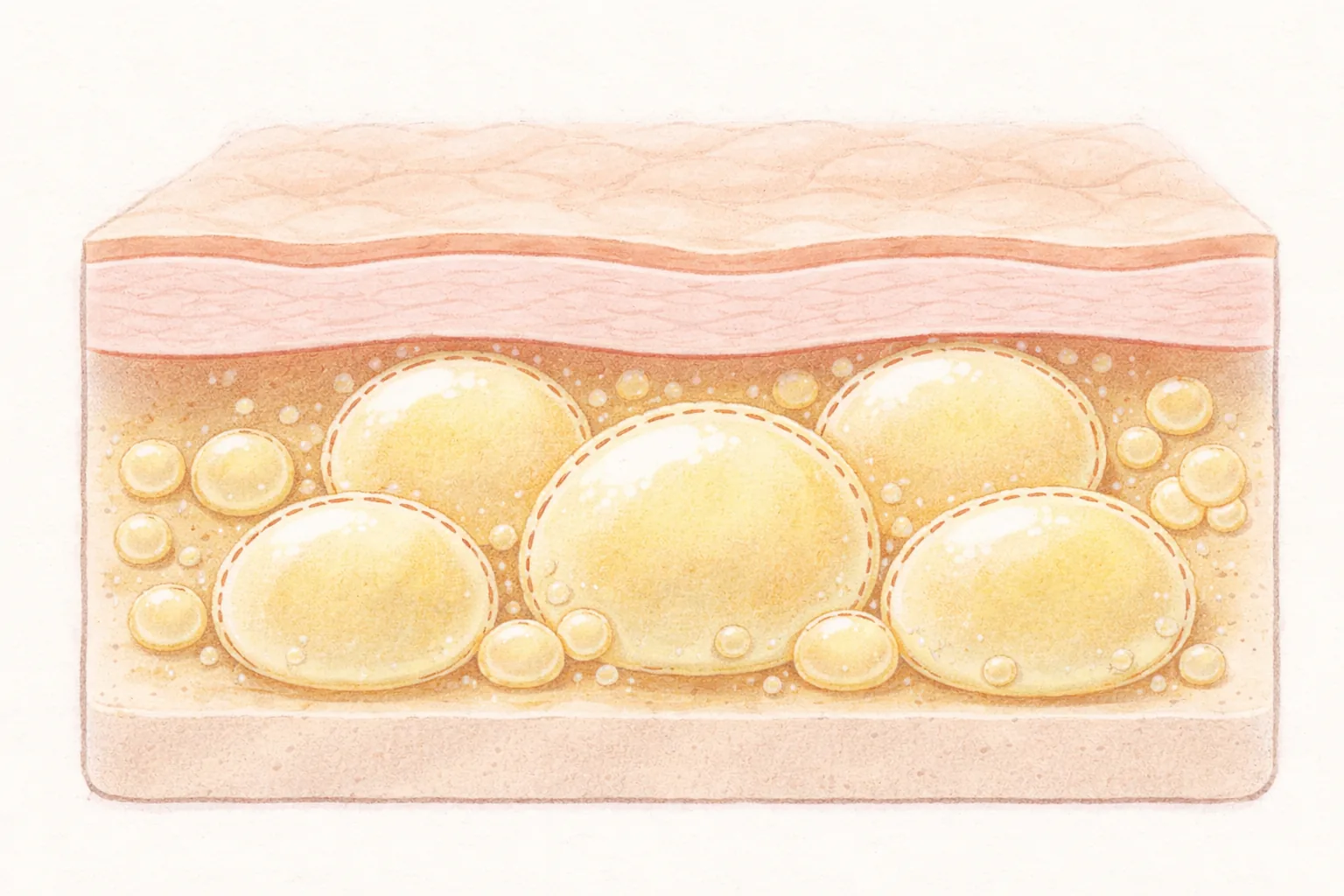
Fat dissolving injections are a series of injections placed under the skin to break down fat cells — a non-surgical procedure known as injection lipolysis (FDA consumer information). The first thing to remember is that broken cells do not vanish on the spot.
When the fat cell membrane breaks down, the fat inside is released, and the body clears this residue slowly. Because that clearing takes time, the contour looks different weeks later rather than the day after — which is why the mirror a few weeks out shows the result better than tomorrow's. The same is why sessions are spaced: if the same area is stimulated again before the swelling has settled, it is hard to tell whether you are seeing this session's response or leftover response from the last.
The type of product also changes the conditions. FDA notes that unapproved fat dissolving injections are sold online under many names, and the ingredients commonly used in them have not been evaluated for safety and effectiveness. The same ingredient placed at a different depth or split across a different number of injection points also affects safety.
How many sessions before you can say it changed?
The FDA-approved double chin injection is labeled for up to 6 sessions, with up to 50 subcutaneous injections per session (FDA safety communication). The ceiling and the minimum interval are fixed, but the number that means "enough" differs from person to person.
Three factors decide how many sessions you need: how thick and how wide the fat is in that area, how much volume is spread across what area in one session, and how the swelling and bruising from the last session settled. With different fat thickness, the same face responds differently from session to session.
One thing that is easy to miss: adding sessions can also add to the risk of side effects. FDA identified a link between deoxycholic acid injection and reports of injection-site nodules (3 cm or smaller) or masses (larger than 3 cm), and stated that these nodules and masses may not resolve over time and may need medical treatment. There were 117 reported unresolved cases, lasting on average about 143 days as of follow-up. They appeared after the first session and after later sessions too. So rather than aiming for "more sessions," keeping the interval and observing the response before deciding the next session is how to address both results and safety.
Face and body: why do the same injections need different numbers?
Different depth and area call for a different approach. ATTITUDE Clinic's treatment guide breaks fat dissolving injections into units — face 3 cc and 6 cc, body 100 cc, 200 cc, and 300 cc — lists the "jogak" contour injection separately as face-only, and notes that DCA is handled in 1 vial units with confirmation needed for body use (ATTITUDE Clinic treatment guide). Worth noting: the guide describes fat dissolving injections as steroid-free and the "jogak" contour injection as containing steroids. Search bars group them under the same word, "contour," but the formulas are not the same.
The numbers change by area because of the fat layer's thickness and the structures beneath it. The face is thinner than the body and packed with nerves and blood vessels, so rather than pooling into one point, the approach spreads across an area. FDA advises against using the approved deoxycholic acid injection outside the submental area, and reports serious adverse reactions such as muscle and nerve injury and blurred vision when it has been used that way. The body takes larger unit volumes, but that means tracking the injection area and recovery between sessions just as carefully.
Table 1 Face and body: why do the same injections need different numbers?
Category
What this guide shows
Main area
What sets the number and interval
Fat dissolving injection
Steroid-free; face 3 cc / 6 cc, body 100–300 cc
Face and body
Fat thickness, volume per session, how fast swelling settles
Jogak contour injection
Face-only, described as containing steroids
Facial contour
Fat volume by area, skin thickness
DCA
1 vial units, confirmation for body use
Body
Treatment area and total volume, recovery
FDA-approved deoxycholic acid injection
For submental fat, up to 6 sessions
Under the chin
At least 1 month between sessions, injections per session
Swipe sideways to see the whole table.
In short The FDA-approved injection has a fixed framework: up to 6 sessions, at least 1 month apart, for submental fat. For other areas and products, the number of sessions cannot be fixed in advance; the next session is set by watching fat thickness, volume, and recovery speed. Keeping the interval makes results easier to judge than adding sessions does.
If this sounds like you
When a wedding or shoot date is already set
Since at least 1 month between sessions is the baseline, count backward from the date to set the first session. Allow room between the last session and the event for swelling to settle. Rather than squeezing sessions closer together, reducing the number of sessions and adjusting volume and area works better for scheduling.
When swelling lingers and your calendar is tight
Instead of forcing the interval shorter, split the volume and area used per session. If you note how many days it took the swelling to settle last time, that goes straight into the next plan. Tell us your schedule for the day before and the day after, too.
When your skin is sensitive or prone to redness
We look at skin thickness and your usual reactions first and start at a lower intensity. If redness lingers or tenderness lasts, the next session is pushed back. If you have had other injections in the same area before, that history matters for the assessment.
When you are in Seoul briefly and want several treatments at once
Overlapping injections make it hard to tell which treatment caused which response. If you tell us your length of stay and your schedule after you fly home, we adjust the order and spacing to match. Rather than trying to fit every session into one visit, it is safer to set a date for the next visit.
Before your consultation, tell us Your recent sun exposure and skin irritation, medications you take, any history of allergic reactions, the devices and volumes used in previous treatments, the dates, and how you reacted then. Also mention any important events in the next 2–3 months. The doctor reviews previous treatment records and checks whether the volume or interval used then was appropriate.
How ATTITUDE Clinic handles this
AI skin analysis record — Your skin condition is recorded and organized so you and the doctor look at the same information. The analysis tool is a reference to support consultation and does not make a medical diagnosis.
Doctor consultation — Your concerns, daily habits, and past treatment experience are added to the analysis record to decide together what is needed and what is not, and in what order and intensity (ATTITUDE Clinic column).
Treatment performed by the doctor — The doctor personally performs the plan set at consultation and adjusts while watching your skin's response during the session. Anesthesia management is decided in the same flow.
Follow-up check — We watch for changes that differ from expectations during recovery and revisit the timing of the next session.
The injections covered in this article are the fat dissolving injection, the "jogak" contour injection, and DCA, which are listed as separate units in the treatment guide. ATTITUDE Clinic's principle is to decide together what is needed and what is not, with the doctor personally handling everything from consultation to treatment.
Aftercare and side effects
Calming — Redness and swelling are common on the day of treatment. That day, do not rub or irritate the treated area; just leave it comfortable.
Moisturizing — If your skin feels tight, keep the barrier comfortable with moisturizer. Avoid strong exfoliation or irritating products on the treated area.
Sun protection — Skin in recovery is sensitive to outside irritation. Use sun protection when you go out, and delay hot saunas or alcohol for a few days.
Follow-up check — Watch whether swelling and bruising are heading in the right direction, and whether anything new can be felt.
ATTITUDE Clinic's column notes that after injectable treatments, redness, swelling, tenderness when pressed, and bruising are common and usually settle within a few days. Rarely, temporary lightening or darkening of the skin, blisters, lumps after injection, burns, or scars can occur (ATTITUDE Clinic column). With deoxycholic acid injection, injection-site nodules and masses have been reported, and when used outside the submental area, adverse reactions such as muscle and nerve injury, blurred vision, and trouble swallowing have been reported. Hair loss at the injection site, ulceration, necrosis, and infection are also mentioned reactions. If you notice something unexpected — pain that does not improve and gets worse, or a nodule you can feel — do not wait for the next session; get it checked.
Frequently asked questions
How many sessions of the "jogak" contour injection do I need?
The "jogak" contour injection is listed as a face-only injection, and how many sessions you need depends on the fat volume in the area, skin thickness, and the volume used per session. Because it is described as containing steroids, the number is set by checking the response rather than repeating the same area at short intervals. The FDA-approved double chin injection has a framework of up to 6 sessions at least 1 month apart, but that is a standard for submental fat and does not apply directly to other areas or other formulas. The number of sessions is decided at consultation.
Why is the interval at least 1 month?
Because it takes time for broken fat cells and their residue to be cleared. Only after that time can you see what this session changed and judge how much volume to use next. The approved labeling also states at least 1 month between each session. Packing sessions closer together overlaps the swelling, blurs your read on the result, and makes it hard to tell which session caused a reaction like a nodule.
Do fat dissolving injections and the "jogak" contour injection differ in whether they contain steroids?
ATTITUDE Clinic's treatment guide lists fat dissolving injections as steroid-free and the "jogak" contour injection as face-only and containing steroids. That means even though they turn up under the same word "contour" in search, the formulas are not the same. Which ingredient goes into which area and how much is decided with an explanation before treatment, so it is more accurate to confirm the formula and whether it contains steroids at consultation. If you have had injections elsewhere before, tell us that history too.
How much pain on the day, and what about the next day's schedule?
Pain is felt differently depending on the skin thickness at the injection site, the volume used in one session, and the formula. ATTITUDE Clinic's column also notes that how anesthesia is managed is part of the treatment process. The next day's schedule depends on how much swelling and bruising remain, so if you have an important appointment, tell us the date in advance. How visible bruising is also varies by treated area.
What should I check when choosing a clinic for this treatment?
Four things: which product is used, who performs the injections, how the area and the number of sessions are split, and how they respond if an adverse reaction occurs. According to FDA guidance, even approved injections must be given by a healthcare professional, and the exact number and location of injections, needle placement, and technique determine safety and results. Buying unapproved products online and injecting them yourself is not advised. It also helps to see whether the consultation reviews your previous treatment records.
At a glance
Table 2 At a glance
Item
Key point
Default rhythm
Not a one-time treatment; given in sessions spaced apart
Approved standard
Deoxycholic acid injection for submental fat, up to 6 sessions, at least 1 month between each
Why the interval
Broken fat cells and residue take time to clear
What sets the number
Fat thickness and area, volume per session, recovery speed of swelling and bruising
Formula distinction
Fat dissolving injections listed as steroid-free; "jogak" contour injection listed as face-only and containing steroids
Reactions to watch
Nodules or masses may not resolve and may need treatment; worsening pain needs checking
This article offers general health information. It is not a substitute for diagnosis or treatment based on your own condition, so please talk through your situation with a doctor.