Onda consultation: What to check first for face and body?
Walk through an Onda consultation step by step: goals and energy planning for face vs. body, when and how to judge results, pain and recovery, sessions and cost scope, and when to contact the clinic.
Written by ATTITUDE Clinic Editorial Team
When you start looking into lifting, device names are usually the first thing you notice. "I heard Onda doesn't hurt," "I heard it works on both face and body," "How many kJ do I need?"—the questions pile up, and what you should actually ask in the consultation room gets left behind. This article walks through what to check at an Onda consultation for face and body separately, when and by what standard to judge results, and how to settle pain and recovery, sessions and cost, and contact criteria, in order.
The short version
The first thing to settle at a consultation is not the device name but the goal and the plan. Even for a treatment with the same name, the design changes depending on whether it's for the face or the body, which layer is being targeted, and how much total energy is planned. According to American Academy of Dermatology guidance, before a cosmetic procedure you should be told about indications, risks, benefits, and alternatives, and should ask about expected results, the number of sessions needed and how long they take, anesthesia, recovery and return to daily life, preparation and aftercare, and cost (AAD). The same treatment produces different results depending on skin type, thickness, and how well you build new collagen, so in the end what remains is the process of adjusting intensity and order based on your own condition (Why do results differ even with the same treatment?).
What does Onda do, and why does the plan matter more than the name?
On the ATTITUDE Clinic price list, Onda appears under microwave lifting, divided into face and body, and is listed as Onda · DEKA (Treatments and pricing). Microwave is a classification of which energy is used; what actually creates results is which layer of skin that energy goes into and how much of it.
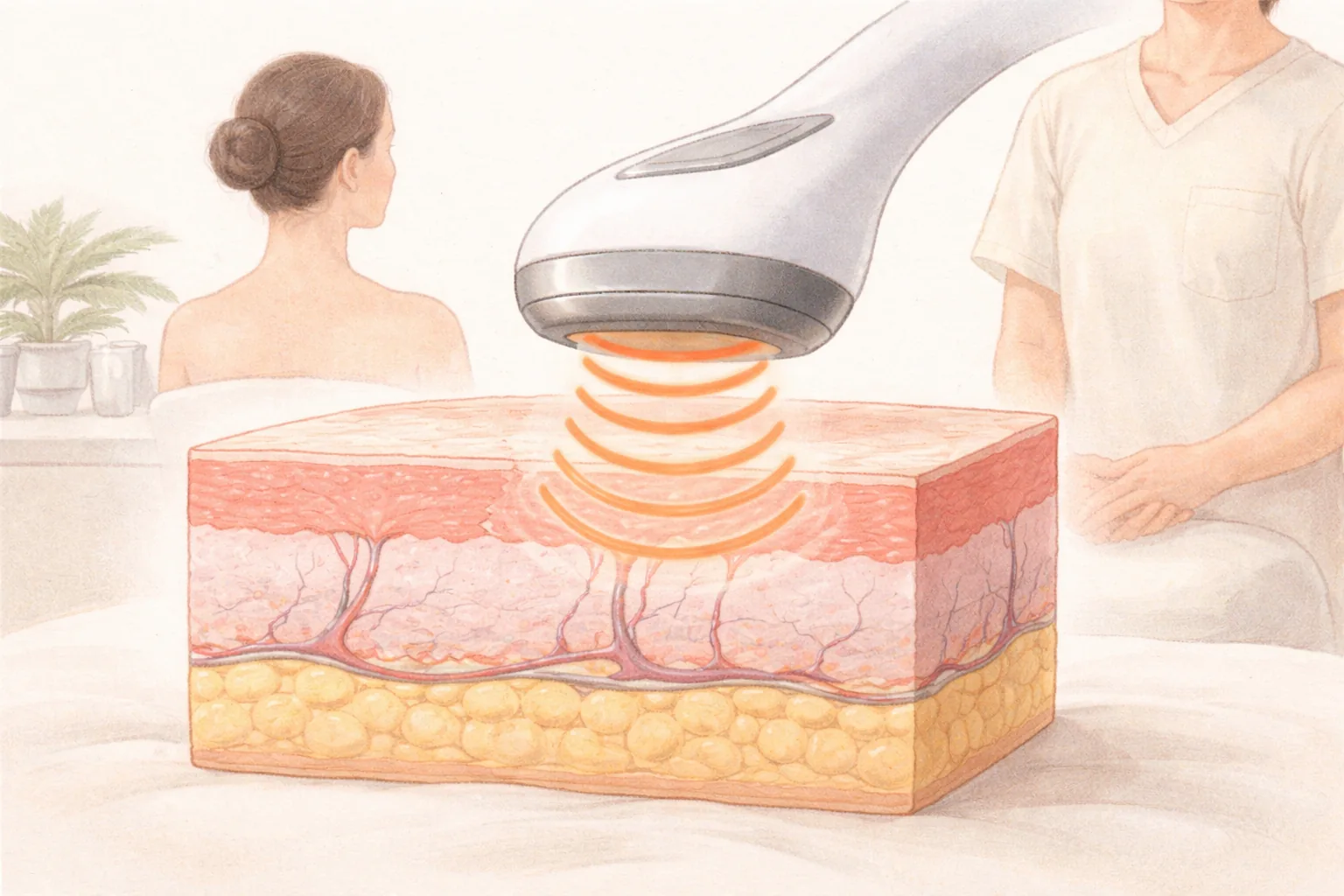
Lifting ultimately comes down to where you deliver heat. AAD guidance notes that skin firming treatments use several approaches—ultrasound, radiofrequency, lasers—and that each method differs in how invasive it is and how much recovery it involves (AAD). Ultrasound sends heat deep into the skin, radiofrequency heats tissue beneath the skin, and lasers deliver heat to deeper layers without injuring the epidermis. In tissue that heat reaches, the process of building new collagen follows, and it takes time before that shows up as a visible change.
So "is Onda a good device" comes after "which layer of my skin are we targeting, and why." The clinic column also explains lifting devices as several different tools—Ultherapy, Thermage FLX, Shurink Universe, Onda—that differ in whether they deliver heat or ultrasound and how deep into the skin they stimulate (Why do results differ even with the same treatment?). Even with the same loss of firmness, which device to use first, what intensity to set, and whether to combine other treatments depend on that person's concerns, recovery time, and how sensitive their skin is.
Why are face and body planned separately?
Even with the same Onda, the face and the body differ in surface area and tissue composition. The ATTITUDE Clinic price list reflects this by listing face and body as separate items and dividing doses by kJ (kilojoules, a unit for counting total energy). The face has thin skin layered over expression muscles, while the body has many areas with a large surface area and a thick fat layer.
According to AAD guidance, non-invasive firming procedures can be applied to almost any area without cutting the skin, minimally invasive radiofrequency is used on specific areas like the neck or upper arms, and lasers are sometimes used on sagging skin such as the abdomen and upper arms (AAD). This means the approach most often chosen differs by area.
Starting points differ from person to person too. If skin type, skin thickness and structure, and regeneration speed differ, then even a treatment at the same intensity will feel different and produce different results (Why do results differ even with the same treatment?). So in a face consultation, we look separately at whether sagging is the main concern, whether there is fat along with it, and whether the skin has thinned; in a body consultation, we look at fat thickness and surface area by area, and even your future weight-change plans. If your weight is going to change significantly, it helps to mention that timing during the consultation so the plan can account for it.
When and by what standard do you judge results?
AAD explains that non-invasive procedures look natural because results appear gradually (AAD). General guidance by method says ultrasound usually shows gradual lifting and tightening over 2–6 months after 1 session, non-invasive radiofrequency may give some tightening right after the procedure but collagen takes time to build so the best results are around 6 months later and can last 2–3 years with maintenance, and lasers may require 3–5 sessions with results appearing 2–6 months after the last session.
These numbers are general guidance by method, and do not mean Onda's performance or any individual's results. So it's best to set your evaluation criteria before the procedure. Take photos under the same lighting and the same angle, compare them at the time agreed on in the consultation, and write down in words whether you're judging contour, skin texture, or satisfaction. If you don't set an evaluation time, it's easy to draw a hasty conclusion before recovery is even over.
Table 1 When and by what standard do you judge results?
How heat is delivered
Layer targeted
When results appear (general guidance)
Recovery burden
Ultrasound
Deep layers of skin
Usually over 2–6 months after 1 session
Almost none
Radiofrequency (non-invasive)
Tissue beneath the skin
Some tightening right after, best results around 6 months
Almost none
Laser (non-invasive)
Deep layers without injuring the epidermis
3–5 sessions, 2–6 months after the last session
Almost none
Radiofrequency (minimally invasive)
Direct heat to the needed location
From about 1 month, gradual over nearly 1 year
A few days, compression garments may be needed
Swipe sideways to see the whole table.
In short This table is a general description by treatment method and does not mean one specific device is superior to another. Knowing in advance when results appear and agreeing on an evaluation time lets you follow the course without getting impatient or veering off the plan in the middle.
What decides pain and recovery?
According to AAD guidance, after a non-invasive firming procedure, temporary redness and swelling are usually the only marks, and while it may be somewhat uncomfortable during the procedure, it often stays at that level. Procedure time is mostly under 1 hour, and makeup can often be applied right after the procedure (AAD).
The sensation you feel is decided by the energy intensity and the skin thickness of the area. In places where the skin is thin and the bone is close, the same intensity feels hotter, while body areas with a thick fat layer feel relatively duller. This is why the clinic column lists fine adjustment of intensity at the treatment site and the process of adjusting while watching reactions during the procedure as factors that decide results (Why do results differ even with the same treatment?).
How does recovery burden divide by method? Non-invasive procedures have little or no downtime, while minimally invasive radiofrequency, which inserts a thin tube or needle into the skin, may involve a few days of recovery and wearing compression garments (AAD). Whether face and body can be done on the same day depends on the area, total energy, and skin reaction, so it is decided in the plan before the procedure.
How many sessions, and at what interval?
AAD general guidance says ultrasound aims for gradual change with 1 session and considers additional sessions if needed, non-invasive radiofrequency is basically 1 session but more than 1 can help in some cases, and lasers may need 3–5 sessions (AAD). What decides the number of sessions is not the device name but the method and how you respond over time.
How Onda is divided into sessions and at what interval depends on whether it's face or body, the surface area and fat thickness of the area, the total energy, and your history of previous procedures. The clinic column explains that even with the same combination, whether you do it all at once or split it up can change the recovery process and how it feels (Why do results differ even with the same treatment?). So at the consultation, it's good to write down the first plan along with a midpoint check-in time and the criteria for adjusting the plan.
If this sounds like your situation
When the date is fixed, like a wedding or a shoot
Count backwards from that date and set the procedure timing and recovery period first. Non-invasive procedures usually cause only temporary redness and swelling, but since results appear gradually, planning with a few months of buffer rather than right before the event is more natural. If you mention unavoidable dates first at the consultation, the area and intensity can be adjusted to fit that date (AAD).
When you're considering face and body together
The price list separates face and body items and designs kJ doses separately (Treatments and pricing). Whether to do them in the same visit or split the order is decided by skin reaction and total energy, so it's best to decide at the consultation which one to look at first.
When your skin is thin or sensitive and reddens easily
Even the same intensity reacts differently depending on skin thickness and regeneration speed (Why do results differ even with the same treatment?). If redness tends to linger for you, mention that history first and secure room in the consultation to adjust intensity and area. Talking about the skincare products you're using also helps reduce irritation.
If you're a visitor on a short stay
With a short stay, the recovery period and when you can return for a follow-up become the center of the plan. Booking application and confirmation are different, and it is confirmed after you receive a confirmation call from the clinic after applying; same-day applications are accepted for time slots 1 hour after the current time (Consultation booking). If you tell us the range of dates you can visit in advance, a plan that fits within them can be made.
Tell us before your consultation Please mention in advance recent UV exposure (outdoor activity or tanning), medications you're taking (including blood thinners), pregnancy or breastfeeding, skin infections or wounds, your history of past procedures and surgeries, reactions to previous procedures, skincare products you're using, and unavoidable dates like weddings or shoots. AAD guidance notes that firming procedures may not be suitable if you are pregnant, have a skin infection, or are taking certain medications (AAD).
How ATTITUDE Clinic handles this
AI skin analysis record: We record and organize your skin condition so you and the doctor look at the same information. The analysis tool only records and organizes information and does not make a medical diagnosis; the judgment is the doctor's.
Doctor consultation: We add your concerns, lifestyle habits, and previous treatment experience to the analysis record and decide together whether Onda will be used on the face or body, and with what combination, order, and intensity. What is needed and what is not is also sorted out here.
Treatment performed by the doctor: The doctor performs the treatment according to the plan set in the consultation and adjusts intensity while watching skin reactions during the procedure. This is so the design and the execution don't drift apart.
Recovery and aftercare guidance: We guide you on soothing after the procedure, sun protection, and when to check your progress. Prices are disclosed by unit for all items, are the same on every language page, and VAT is separate.
Devices used for this topic include the face and body microwave lifting items (Onda · DEKA), and depending on the cause of your firmness concerns, other lifting devices such as Ultherapy, Thermage FLX, and Shurink Universe are also considered (Treatments and pricing, Why do results differ even with the same treatment?). Which device fits is decided after looking at your skin.
Aftercare and side effects
Soothing: Redness and swelling right after the procedure are common reactions and usually subside within a few days. During that time, avoid strong massage or stimulation and watch your skin's reaction (Why do results differ even with the same treatment?).
Sun protection: During recovery, apply sunscreen carefully. AAD guidance lists the habit of protecting your skin from UV as a condition that helps firming results last (AAD).
Cleansing and makeup: Non-invasive procedures often allow makeup right after the procedure (AAD). When you can cleanse and apply makeup differs by method, so follow the timing guided at your consultation.
Checking progress: At the evaluation time set in the consultation, compare photos under the same lighting and angle. It's good to keep to that time so you don't judge results while swelling and redness are still present.
Side effects range from common to rare. Redness, swelling, tenderness when pressed, and bruising are common and usually subside within a few days. Rarely, temporary pigment changes where skin darkens or lightens, blisters, lumps after injection, burns, or scars can occur (Why do results differ even with the same treatment?). AAD explains that for non-invasive procedures, the risk of side effects other than redness and swelling is low (AAD).
Criteria for contacting the clinic without waiting are pain that doesn't improve and keeps getting worse, or changes that differ from what you expected (Why do results differ even with the same treatment?). Redness that deepens beyond a few days or blisters are judged by the same criteria.
Frequently asked questions
Can Onda be done on both face and body?
The ATTITUDE Clinic price list divides Onda into face and body, so both areas can be treated (Treatments and pricing). That said, even with the same name, surface area and fat thickness differ, so kJ doses and sessions are designed differently. Whether it can be done on the same day is decided by total energy and skin reaction, so it's good to settle the order and scope at the consultation. Which layer to target by area, and whether to look at face or body first, are also sorted out at that time.
When do results start to appear, and when should I evaluate them?
Non-invasive procedures tend to show results gradually, and by general guidance by method, ultrasound takes 2–6 months after 1 session, non-invasive radiofrequency around 6 months, and lasers 2–6 months after the last session (AAD). These periods are descriptions by method, so it's good to set your own evaluation time separately at the consultation. Rather than judging after 1 month, comparing photos under the same conditions at the agreed time is better. Even when you feel it isn't working, discussing the next plan at that time is the natural order. How fast results appear differs from person to person depending on skin thickness and regeneration speed.
How many sessions, and at what interval?
The number of sessions is decided by the method and how you respond over time, not the device name. AAD guidance also says lasers may need 3–5 sessions, while ultrasound or radiofrequency is basically 1 session but additional sessions can help in some cases (AAD). Onda varies depending on whether it's face or body, surface area and fat thickness, and previous treatment history, so it's good to write down adjustment criteria along with the first plan at the consultation. Rather than shortening the interval, adjusting based on how you're progressing helps you stick to the plan.
How much pain and recovery burden is there?
After a non-invasive procedure, temporary redness and swelling are usually the only marks, and procedure time is mostly under 1 hour (AAD). The sensation you feel varies with energy intensity and the skin thickness of the area, and thin areas near bone can feel hotter (Why do results differ even with the same treatment?). Recovery time differs by method, and minimally invasive methods that insert a tube or needle may involve a few days of recovery (AAD). Rather than enduring pain, it's safer to tell us about the heat you feel during the procedure so intensity can be adjusted.
What should I look at when choosing a clinic for Onda?
AAD explains that results depend heavily on the skill and experience of the person performing the procedure, and recommends asking at the consultation how long they've been doing this procedure and how much experience they have with your skin tone and age group (AAD). Rather than just asking the same items, it's good to also check whether the same medical team handles both consultation and procedure, whether they present total energy and session count in numbers, and whether they document recovery and contact criteria. At our clinic, the doctor handles everything from consultation to procedure, all prices are disclosed by unit, and VAT is separate (Why do results differ even with the same treatment?, Treatments and pricing).
At a glance
Table 2 At a glance
Item
Key point
Onda's classification
Lifting using microwave, divided into face and body items
Factors that shape the plan
Target area, layer targeted, total energy (kJ), skin thickness and fat distribution
Judging results
Non-invasive procedures show results gradually; agree on an evaluation time in advance
Pain and recovery
Redness and swelling are common and temporary; sensation is decided by intensity and area thickness
Sessions and interval
Decided by method and how you respond over time; record the first plan and adjustment criteria
Before the consultation
Medications, pregnancy/breastfeeding, skin infections, previous treatment history, important dates
같은 시술을 받아도 왜 결과는 다를까요?https://theattitudeclinic.com/column/doctor-column/why-results-differ/
This article offers general health information. It is not a substitute for diagnosis or treatment based on your own condition, so please talk through your situation with a doctor.