Shurink HIFU: When Results Show and How Long They Last
When Shurink results start to show and what determines how long they last. Collagen remodeling timelines, what sets the repeat interval, and aftercare, based on the ATTITUDE Clinic column.
Written by ATTITUDE Clinic Editorial Team
One of the most common questions after booking Shurink is, "So when will I actually see a difference?" Many people look in the mirror on the day of treatment and see nothing obvious, and they also wonder how many months the change will hold. This article starts with what Shurink does inside the skin, then walks through when results appear, what determines how long they last, and how the interval between sessions is set.
The short answer first
Shurink uses high-intensity focused ultrasound to create small thermal points from the dermis down to the SMAS layer, and the change comes afterward as collagen rebuilds. Because new collagen takes time to form, it is hard to feel much of a difference right after the session; if there is a change, it usually appears gradually over about 2–3 months. How long it lasts varies a lot from person to person, so it is difficult to promise a single number, and the repeat interval is usually set around 1 year after reviewing your progress. So "when" and "how long" depend less on the treatment name and more on how fast your skin rebuilds collagen and the energy settings used that day.
What does Shurink do inside the skin?
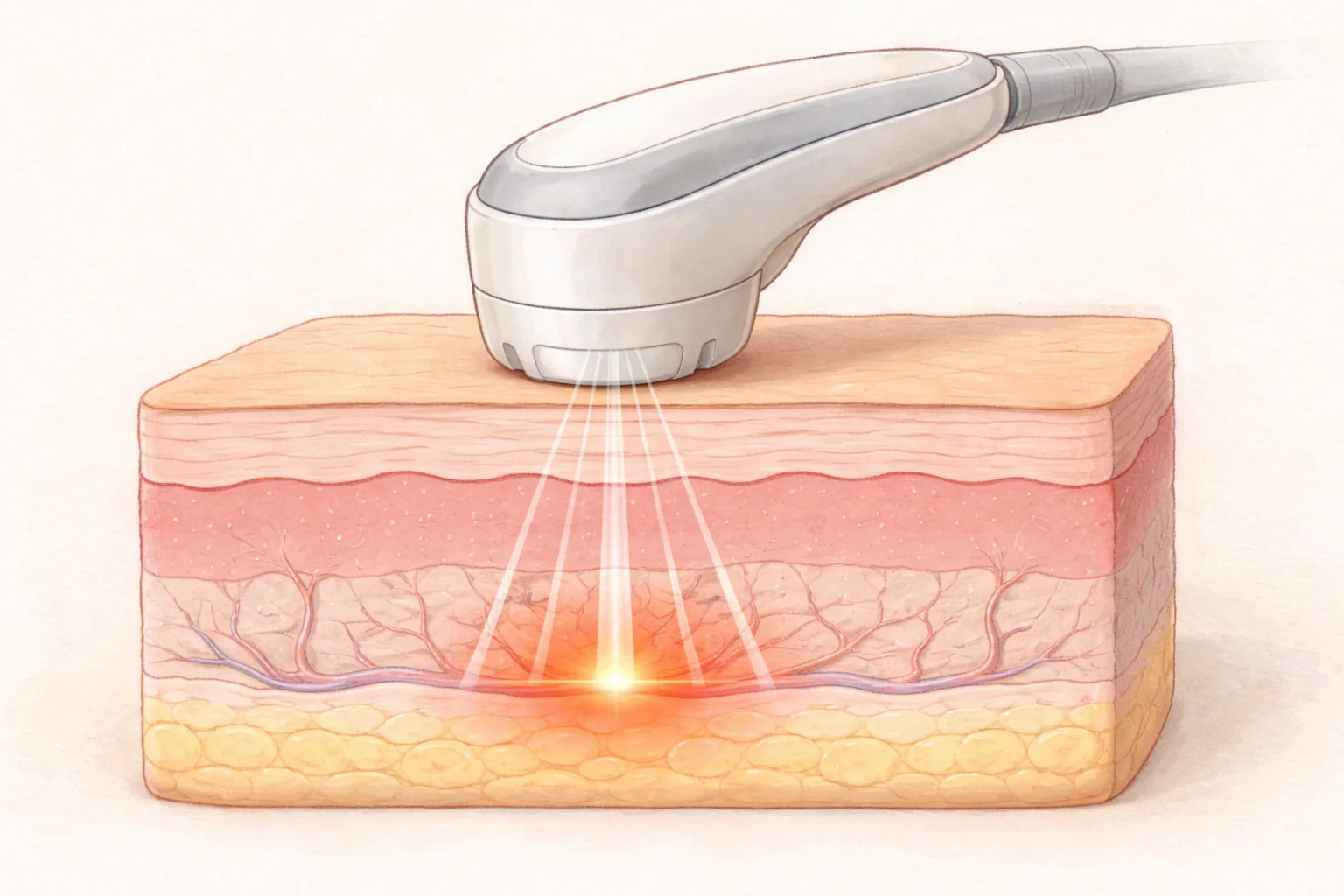
Shurink uses a method medically called HIFU (high-intensity focused ultrasound, the principle of concentrating ultrasound at one point like a magnifying glass). It gathers ultrasound energy at a set depth in the skin to create small thermal points, and this heat is thought to slightly contract collagen (the protein that keeps skin firm) and gradually set off remodeling. The ATTITUDE Clinic column also explains this principle by comparing it to focusing sunlight through a magnifying glass onto one point.
The target layers are the dermis and the deeper SMAS layer. The SMAS layer is a thin sheet that supports the facial muscles and skin, often compared to the lining inside a garment. Because stretching of this sheet with age is considered one of the main causes of sagging, the key to lifting treatments is how accurately heat is delivered to this layer. Shurink uses different cartridges with different depths to treat step by step from the dermis to the SMAS.
One point worth noting here: this treatment does not cut tissue or pull it tight immediately. It delivers heat stimulation and then waits for the body to rebuild collagen on its own, so the timeline for seeing results follows that process.
When do results start to show?
According to the ATTITUDE Clinic column, Shurink is unlikely to feel dramatically different right after the session, and if there is a change, it usually appears gradually over about 2–3 months. This is not because the treatment went wrong, but because rebuilding collagen takes time. The American Academy of Dermatology (AAD) guide to skin firming treatments also explains that because collagen takes time to form, results appear gradually, and the best results are often seen at around 6 months. This guide covers firming treatments in general rather than one specific device, but it helps explain why you will not see results immediately.
This is also why the tightness or firmness you feel in the mirror right after a session can be mistaken for results. That sensation may include swelling or temporary tissue tension, and once the swelling goes down, you may even look more deflated. On the other hand, when people around you say "your face looks a bit different lately" a few months later, that is closer to the point where the real change has settled in.
To lay out the flow: right after the session there is little or no visible change; over 1–2 weeks the heat sensation and swelling subside; from about 2–3 months the change gradually builds. How long that change stays then varies again from person to person.
What determines how long results last?
Why results differ even after the same treatment can be divided into three broad areas. The ATTITUDE Clinic column points to skin type, skin thickness and structure, and the regeneration speed at which collagen is newly produced. Because the speed and amount of collagen synthesis differ with age, lifestyle habits and hormonal status, both when results appear and how long they stay differ too.
There are also treatment-side variables. How much elasticity loss there is in the SMAS layer, how the energy level and number of shots are set, and how much sun exposure you normally get all affect how long results last. A case needing strong energy because sagging is deep and a case using lower energy for prevention are different plans even under the same treatment name. That is why Shurink is better approached as care that is designed individually rather than a one-off event.
On firming treatments in general, the AAD guide mentions that results may last longer when consistent skin care is added. It is not a figure guaranteeing the duration of a specific device; read it as meaning that care after treatment affects the outcome.
How many months apart should sessions be?
In the ATTITUDE Clinic column, the repeat interval is given as roughly around 1 year, decided by the doctor after reviewing your progress. This means not everyone follows the same schedule: the next point is set after checking your progress and degree of sagging at 2–3 months. Because the number of sessions and the interval needed differ with skin condition, it is usual to set an individual plan at the first consultation.
So how is the interval decided? Shortening the interval does not lead to a stronger result. Heat stimulation needs recovery time to accumulate, and judging before the collagen remodeling process finishes means you are assessing the real change too early. The right order is to set the next visit after reviewing your progress.
Even within the same ultrasound family, results feel different depending on where and how much energy is delivered. Putting Shurink, Ultherapy and the broadly heating radiofrequency family side by side makes the differences clearer.
Table 1 How many months apart should sessions be?
Treatment
What it does inside the skin
Concerns it suits
How it feels over time
Shurink (HIFU)
Small thermal points at set depths from dermis to SMAS by cartridge
Deep sagging, jawline contour care
Little visible change; if there is a change, gradual over about 2–3 months
Ultherapy (HIFU)
Thermal points at set depths in the same ultrasound family
Areas sagging deeply in a localized spot
Same flow as Shurink; felt months later rather than right after
Thermage (RF)
Radiofrequency broadly heats from dermis to subcutaneous fat
Elasticity loss over a wide area, skin texture
Initial firm feeling (partly swelling), then further change usually over 2–6 months
Swipe sideways to see the whole table.
The devices ATTITUDE Clinic works with are listed on the treatment guide, where Shurink is listed as a Classys device, Ultherapy as Merz, and Thermage FLX as Solta.
In short Shurink results are not made on the day of treatment but over the following months of collagen remodeling. So when results appear and how long they last are decided together by how fast your skin rebuilds, how much sagging there is, and the energy settings used, and the next session is naturally set after reviewing your progress.
If this sounds like your situation
When a ceremony or photo shoot is a few months away
Because the change appears gradually, if your event is less than two months away, the range you can expect is limited. Given that the change usually builds over about 2–3 months, telling the clinic your schedule first at the consultation lets them separate a plan that can fit within it from one that would be rushed.
When you want to maintain your contour with ongoing care
If sagging is not yet pronounced and you are at the stage of maintaining a contour you have already established, it fits better to set intervals while watching your progress than to go in strongly all at once. Base the repeat interval on roughly around 1 year, while also watching how your skin changes in between.
When your skin is sensitive or tends to redden
Sensitive skin can react more strongly even to the same energy. Letting the clinic know about your usual redness or reactions to irritation at the consultation helps them judge how to adjust the energy level and areas.
When you are an overseas visitor on a short stay
If your stay is short, it is hard to experience all of the 1–2 weeks during which the heat sensation and swelling subside right after treatment and the 2–3 months during which the change builds. Still, the treatment itself involves no incision, so returning to daily life tends to be quick; it helps to decide at the consultation how you will check your progress after returning home.
Before your consultation, please let us know your recent sun exposure or travel schedule, any medications you take and active ingredients you apply to your skin (retinol, acids, and so on), your reactions and records from previous lifting or laser treatments, and any fixed dates such as a ceremony or photo shoot. For previous treatments, records including the device, number of shots, product and dosage, and dates help with the assessment.
How ATTITUDE Clinic proceeds
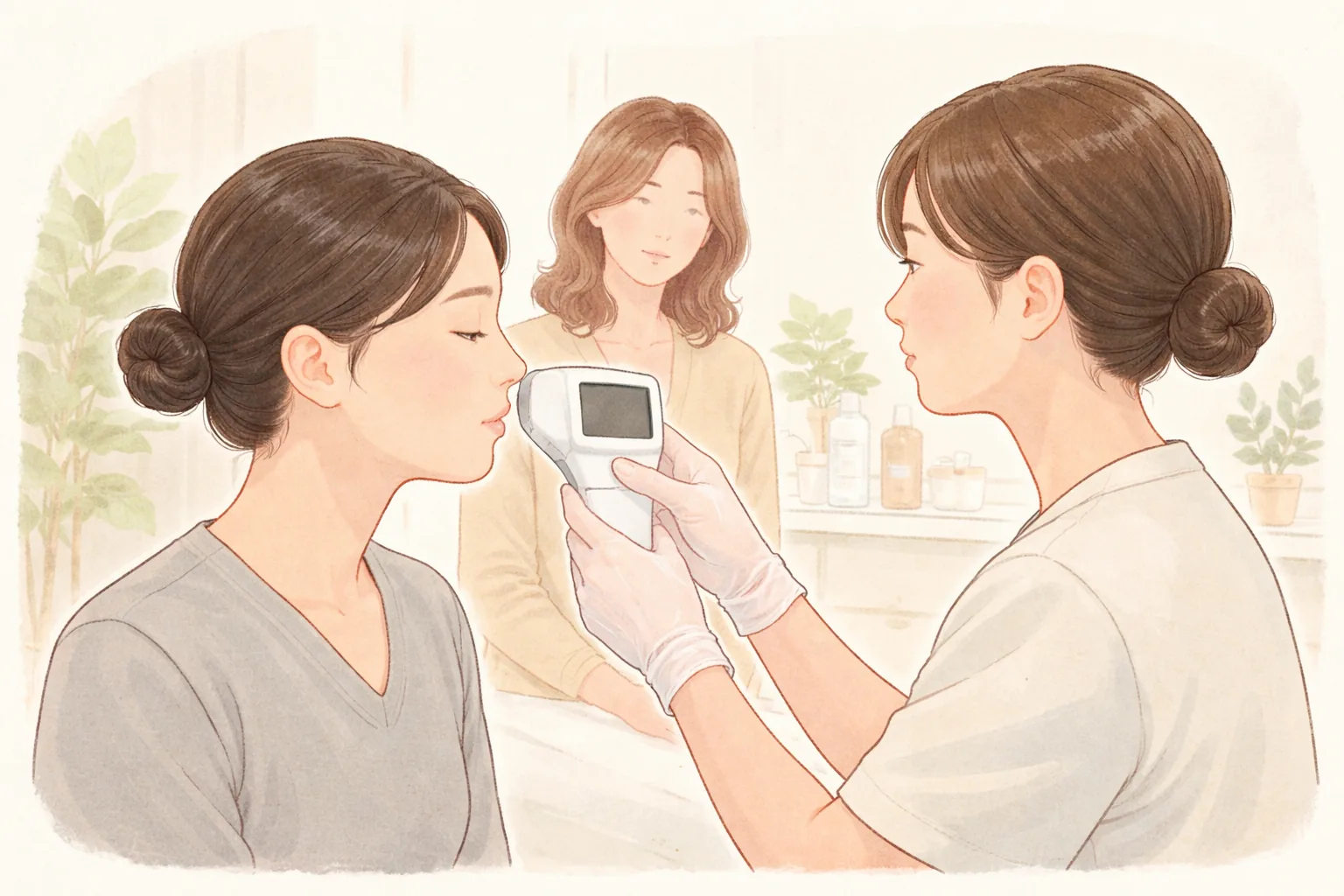
AI skin analysis record: We record and organize your skin condition so that you and the doctor look at the same information together. The analysis tool only records and organizes information and does not make a medical diagnosis; the doctor makes the judgment.
Doctor consultation: We add your concerns, lifestyle habits and previous treatment experience to the analysis record to decide together which devices to use, in what order and at what intensity. How much sagging there is, how much downtime you can allow, and how sensitive your skin is are all reflected here.
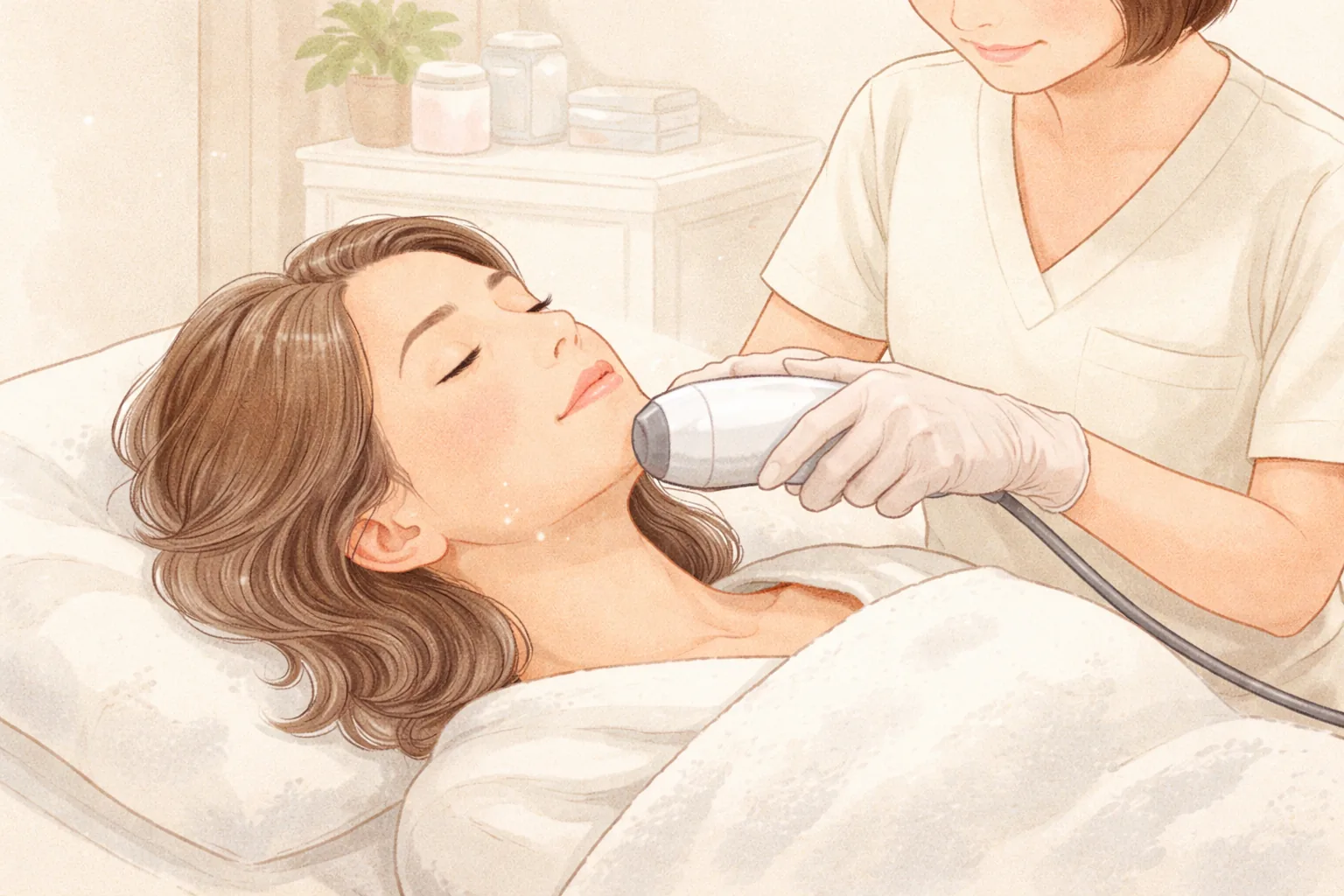
Treatment performed by the doctor: The doctor personally performs the treatment according to the plan set at the consultation, adjusting intensity based on your skin's response during the session. This flow is meant to keep the plan and the execution aligned.
Progress check and next plan: We review your progress after treatment and set the timing of your next visit. Base the repeat interval on roughly around 1 year, though it differs with skin condition.
Devices offered for this topic include the ultrasound family such as Shurink and Ultherapy, and the radiofrequency family such as Thermage FLX. Which family suits you depends on whether the sagging is deep or whether elasticity loss is over a wide area, and the two families are sometimes used in combination.
Aftercare and side effects
Soothing: Heat sensation and redness may remain right after treatment, so let the skin rest without irritating it. It is better to avoid saunas, strenuous exercise and alcohol on the day.
Moisturizing: Skin that has received heat stimulation tends to dry out, so keep up moisturizing. Hold off for a while on irritating care such as exfoliation.
Sun protection: During this period the skin's barrier is temporarily weaker, so being more thorough than usual with sun protection helps you recover without pigmentation.
Progress check: Watch how the swelling and heat sensation subside, and if there is any change different from what you expected, check in without waiting for your next appointment.
Common reactions include temporary redness, swelling, small bruises, and temporary numbness or reduced sensation, which usually subside within a few days. Rarely, burns or blisters, small scars, temporary facial muscle weakness, and unwanted fat layer volume loss can occur, which is why setting the energy level and treatment depth accurately matters. If you notice symptoms different from what you expected, such as blisters or pain that keeps worsening, it is safest to seek care right away.
Frequently asked questions
Exactly when do Shurink results start to be felt?
It is hard to feel much of a difference right after the session, and if there is a change, it usually appears gradually over about 2–3 months. This is because rebuilding collagen takes that long, and the American Academy of Dermatology guide also says the best results are often seen at around 6 months. That said, this is a general description of firming treatments overall, so when you feel it can shift earlier or later depending on your skin thickness and regeneration speed. If it is hard to judge in between, checking your progress together at the 2–3 month point helps.
How many months apart should Shurink sessions be?
Base the repeat interval on roughly around 1 year, with the doctor deciding after reviewing your progress. Not everyone follows the same schedule; it differs with the degree of sagging and your skin's response. Shortening the interval does not make the result stronger, and overlapping the next session before collagen remodeling has finished can actually blur your assessment.
Is one session enough to see results?
A single session can produce a change, but how much and how long it lasts varies with skin condition. Because it is felt months later rather than right after treatment, it is more accurate to check your progress at 2–3 months and then plan the next step rather than judging immediately after one session. The number of sessions needed and the interval are set individually at the first consultation.
Is Shurink very painful?
The higher the energy level and the more shots delivered to one area, the greater the discomfort. Areas close to bone with dense nerves, such as the jawline or forehead, tend to feel more sensitive, while areas with thicker tissue such as the cheeks tend to feel less even at the same energy. Right after treatment, heat sensation and fine redness may remain and mostly fade on their own, and if you are sensitive to pain, you can decide on a numbing method together at the consultation.
How do I choose a good place for Shurink?
What the clinic checks at the consultation matters more than the device name. Ask how they diagnose the degree of sagging and skin thickness, on what basis they set the energy level and number of shots, and how they check progress before and after treatment. Whether the same person handles the consultation and the treatment, and whether they review previous treatment records, also helps you judge. If you are offered a fixed package, it is better to check together why each item is needed and what could be left out.
At a glance
Table 2 At a glance
Item
Key point
Mechanism
HIFU creates small thermal points at set depths from dermis to SMAS and waits for collagen remodeling
When results appear
Little visible change right after; if there is a change, gradual over about 2–3 months
How long results last
Varies widely between individuals; set by degree of sagging, regeneration speed and energy level together
Repeat interval
Based on roughly around 1 year, decided after reviewing progress
Pain and recovery
Varies with energy level and nerve density by area; redness and heat sensation usually ease within a few days
What shapes the result
Skin type, thickness and regeneration speed, treatment settings, and care after treatment
This article offers general health information. It is not a substitute for diagnosis or treatment based on your own condition, so please talk through your situation with a doctor.