Density Consultation: What to Check on Devices and Tips
What to ask at an RF lifting consultation: which device and tip, the goal of treatment, when results are assessed, cost and session counts, and who to contact during recovery.
Written by ATTITUDE Clinic Editorial Team
You book an RF lifting consultation and then realize you have no idea what to ask first. Device names, shot counts, and prices are easy to spot, but the conditions that shape your result only come out once you are sitting in the consultation. This article walks through what to check at an RF lifting consultation, in order, and adds the follow-up questions to ask when an answer sounds vague.
The short answer first
RF lifting places a device against the skin and heats the tissue underneath. So what should a consultation settle first? What to heat, and how much. How deep the energy reaches, what determines the tip and the intensity, when and by which measures results will be assessed, what the cost includes and what it leaves out, and where to contact the clinic and when to come back if something seems off during recovery — these 5 points are the backbone of the consultation. Shot count is only a unit for counting how much energy was delivered, not a number that guarantees an outcome, and the same settings can feel different depending on skin thickness, fat layer, and how quickly you recover. The American Academy of Dermatology advises asking at a cosmetic consultation about indications and risks, benefits and alternatives, realistically expected results, the number of sessions needed and how long they take, recovery and return to daily life, preparation and aftercare, and cost (AAD consultation guide).
What does RF actually do beneath the skin?
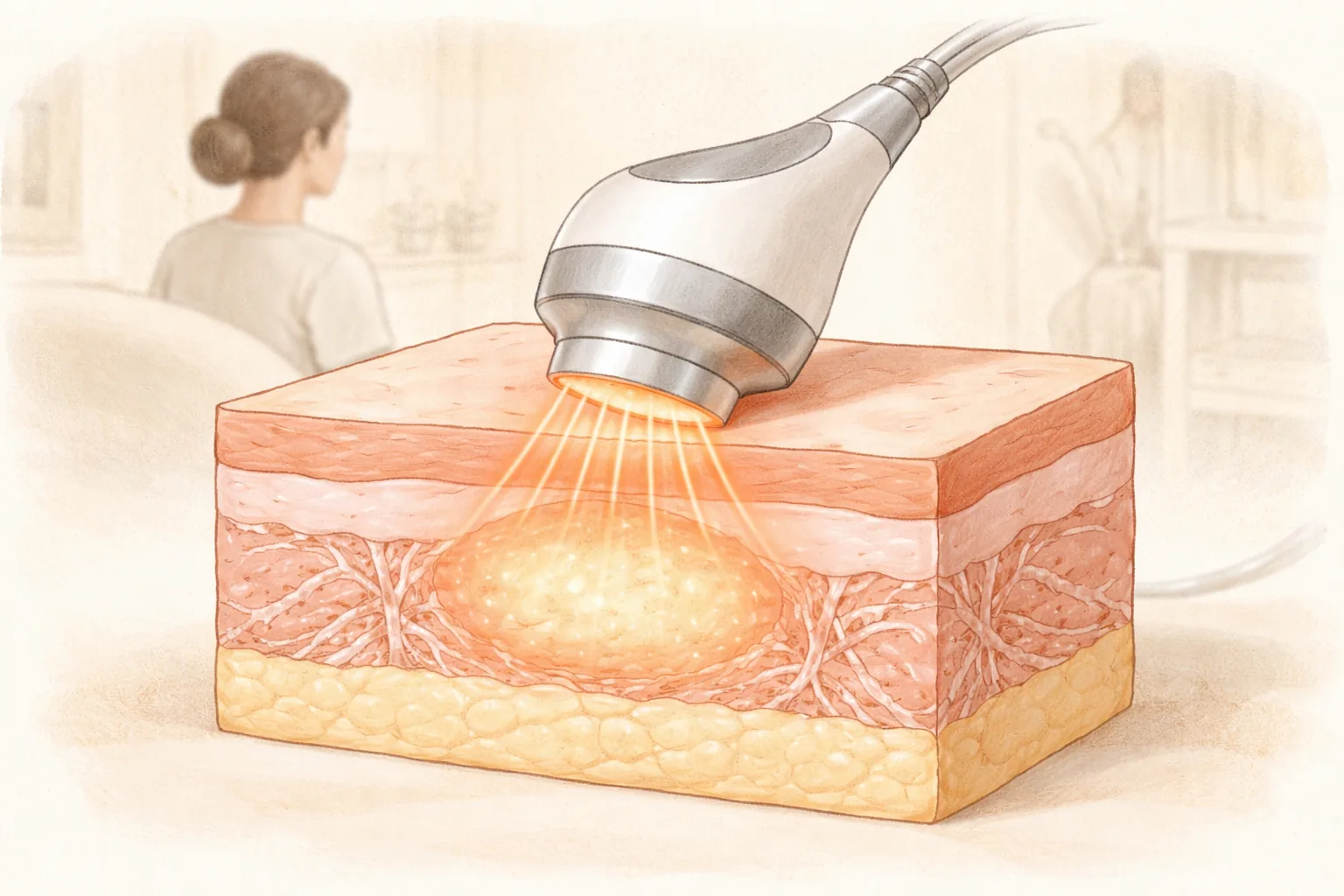
When a device using radiofrequency (RF, electrical current energy, also called radio waves) is pressed against the skin, the current passes through the skin and heats the tissue below (AAD guide to firming sagging skin). That heat stimulates collagen production, and the body takes time to build new collagen. So thickness or redness right after treatment is a reaction, not a result, and the real change appears gradually over months. With non-invasive treatment (meaning the skin is not cut or punctured), redness and swelling are usually the only visible marks.
A common misconception is that "RF burns the skin." It does use heat, but intensity and time are adjusted so the heat concentrates only in the targeted layer. The same heat is treatment when it is narrow and precise, and a burden when it spreads. HIFU, which focuses ultrasound on deeper layers, and lasers that target only specific goals can be understood in the same way. Whichever approach is used, the plan differs depending on whether your concern comes from sagging or from overall skin firmness.
A cream you apply at home can hardly lift sagging skin. A moisturizer can fill the stratum corneum and briefly make fine lines less visible, but addressing sagging itself requires energy that reaches beneath the skin.
What determines the tip, shot count, and intensity?
The tip is the contact surface the energy comes out of. A larger area covers more at once, while a smaller one handles contoured areas like around the eyes or mouth with more precision. Some devices use tips of different strengths, and which tip and intensity to use is decided by looking at the area's size, skin thickness, and target depth together. Even with the same device, a different tip setup changes what you feel and how you recover, so hearing the actual tip name and the reason for choosing it at the consultation helps you understand the plan.
Shot count is a unit for counting how many times energy was delivered. On the ATTITUDE Clinic price list, lifting items are divided by shot count or by energy units such as kJ, and all amounts are shown with VAT excluded (treatments and pricing). A higher number can cover a larger area, but if energy overlaps in the same spot, it becomes similar to raising the intensity. An ATTITUDE Clinic column also notes that for energy-based treatments, the intensity and spacing suited to your skin condition shape the result (lasers and skin burden). So the question to ask at the consultation is not "how many shots" but "why this much for this area."
Lifting and skin boosters have different goals. PN and HA skin boosters work by inducing collagen production for hydration and skin texture (collagen injection column), while RF lifting heats tissue beneath the skin. Whether to do them on the same day or spaced a few days apart is decided at the consultation based on recovery burden and priorities.
Here is how the devices ATTITUDE Clinic uses for RF and ultrasound lifting consultations compare.
Table 1 What determines the tip, shot count, and intensity?
Category
Energy method
Concerns it suits
What to check at the consultation
Thermage FLX
Monopolar RF heats beneath the skin
Overall facial firmness and contour
Shot count and intensity, whether the eye area is included
XERF
Lifting using RF current
Firmness loss by area
How energy is distributed by area, pain control method
Ultherapy·Shurink Universe
Ultrasound focused on deeper layers
Concerns with noticeable sagging
Depth and shot count, whether the jawline and neck are included
Potenza
RF delivered directly to the dermis via fine needles
Pores and scars
Needle depth and areas, recovery period
Swipe sideways to see the whole table.
In short
The tip represents area and location, and shot count is a unit representing how much energy is delivered. More is not better — the standard is whether it is what your skin needs, and once you decide which concern to address at which layer, the tip and intensity follow.
When do results show, and how do you check them?
With non-invasive RF treatment, most people feel a slight firmness right after 1 session, and because the body takes time to make collagen, the best results appear at around 6 months. For some, additional sessions help, and results can be maintained for 2–3 years with proper skin care (AAD guide to firming sagging skin). This describes RF methods in general, and individual results and how long they last vary with skin condition and care.
When assessing results, matching the comparison conditions helps. Take photos under the same lighting, from the same angle, with the same expression, and at the same time of day to account for morning and evening swelling differences. Rather than asking only about satisfaction, breaking it down into things you can see — jawline definition, shadows around the nasolabial area, skin texture — makes it easier to tell where any change came from. The timing of a repeat session is decided at the consultation based on these comparison records and your skin condition.
Expectations are adjusted too. Skin firming treatments do not produce results equal to surgical lifting, and if sagging is advanced they may not help much (AAD guide to firming sagging skin). Reviewing before-and-after photos in person at the consultation helps set expectations realistically.
How do you check pain and safety at a consultation?
Non-invasive treatments can be uncomfortable during the session, but it usually ends there, and redness and swelling are common afterward. Pain varies with intensity, area, and individual sensitivity, so asking whether numbing is used and by what method makes planning easier. If something feels unbearable during the session, you can say so right away and the intensity can be adjusted.
Suitability depends on your health status. It is safer not to proceed if you are pregnant, have a skin infection at the treatment area, or take certain medications, and firming treatments are unlikely to be the answer when sagging is advanced. Conversely, results tend to be better if your weight is stable, you do not smoke, you use sun protection well, and sagging is mild (AAD guide to firming sagging skin).
You can ask the practitioner about their experience specifically. Those questions include how many times they have performed this treatment, how many patients with your skin tone and age group they have treated, what results you can realistically expect, and whether you can see before-and-after photos (AAD consultation guide). Qualification systems differ by country, so in Korea the standard is to verify directly whether the practitioner conducting the consultation is a specialist and what their experience is.
If this sounds like your situation
If a ceremony or a shoot is coming up
Redness and heat right after treatment are a problem if they clash with your schedule. Counting backward from the date and starting with buffer time gives you more options for adjusting intensity and timing. Telling the clinic your ceremony date and shoot schedule at the consultation changes the plan.
If you want steady, ongoing care
Planning around recovery intervals rather than going strong all at once is easier on the skin. Splitting target areas into an order and agreeing on assessment points in advance makes it easier to change direction midway.
If your skin is thin or sensitive
Starting at a lower intensity and increasing it based on your response is safer. If redness lingers or cosmetics sting more than usual, describing that state as it is at the consultation gives a basis for adjusting settings.
If you are an overseas visitor on a short stay
If your stay is fixed, redness or dryness right after treatment can affect your plans. Telling the clinic your return date and next commitments in advance lets intensity and treatment type be adjusted accordingly at the consultation. It is also worth asking for a contact channel in case you need to check something after returning home.
Tell us before your consultation
Let us know whether you have had a lot of recent sun exposure, medications you take and skincare products you use (including retinoids or exfoliating ingredients), whether you are pregnant or breastfeeding, any inflammation or wound at the treatment area, any experience of sensitive skin after a previous treatment, commitments you absolutely cannot miss, and how sensitive you are to pain. Even for the same treatment, timing and settings differ based on this information.
How ATTITUDE Clinic handles this
AI skin analysis record — Current skin condition, including pigmentation, redness, texture, and pores, is recorded with an analysis tool. This record organizes information to support the consultation and is not a medical diagnosis.
Direction set in a doctor consultation — Your schedule, pain sensitivity, and skin history are added to the analysis record to decide the treatment type, intensity, and timing together. Which layer to treat and to what degree is agreed here.
Treatment performed by the doctor — Topical numbing is used as needed to reduce discomfort, and the doctor performs the treatment personally. ATTITUDE Clinic's principle is not to recommend more treatment than necessary, and guidance is based on genuine products, accurate dosing, and set prices.
Recovery and aftercare guidance — You are told what to watch for after treatment and when to check in again. A booking request is not a confirmation; it is confirmed after the clinic contacts you (consultation and booking).
Devices covered in lifting consultations include Thermage FLX with monopolar RF, XERF for RF lifting, Ultherapy and Shurink Universe using ultrasound, Potenza for microneedle RF, Onda for microwave lifting, and Titanium with 3-wavelength laser (treatments and pricing). Which combination suits you is decided at the consultation based on your skin condition and concerns.
Aftercare and side effects
Calming — On the day of treatment, focus on bringing down heat and redness. It is best to avoid saunas, hot compresses, alcohol, and strenuous exercise for the period you are advised.
Moisturizing — Skin is temporarily sensitive after treatment. Apply the gentle moisturizer you normally use frequently to reduce flaking and tightness.
Sun protection — Areas treated with heat can become more sensitive to UV. Apply sunscreen before going out and reapply during time outdoors.
Checking progress — At the planned point, compare photos taken under the same conditions. If redness or heat lasts longer than expected or pain worsens, do not tough it out — come in to have it checked (lasers and skin burden).
After non-invasive treatment, redness and swelling are usually the entirety of the visible reaction (AAD guide to firming sagging skin). Still, all medical treatments carry risk, so the accurate way to learn about uncommon reactions and how to respond is to hear it explained for the specific treatment planned at your consultation (AAD consultation guide). During recovery, also avoid strong exfoliation and irritating scrubs.
Frequently asked questions
How do Density, Thermage, XERF, and Ultherapy differ?
Broadly, they split into RF and ultrasound. RF places a device against the skin and heats the tissue below, while ultrasound focuses heat on deeper layers (AAD guide to firming sagging skin). Thermage FLX and XERF are in the RF family, while Ultherapy and Shurink Universe are in the ultrasound family. Even within the same family, tip configuration, how intensity is adjusted, and which areas can be treated differ, so it is hard to rank them by name alone. Whether your concern comes from sagging or from overall skin firmness is the starting point for choosing.
Do more shots mean better results?
Shot count is a unit for counting how many times energy was delivered. The amount needed varies with facial area and location, skin thickness, and the intensity used, so a bigger number does not proportionally mean a better result. Energy overlapping in the same spot can create a burden similar to raising the intensity, so intensity and spacing need to be considered together. At a consultation, checking how the total shot count is divided by area and why it was decided that way helps you understand the actual plan.
I heard tips differ in strength — what should the choice be based on?
The tip is the contact surface the energy comes out of, so area and strength differ. A larger tip covers the whole face quickly, while a smaller one suits delicate areas like around the eyes or mouth. If pain worries you, ask both whether topical numbing is used and whether you can start at a lower intensity. Which tip fits is decided by looking at the area, skin thickness, and target depth.
When do results appear, and how long do they last?
With non-invasive RF treatment there is a slight firmness right away, and because collagen takes time to build, the best results are said to appear at around 6 months. Some explanations note results can be maintained for 2–3 years with proper skin care, but this describes the method in general, and how long it actually lasts varies with skin condition and lifestyle. So even with the same treatment, when you notice a difference and how long it lasts differ from person to person, and the timing of a repeat session is set by watching your progress.
What should I look at when choosing where to get this consultation and treatment?
First, see whether the clinic identifies which layer your concern comes from. Next, check whether they explain the actual device and tip, the planned shot count and intensity, and whether they avoid recommending more sessions than necessary. Whether you can confirm pain and recovery schedules, aftercare precautions, and what the cost includes in writing at the consultation is another standard (AAD consultation guide). Finally, look at whether there is a channel to have things checked again if you are uncomfortable after treatment.
At a glance
Table 2 At a glance
Item
Key point
How it works
Device is placed against the skin to heat tissue below and stimulate collagen production
When results appear
Slight firmness right away, then gradual change over months as collagen is built
Tip selection
Decided by area size, skin thickness, and target depth
Shot count
A unit for how many times energy was delivered; more does not proportionally mean better
Checking cost
Divided by shot count or kJ units, shown with VAT excluded
Recovery and contact
Redness and swelling are common; if they last long, come in to have it checked
This article offers general health information. It is not a substitute for diagnosis or treatment based on your own condition, so please talk through your situation with a doctor.