Hilo Wave vs Re2O: How Their Ingredients and Purposes Diverge
How Hilo Wave and Re2O differ in what they do in the skin, how to check ingredients and treatment goals during consultation, and aftercare and side effects, based on ATTITUDE Clinic guidance and American Academy of Dermatology resources.
Written by ATTITUDE Clinic Editorial Team
Search for skin boosters and the names Hilo Wave and Re2O almost always come up together. Both are injected into the skin, so the visible process looks similar, and the question "so which one is better" naturally follows. This article lays out, step by step, where the two treatments diverge in what they do inside the skin, and what to check during consultation so you don't get confused.
The conclusion first
The two treatments are good at different things. In ATTITUDE Clinic's treatment guide, Re2O (Elravie Re2O) is described as human-derived acellular dermal matrix (hADM) that directly replenishes structural skin components in the dermis, while Hilo Wave (Hilo Wave) is listed as an injection treatment that delivers ingredients directly into the skin base (treatments and pricing guide). So rather than "which is better," it is far more useful to first decide "what my skin currently lacks." Because Re2O is made from donated human tissue, suitability screening is the starting point of any plan, and for Hilo Wave, it is more accurate to confirm ingredient composition and origin based on the product during consultation.
What do Hilo Wave and Re2O do inside the skin?
"Skin booster" is not a specific product name but closer to an umbrella term for methods that inject ingredients into the skin to lift its condition. In ATTITUDE Clinic's treatment guide as well, Rejuran Healer, Juvelook (PDLLA), Sculptra, Re2O, Hilo Wave, and skin booster ("water glow" injection) are listed side by side under the same injection category (treatments and pricing guide). Within similarly named items, what is actually done varies quite a bit.
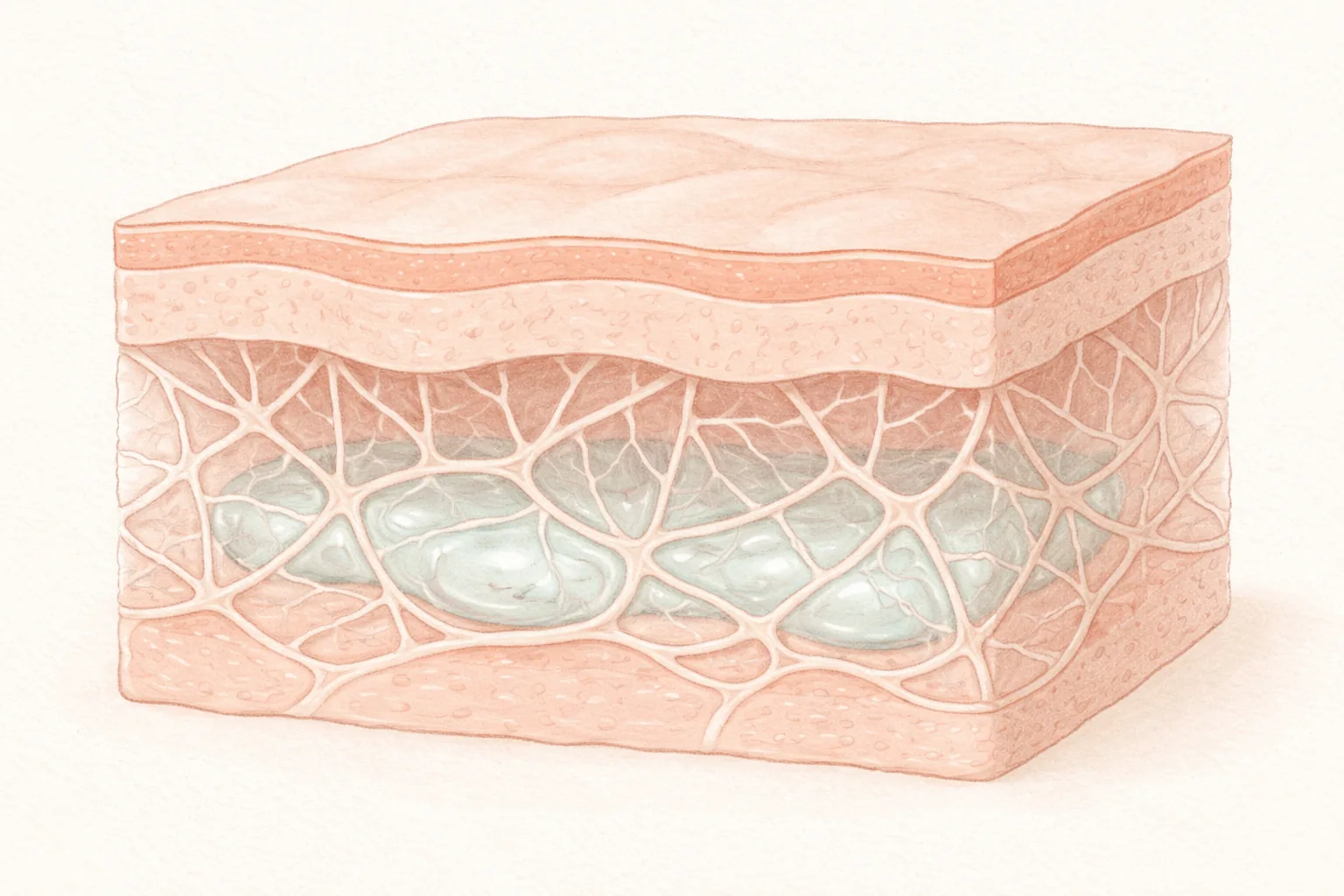
Let's start with Re2O. The dermis has a protein mesh that fills the space between cells, called the extracellular matrix (ECM, a structure comparable to the steel framework that supports the skin). With age, collagen, elastin, and hyaluronic acid—the main materials of this mesh—decrease, and the skin begins to thin and sag. The key ingredient of Re2O, hADM, is made by removing cell components that could cause immune reactions from donated human skin tissue and leaving only these ECM components, so when injected into the dermis it is described as acting as a scaffold and potentially helping new collagen formation (Do collagen injections build up in the skin right away?).
In short, Re2O is closer to "filling in with the materials the skin originally used" rather than "instructing the skin to make collagen." In the ATTITUDE Clinic column as well, PN and HA-based skin boosters are distinguished as inducing collagen production through cell regeneration signals, while Re2O is described as directly replenishing the ECM structure itself in the dermis (Exosomes: does spraying after treatment really work?).
So which side is Hilo Wave on? In the treatment guide, Hilo Wave is an injection treatment listed in 2cc units, placed in the same group as skin booster ("water glow" injection) and PDRN (salmon DNA) injection. Even with the same injection, if what is being filled differs, the plan differs too, so for Hilo Wave, it is more accurate to confirm ingredient composition and origin based on the product during consultation.
Why the question "which is better" misses the mark
Thinking of dermal fillers and skin boosters as one lump increases confusion. The American Academy of Dermatology notes that while fillers are a widely used treatment, they carry risks like any other medical procedure (AAD filler FAQ). If fillers are used to fill volume in a specific area and change shape, the treatments grouped as skin boosters are closer to addressing the condition of the skin itself. In the ATTITUDE Clinic column as well, hyaluronic acid fillers are distinguished as injected ingredients that fill and then degrade over time, while Re2O targets the skin's own texture and elasticity (collagen injection column).
So the question "is Hilo Wave a filler" can only be answered once the purpose is set first. Specifications, injection depth, and classification in guidance can be organized differently depending on the product and clinic, so it is faster to confirm which of your concerns this treatment handles.
What ultimately determines the result
Even with the same product and the same amount, results differ from person to person. First is skin condition. The change produced by the same injection volume differs depending on skin thickness, elasticity, and fat layer thickness by area, and thin areas like around the eyes require more precise control of volume and depth (collagen injection column). Second is purpose. The plan diverges depending on whether the concern is moisture and texture, volume in a sunken area, or the skin thickness itself. Third is aftercare. Basic habits like sun protection and moisturizing affect how long changes last.
Recovery capacity and lifestyle patterns add to this. Even with the same treatment, the speed at which swelling subsides and the period for bruises to fade differ from person to person. These three factors overlap to create the range of results, so deciding based only on an ingredient list can lead to mismatches later.
How to check ingredients and purpose during consultation
The American Academy of Dermatology advises that during cosmetic treatment consultations, it is important to receive information about the indications, risks, benefits, and alternatives of the procedure (AAD consultation checklist). Looking at the two treatments through this framework, what to check comes down to four things.
First, which product it is. Confirm the product name, manufacturer, ingredient composition, and origin. For products derived from human tissue like Re2O, you should inform in advance about autoimmune conditions, history of reactions to tissue-derived products, medications being taken, and pregnancy or breastfeeding status. Second, which of your concerns this treatment handles. Third, how many sessions at what intervals are planned and on what basis. Fourth, recovery period and when you can return to daily life. Recovery periods differ by treatment, and knowing the return point in advance lets you plan your schedule (AAD consultation checklist).
Table 1 How to check ingredients and purpose during consultation
Item
Re2O (Elravie Re2O)
Hilo Wave (Hilo Wave)
What to check in consultation
Classification in guidance
Skin booster injection item, 1 vial
Skin booster injection item, 2cc
How purposes diverge within the same category
What it does in the skin
Directly replenishes ECM in the dermis with human-derived acellular dermal matrix (hADM)
Injection treatment delivering directly into the skin base
Product ingredient composition and origin
Target point
The skin's own texture, elasticity, and thickness
Condition management of the skin base
Which part of my concerns this treatment handles
Common reactions
Redness, stinging, 1–3 days of swelling, bruising, lumpy feeling
Redness and swelling common to injection treatments
Recovery period and return-to-daily-life timing
Swipe sideways to see the whole table.
In summary The two treatments are not competitors but have different roles. Re2O is listed as replenishing the structural component ECM in the dermis, while Hilo Wave is listed as an injection treatment delivering ingredients into the skin base. Which to choose starts not from ingredient names but from what your skin currently lacks.
In these situations
When an important event is a few weeks away
Injection treatments usually allow a return to daily life the same day or the next, but the injection site may look puffy for 1–2 days or bruising may remain. If bruising occurs, it can take 1 week or more to fade, so if you have a date-fixed event like a photo shoot or ceremony, it is better to plan with at least a few weeks of buffer (collagen injection column).
When your skin is thin and prone to redness
If redness tends to last long, an approach that fills in material may be less burdensome than methods that trigger a large inflammatory response. However, products derived from human tissue can cause allergic or foreign body reactions, so it is safer to mention any prior reaction experience first during consultation.
When the concern is skin texture and moisture rather than sunken volume
If the cheeks are noticeably sunken, a volume-filling treatment comes first, and if the concern is dull skin and makeup not sitting well, an injection treatment addressing the skin base is considered first. If both concerns overlap, approach step by step with a set order rather than deciding all at once.
For short-stay international visitors
If you have little time to observe the course after treatment, it is better to avoid treatments with long recovery periods or long-lasting reactions. Allow at least a few days of buffer rather than the day before departure, and decide in advance how you would contact the clinic if a problem arises after returning home.
Please tell us before consultation
Recent sun exposure, travel, and outdoor activity schedule
Medications being taken (including blood thinners) and active ingredients applied to the skin
Experience of prolonged redness or swelling from previous treatments, history of allergic reactions
Autoimmune conditions, pregnancy or breastfeeding status
Date-fixed events such as photo shoots or ceremonies
How ATTITUDE Clinic proceeds
AI skin analysis records — Information such as skin thickness and texture, and the distribution of pigment and facial redness / rosacea is recorded and organized with a device. These records assist consultation and do not replace medical diagnosis. Because the same area can be compared over time, they provide a basis when discussing changes.
Doctor consultation — Sitting with the records, we discuss what your skin currently lacks and which treatment will handle that part. Whether Re2O or Hilo Wave is right, and if planning them together, what order and interval to set, is decided here. The products and ingredients used, expected reactions, and recovery period are also explained at this point.
Treatment by the doctor directly — Injection depth, volume, and area are decided by the doctor who has seen your skin. For products derived from human tissue like Re2O, suitability screening comes first, so your medical history is directly reflected in the plan.
Recovery and management — We explain what to observe right after treatment and when to check progress. We also decide together where to contact if an adverse reaction occurs.
The products used for this topic are Re2O (Elravie Re2O) and Hilo Wave (Hilo Wave), listed in the treatment guide. Costs are listed on the guide page as regular and discounted prices, and all amounts exclude VAT (treatments and pricing guide).
Aftercare and side effects
Soothing — Do not press hard or massage the injection site right after treatment. Applying physical stimulation before hADM settles in the dermis can lead to uneven distribution. Avoid intense exercise, drinking, and saunas on the same day.
Cleansing and moisturizing — Wash your face gently starting 4–6 hours after treatment, and makeup is possible from the next day. Manage dryness with your usual moisturizer.
Sun protection — Apply sunscreen carefully throughout the recovery period. Sun exposure also affects how long changes last.
Progress check — A lumpy feeling at the injection site may persist while the product settles. If this feeling continues, or swelling, pain, or heat does not subside, do not wait—notify the clinic (collagen injection column).
Common reactions are redness and stinging, swelling, tenderness when pressed, and bruising. Redness and stinging usually subside within hours to the same day, swelling within 1–3 days, and if bruising occurs, it can take 1 week or more to fade. More rarely, infection, allergic reactions or foreign body reactions, and small lumps (nodules) can occur.
Although rare, injected product can block or damage blood vessels. If you have pain that is different from usual or progressively worsening, if the skin at the injection site turns white or mottled, bluish-gray or black, or if there is any change in vision, do not wait—seek medical care immediately. These signals are not something to observe over time.
Frequently asked questions
During a Re2O or Hilo Wave consultation, how do I check ingredients and treatment purpose?
First confirm the product name, manufacturer, ingredient composition, and origin. Re2O is an hADM-based product made by removing cell components from donated human skin tissue, and before treatment you should inform about autoimmune conditions, history of reactions to tissue-derived products, medications being taken, and pregnancy or breastfeeding status. Purpose is confirmed by "which of my concerns this treatment handles." The answer differs depending on whether it is skin texture and elasticity, volume, or moisture. Asking how many sessions are planned at what intervals also makes the plan much clearer.
Is Hilo Wave a filler?
In ATTITUDE Clinic's treatment guide, Hilo Wave is listed under the same injection category as Rejuran Healer, Juvelook (PDLLA), and Re2O (treatments and pricing guide). Fillers are used to fill volume in a specific area and change shape, with injected ingredients degrading over time. On the other hand, treatments grouped as skin boosters are closer to addressing the skin's own condition. Even with the same needle, what is being targeted differs, so it is more accurate to confirm the role this treatment plays during consultation rather than relying on category names.
When can I see effects?
With Re2O, some of the plumpness right after injection subsides over several days as swelling, and any change appears gradually over several weeks. The immediate plumpness and the later change are different phenomena, so view them separately in time order. The degree and timing vary greatly depending on skin condition. For injection treatments overall, including Hilo Wave, the onset and duration of effects also vary with individual skin condition and lifestyle, so it is most accurate to receive guidance based on your skin during consultation.
What are the side effects?
The most common are redness and stinging at the injection site, swelling, and bruising. They usually subside within a few days. Rarely, infection, allergic reactions, foreign body reactions, and small lumps can occur, and for products derived from human tissue, suitability screening comes first. If the skin color at the injection site turns white or bluish-gray, or if vision changes accompany it, seek medical care immediately.
What should I look for when choosing a clinic?
The American Academy of Dermatology notes that treatment results depend heavily on the practitioner's technique and experience, and recommends receiving explanations of indications, risks, benefits, and alternatives along with the practitioner's experience during consultation (AAD consultation checklist). Practical criteria include whether the clinic builds a plan based on evidence from your skin condition, discloses which products and ingredients are used, and specifically explains recovery periods and how adverse reactions are handled. Clinics that give different answers tailored to your skin thickness and concerns stand out more than those that repeat the same explanation to everyone.
At a glance
Table 2 At a glance
Item
Key point
Where the two treatments diverge
Re2O replenishes ECM; Hilo Wave is an injection treatment delivering into the skin base
This article offers general health information. It is not a substitute for diagnosis or treatment based on your own condition, so please talk through your situation with a doctor.