Pico Laser Aftercare: Washing and Makeup Around a Short Seoul Trip
Planning a pico laser treatment during a short stay in Korea? Learn how to time your sessions, washing and makeup around your return flight and recovery.
Written by ATTITUDE Clinic Editorial Team
Many people wonder whether they can get a laser treatment during a short stay in Korea and fly home safely, or whether redness will linger before a photo shoot or interview back home. When your schedule is fixed, your departure date and recovery time matter more than the laser's name. Even with the same laser, recovery varies by power and treatment area, and the timing for washing and makeup changes accordingly.
The short answer
For a short visit, the recovery window counted backward from your departure date determines your treatment choice. Pico toning with low power is an option when your schedule is tight, while high-power pigment lasers or fractional lasers that cause crusting or swelling should be planned with at least 1 week of recovery. Washing and makeup timing varies by treatment type and power, so it is safer to tell the clinic your dates and set specific days on the spot. Recovery varies with skin condition and treatment area, so the guidelines below are a starting point for planning.
Why does recovery time come first on a short stay?
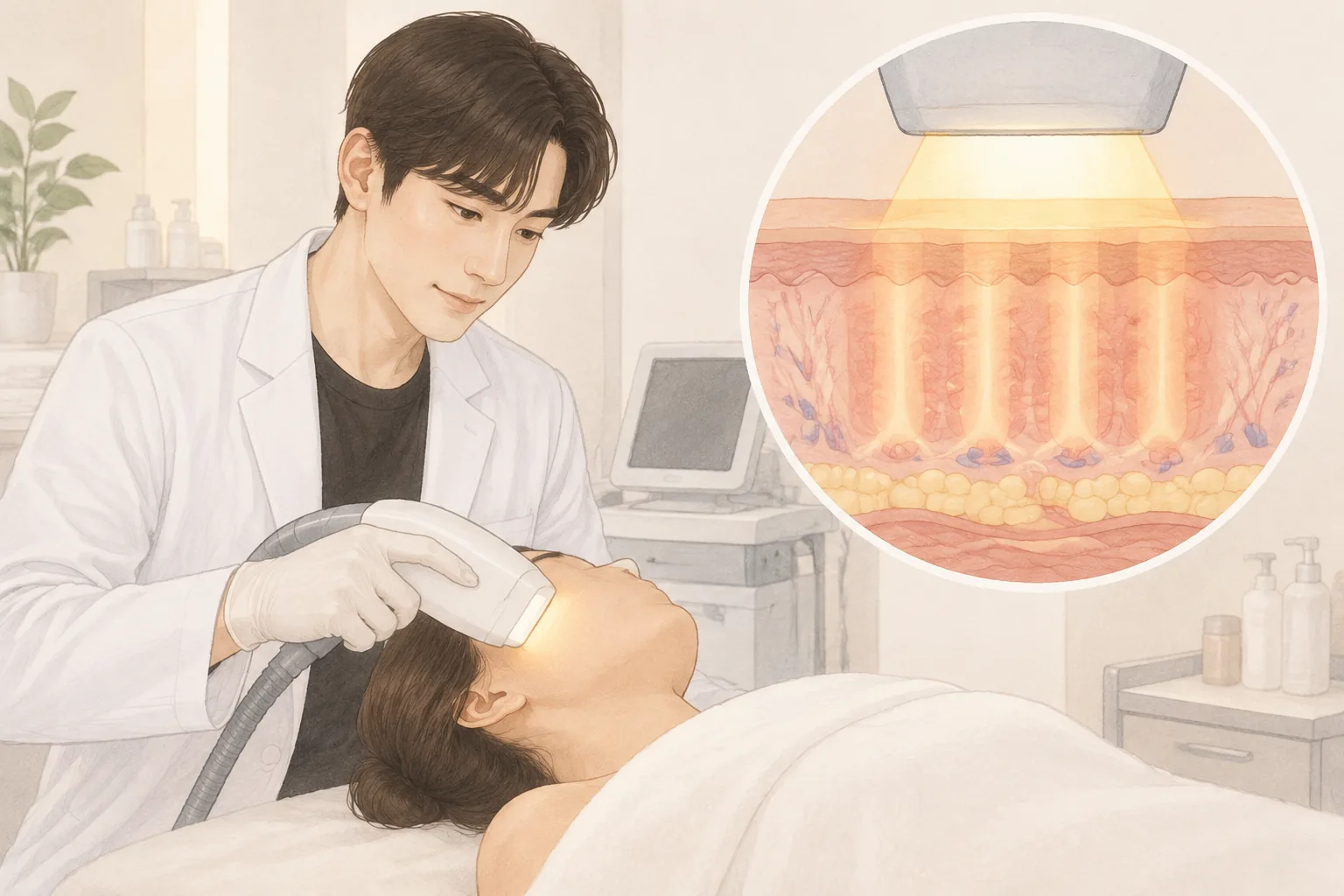
A laser is light energy concentrated at a single wavelength. When it reaches the skin, it is absorbed by targets that respond to that wavelength and converted into heat or impact. This principle is called selective photothermolysis (targeting the target while sparing surrounding tissue). ATTITUDE Clinic's column describes lasers as light that targets different structures depending on wavelength. That is why light aimed at pigment differs from light aimed at blood vessels.
Fractional lasers do not remove the entire skin surface at once; they create thousands of microscopic treatment zones (MTZ, tiny column-shaped points of stimulation the laser makes in the skin). The stimulated zones trigger collagen remodeling, while the healthy tissue between them aids recovery. DermNet's explanation of fractional laser treatment describes this approach as faster to recover than treating the entire area.
So why can one person wear makeup the next day after the same laser while another has crusts for over a week? Wavelength, energy, treatment density, treatment area and skin condition all affect recovery. According to Cleveland Clinic, healing time after laser resurfacing ranges from 5–21 days depending on the condition treated and the laser type. Even within resurfacing, CO2 is listed at up to 2 weeks and erbium and fractional at about 1 week.
It is easy to think one laser session gives immediate results, but pigment lasers need time for the body to clear fragmented pigment, and fractional lasers need time for new collagen to settle. DermNet notes that with Fraxel, 4–5 sessions may be needed at one-month intervals, with results appearing gradually over 3–4 months. On a short stay, matching your departure date and recovery time before choosing a treatment name is the starting point of your plan.
Why does recovery vary from one laser to another?
Pigment treatments use wavelengths that melanin (the pigment that gives skin its color) absorbs well. Redness treatments use wavelengths absorbed by oxygen-carrying hemoglobin. For concerns like pores and scars where skin structure has changed, fractional lasers that create microscopic stimulation in the epidermis and dermis are mainly used. ATTITUDE Clinic's laser column explains these differences by pigment, blood vessels and skin structure.
Looking at the lasers used at ATTITUDE Clinic by target, PicoPlus targets pigment, Vbeam targets shallow blood vessels, and Erbium YAG laser targets the skin surface and texture. Even on the same face, spots, redness and rough texture have different causes, so one device cannot solve everything. Recovery also varies by power and area, so it is hard to judge whether a treatment fits your schedule from the device name alone.
Table 1 Why does recovery vary from one laser to another?
Laser
Target
Concerns it suits
Recovery range
PicoPlus
Pigment
Spots, melasma
Same day to 7–10 days depending on power
Vbeam
Blood vessels
Redness, rosacea
Redness and swelling for a few days, bruising for 1–2 weeks
Erbium YAG laser
Skin surface
Texture, around pores, shallow scar texture
A few days to 1 week
Fractional laser
Epidermis and dermis structure
Pores, scars, skin texture
Low power 3–5 days, high power 7–14 days
Swipe sideways to see the whole table.
In summary even with the same laser, recovery varies by target and power. The shorter your stay, the more realistic it is to first identify whether your concern comes from pigment, blood vessels or the surface, and start with the treatment that has the shortest recovery.
When can I start washing and wearing makeup?
It is hard to set a single date for washing and makeup after laser. Even the same fractional laser resource notes that shaving or mineral makeup may be possible soon after treatment and most people can return to daily life the next day, but this refers to non-aggressive fractional treatment. DermNet notes that recovery varies between people and with treatment intensity.
After resurfacing that removes the epidermis, care differs while the skin covers the wound itself. Cleveland Clinic advises a non-adhesive dressing for 24 hours, then wiping with saline or diluted vinegar solution 2–5 times a day and applying ointment or moisturizer. This care helps prevent crusts from forming.
ATTITUDE Clinic's material emphasizes sun protection and moisturizing because skin becomes temporarily sensitive after treatment, and advises avoiding saunas, strong exfoliation and irritating scrubs for the instructed period. For washing, lukewarm water rather than hot, and patting gently without rubbing, is advised. For makeup, if the treatment causes crusts, postpone until the surface heals; if there is only redness, start at the time advised in consultation. Do not pick at crusts with your hands after treatments that form them.
If your flight home is the day after treatment, using the moisturizer and sunscreen you were advised to use, rather than new products on the plane, reduces variables. Washing and makeup timing varies by treatment type and power, so it is safer to tell the clinic your dates and set specific days in consultation.
What should be decided in consultation?
The first things to settle in consultation are your departure date and important events. If you have a date when your face will be seen, such as a wedding, photo shoot, interview or presentation, count backward from that date to decide the treatment type and intensity. ATTITUDE Clinic's column also advises that telling the clinic your schedule in advance allows adjustment of treatment type, intensity and start timing.
You should also mention recent sun exposure, medications you are taking, cosmetics you use, and any experience of sensitivity after previous treatments. Even for the same treatment, timing and settings change based on this information. According to the American Academy of Dermatology's laser preparation guide, you should tell the clinic about recent tanning and scarring tendencies before laser hair removal. Facial lasers are also affected by tanned skin or a tendency to scar, so the same information is needed in consultation.
Whether your concern is pigment, blood vessels or surface determines the laser and number of sessions needed. ATTITUDE Clinic's column gives examples: spots with 1–3 pico-second sessions at 4–8 week intervals, and redness or vessels with 3–5 vascular laser sessions at 4–6 week intervals. These numbers are common examples; if your stay is short, plan only the number of sessions possible and defer the rest to your next visit.
Also decide in consultation when washing and makeup are possible after treatment, which reactions are common and which require contact, and how to get in touch if a problem arises after you return home. Splitting the plan into sessions possible during your stay and a plan to continue after returning home helps you avoid an excessive course even on a short schedule.
In these situations
If a ceremony or photo shoot is a few weeks away
A first-time high-power treatment right before a ceremony can overlap with redness or crusts. Tell the clinic your date first, and check in consultation whether even a short-recovery treatment can be finished a few days before the ceremony. For a first-time treatment, it is safer to allow more margin than the day before the ceremony.
If you want consistent maintenance
Rather than one strong session, maintaining regular intervals reduces the burden on your skin. During your stay, plan 1 session and schedule the next session for your next visit, and continue sun protection and moisturizing after returning home. Repeating the same area before recovery can stress the skin barrier.
If your skin is sensitive or flushes easily
Redness may linger longer even at the same power. Before treatment, tell the clinic whether cosmetics have stung, whether you have exfoliated recently, and how red you were after previous laser treatments. In consultation, the plan is adjusted by lowering intensity or dividing the area.
If you are an international visitor on a short stay
Tell the clinic your departure date and flight time first, and decide which reactions to check yourself and how to contact the clinic. If multiple sessions are difficult during your stay, it is realistic to start with a short-recovery treatment and outline a plan to continue at your next visit in consultation.
Please tell us before consultation Your departure date and important events such as photo shoots or interviews, recent sun exposure and tanning, medications you are taking and cosmetics you use, any sensitivity after previous laser or filler treatments, and any tendency to scar.
How ATTITUDE Clinic proceeds
Precise diagnosis and skin analysis Skin condition is recorded with devices and pigment, redness, texture and pores are reviewed. Analysis tools are used to record and organize information to support consultation.
Direction setting through doctor consultation Your departure date, important events, pain sensitivity and skin history are added to the analysis record to decide treatment type, intensity and timing.
Treatment performed by the doctor Topical anesthesia may be used to reduce discomfort, and the doctor performs the treatment. We do not recommend unnecessary treatments.
Recovery and schedule check After treatment, we explain washing and makeup timing, sun protection and moisturizing methods, and contact criteria, and check progress according to your return schedule.
Four steps your doctor sees to in person
From the diagnostic device to the treatment bed, the doctor you first consult takes care of everything.
01
Precision diagnosis
In a private diagnosis room the whole face is photographed, recording even skin conditions that are hard to see with the eye.
02
Skin analysis
The doctor goes through your pore, pigmentation, wrinkle and firmness results with you on screen and explains what comes first.
03
One-to-one design
With your skin, the balance of your face, the change you want and your schedule in view, you decide the treatment and its extent together.
04
Treatment by your doctor
The doctor who consulted you performs the treatment from start to finish in a private treatment room. No one takes over halfway.
“I take injection pain seriously.”
Co-Director Dr. Lee Dong Hun
Many people hesitate over injection treatments because they hurt. So we went back over everything, from the anesthetic to the products used.
Careful numbing, unhurried timingWe allow plenty of time for a special numbing cream to take full effect, and add anesthetic injections for the treatments and areas that need them.
Fine needles, finished quicklyInjection treatments use fine needles, and the doctor finishes them personally in a short time, adjusting along the way by watching how you are doing.
Even the product formulation countsThe same treatment can feel more or less demanding depending on the product, so we take that into account too.
The anesthetic method and whether it is used are decided after an examination, according to the treatment, the area and your condition. How much it hurts varies from person to person.
The devices used for this topic are PicoPlus (pigment), Vbeam (shallow blood vessels) and Erbium YAG laser (skin surface). Selection and combination depend on the cause of your concern and are decided after individual consultation. ATTITUDE Clinic's column explains that lasers are not treatments where stronger and more frequent is better, and outlines the principle of authentic products, proper dosage and fair pricing.
Post-treatment care and side effects
Soothing Immediately after treatment, lower skin heat and reduce irritation. Do not add new products beyond the cooling or soothing care advised in consultation.
Moisturizing Maintain moisture while the skin barrier recovers. Wash gently with lukewarm water and do not rub.
Sun protection Apply SPF 50+ sunscreen for at least 2 weeks after treatment, and reapply about every 2 hours outdoors.
Progress check Check whether redness and heat are decreasing and whether crusts are shedding naturally. Do not pick crusts with your hands; wait for them to shed naturally.
According to ATTITUDE Clinic's material, common reactions are redness, heat, swelling and stinging, and ablative lasers such as pigment spot lasers or Erbium YAG laser may cause crusts. Temporary hyperpigmentation can occur, and Vbeam can cause bruising. Rarely, blisters, hypopigmented patches, infection, scarring or rebound pigmentation can occur.
If redness or heat lasts longer than expected or pain worsens, do not endure it—visit the clinic for a check. Also contact us if redness or stinging lasts 3 days or more or suddenly worsens. After returning home, take photos and contact us through the method set during consultation.
FAQ
When can I wash my face after pico laser treatment?
Washing timing varies by pico toning treatment type and power, so it is hard to apply the same date to all lasers. For short-recovery toning, gentle washing may start within the range advised in consultation, but for high-power or fractional treatments that form crusts, short rinses with lukewarm water without rubbing are advised until crusts shed naturally. Cleveland Clinic describes wiping with saline or diluted vinegar solution 2–5 times a day and applying ointment after resurfacing. ATTITUDE Clinic's material also advises lukewarm rather than hot water, and patting without rubbing. Ask specifically in consultation whether you can wash this evening and when you can use cleanser again to avoid confusion.
When can I start wearing makeup?
Makeup timing also depends on pico toning treatment type and surface recovery. DermNet notes that with non-aggressive fractional laser, mineral makeup may be possible soon after treatment and most people can return to daily life the next day. In contrast, resurfacing that removes the epidermis needs more time for crusts and redness to settle. For treatments that form crusts, layering makeup before crusts fall off can irritate the skin, so postpone until the time set in consultation. If you have a photo shoot before returning home, confirm the makeup timing together with your schedule in consultation.
How should I handle sunscreen and showers after pico laser treatment?
Skin becomes temporarily sensitive after pico toning treatment, so sun protection and moisturizing are especially important. ATTITUDE Clinic's material advises applying SPF 50+ sunscreen for at least 2 weeks after treatment and reapplying about every 2 hours outdoors. Avoid saunas, jjimjilbangs and intense exercise during recovery, and keep showers short with lukewarm rather than hot water. Avoid strong exfoliation and scrubs during the instructed period. If you fly home often, using the moisturizer and sunscreen advised in consultation rather than new products on the plane reduces variables.
How many pico laser sessions do I need during a short stay?
If your stay is 1–2 weeks, completing a full course is difficult. ATTITUDE Clinic's column gives examples: spots with 1–3 pico-second sessions at 4–8 week intervals, and redness or vessels with 3–5 vascular laser sessions at 4–6 week intervals. These numbers are common examples; during your stay, it is realistic to do 1 short-recovery session and schedule the next session for your next visit. Cramming multiple sessions into a short schedule can mean repeating before recovery and increase the burden on your skin. Tell the clinic your departure date and set the possible number of sessions and intervals in consultation.
How do I choose a pico laser clinic?
What the clinic checks in consultation matters more than device names. Look at whether they first identify whether your concern comes from pigment, blood vessels or the skin surface, whether they recommend only necessary treatments, and whether they explain pain, recovery schedule and post-treatment precautions. The American Academy of Dermatology advises asking about the practitioner's experience with your skin color, expected results and side-effect risks during a laser consultation. Also check whether they set a way to contact them if you have discomfort after returning home. ATTITUDE Clinic proceeds in the order of AI skin analysis records, doctor consultation and treatment performed by the doctor.
At a glance
Table 2 At a glance
Item
Key point
Basis for a short stay
Match departure date and recovery time first
Shorter recovery
Pico-second low-power toning: several hours to same day; Vbeam: redness and swelling for a few days
Longer recovery
High-power pigment laser 7–10 days, fractional high power 7–14 days
Washing and makeup
Varies by treatment type and power; set dates in consultation
Post-treatment care
Moisturizing, SPF 50+ for 2 weeks, avoid saunas and exfoliation
Contact criteria
Redness or stinging lasting 3 days or more, or sudden worsening
This article offers general health information. It is not a substitute for diagnosis or treatment based on your own condition, so please talk through your situation with a doctor.