Exosome vs PDRN: How They Differ in Ingredients and Delivery
Exosome vs PDRN explained: how exosome facials and salmon DNA injections differ in ingredients, delivery, combining, and recovery, based on ATTITUDE Clinic's guidance.
Written by ATTITUDE Clinic Editorial Team
When people search for exosome vs PDRN side by side, they usually end up asking "which one is better?" But the two treatments are similar only in name—their delivery methods and the basis for comparison are different. Starting from ingredients and delivery routes makes it clearer which option fits your schedule and skin concerns.
The short answer
Exosomes and salmon injections are not the same rejuvenation treatment. In ATTITUDE Clinic's column, exosomes refer to signal substances secreted by cells that are delivered to the skin surface, while salmon injections involve injecting PDRN (polydeoxyribonucleotide) into the skin. So rather than deciding "which is better," consider whether your concern is recovery support or skin texture and regeneration, whether injection or topical delivery suits you, and how much recovery time you have. Both treatments are planned differently depending on the product and your skin condition.
What does an exosome facial treatment do?
Exosomes are tiny vesicles secreted by cells. They range from tens to about 150 nanometers and contain signaling molecules that cells send to other cells. This is not about injecting stem cells directly; rather, it uses only the signaling substances secreted by cultured cells. ATTITUDE Clinic's column describes this as using "cellular messages".
A review published in 2024 describes exosomes as extracellular vesicles (small sacs released outside cells) and reported potential uses in wound healing, scar prevention, photodamage prevention, and skin regeneration. At the same time, it noted that cost, complex isolation processes, lack of standard protocols, and insufficient clinical evidence make real-world clinical application difficult (PMC review). So the fact that each product differs in source, concentration, and purification method—and that there is no single standard—is a major factor in choosing.
At ATTITUDE Clinic, exosomes are often combined with microneedling or fractional ablative laser immediately afterward rather than used alone. The outer skin layer blocks foreign substances, so simply applying topically makes it hard to reach deeper; this method uses temporary micro-channels created on the surface. After HIFU (high-intensity focused ultrasound) or RF (radiofrequency) lifting, or low-energy Pico toning—treatments that barely open the surface—the same approach is hard to expect. Exosomes have a different absorption route when combined after a treatment that opens the skin.
How is a PDRN salmon injection different?
Salmon injections are injections that put PDRN into the skin. PDRN and PN (polynucleotide) are different ingredients and different products. ATTITUDE Clinic's collagen injection column explains both as activating cell regeneration signals to help fibroblasts produce collagen on their own. Fibroblasts are cells in the skin that make collagen.
Hyaluronic acid (HA) is an ingredient that attracts moisture in the skin to give volume and hydration. Skin booster ("water glow") injections and salmon injections are both injections, but their ingredients and purposes differ. PN·HA skin boosters are usually guided as several sessions 2–4 weeks apart, with maintenance treatments considered afterward. This schedule describes PN·HA skin boosters and is not a number that applies directly to PDRN salmon injections. Even though they are all injections, PDRN, PN, and HA differ from the ingredient level. On the price list as well, salmon injections and exosomes are listed as separate items (ATTITUDE Clinic treatments and pricing).
Can the two treatments be compared on the same scale?
Table 1 Can the two treatments be compared on the same scale?
Category
Exosomes
Salmon injection (PDRN)
What is put in
Signaling substances (vesicles) secreted by cells; source, concentration, and purification differ by product
PDRN ingredient injected; different ingredient and product from PN
How it reaches the skin
Applied topically, using channels created right after microneedling or ablative laser
Injected directly into the skin
Situations usually considered
Recovery support after laser or microneedling, skin regeneration signals
Skin texture and regeneration signals, collagen production direction
What to check in consultation
Product used, concentration, allergy or inflammation status
Product name, ingredient, injection site, recovery plan
Swipe sideways to see the whole table.
In summary exosomes add signaling substances after a treatment that opens the skin, while salmon injections directly inject PDRN. Neither replaces the other, so your concern, recovery schedule, and product confirmation determine the choice.
Is it okay to combine both treatments on the same day?
There is no fixed order that applies to all skin. ATTITUDE Clinic's column explains that skin boosters, Re2O, and exosomes are not competing but can be combined or sequenced according to purpose. However, exosomes are often combined right after microneedling or ablative laser, so if done on the same day, the intensity of that treatment and the recovery plan are decided first. Whether to add salmon injections is decided in consultation based on skin response and schedule flexibility. If there is an infection, lip herpes, or inflammatory acne at the treatment site, treating the inflammation first takes priority over proceeding on the same day.
The American Academy of Dermatology's filler consultation guidance also advises consulting with a clinician before treatment (AAD filler guidance). Before any injection, it is basic to inform about allergies, medications, and reactions to previous treatments.
Which skin concern calls for which?
If you have had redness after laser that lasts long or slow recovery, exosomes can be considered as recovery support. However, recovery mostly depends on the treatment itself and its settings. If skin texture, elasticity, and regeneration signals are your concern, you would compare PDRN salmon injections or PN·HA skin boosters. If hydration and moisture are the main goal, HA-based skin booster injections are more direct. If thinning skin and loss of elasticity are the main concern, other treatments that replenish collagen structure are reviewed together in consultation. The first choice differs depending on whether your concern is recovery support, skin texture, or hydration.
If this sounds like you
International visitors staying briefly in Seoul
If your stay is short, it is better to plan one main treatment and an adjunct separately rather than a combination with long recovery. Adding exosomes after laser or microneedling can leave redness and swelling, so check the recovery plan in consultation with enough time before departure. Getting post-treatment precautions in writing helps even if the language is different.
When a ceremony or photo shoot is just around the corner
Before an important event, it is safer to maintain a treatment you already know rather than newly combining a skin-opening treatment with exosomes. Redness or crusting can affect your schedule, so plan with ample recovery time.
Sensitive skin prone to redness
For skin prone to redness, the first step is to check for inflammatory conditions. If you have reacted to an exosome product before, redness, itching, swelling, or irritation can occur, so tell the clinic about products used and allergy history during consultation. Also mention any prior reactions to cosmetics or medications.
When you want consistent maintenance
Standardized repeat cycles for exosomes are still being established, so whether to add more and the interval are judged by the doctor for each treatment. Salmon injections are also planned differently depending on the product and skin condition, so rather than fixing a set number of sessions upfront, the next appointment is decided based on progress. Do not lock in every plan based on a single result.
Please tell us before consultation Recent UV exposure and outdoor plans, medications you are taking and blood thinners, topical retinoids or acid products, reactions after previous laser, injection, or filler treatments, pregnancy or breastfeeding status, autoimmune conditions and allergy history, and important dates such as ceremonies or departure.
How ATTITUDE Clinic proceeds
Check skin condition and concerns During consultation, we check your current skin condition and concerns, previous laser or microneedling experience, and recovery speed. If your skin is sensitive or prone to redness, we first look for inflammation.
Explain the product used and combination method Because exosomes differ by product in source, concentration, and purification method, we explain which product is used. For salmon injections, we confirm the PDRN ingredient, product name, and injection site. This is also why the two treatments are listed as separate items on the price list (ATTITUDE Clinic treatments and pricing).
Explain risks before treatment We check and explain risks for pregnancy or breastfeeding, autoimmune conditions, prior reactions to cosmetics or medications, and infection or inflammatory acne at the treatment site.
Guide post-treatment progress After treatment, we advise using only products approved by the doctor and explain how redness, swelling, and itching settle. Recovery progress and timing vary between individuals, so the next appointment is set based on progress.
Four steps your doctor sees to in person
From the diagnostic device to the treatment bed, the doctor you first consult takes care of everything.
01
Precision diagnosis
In a private diagnosis room the whole face is photographed, recording even skin conditions that are hard to see with the eye.
02
Skin analysis
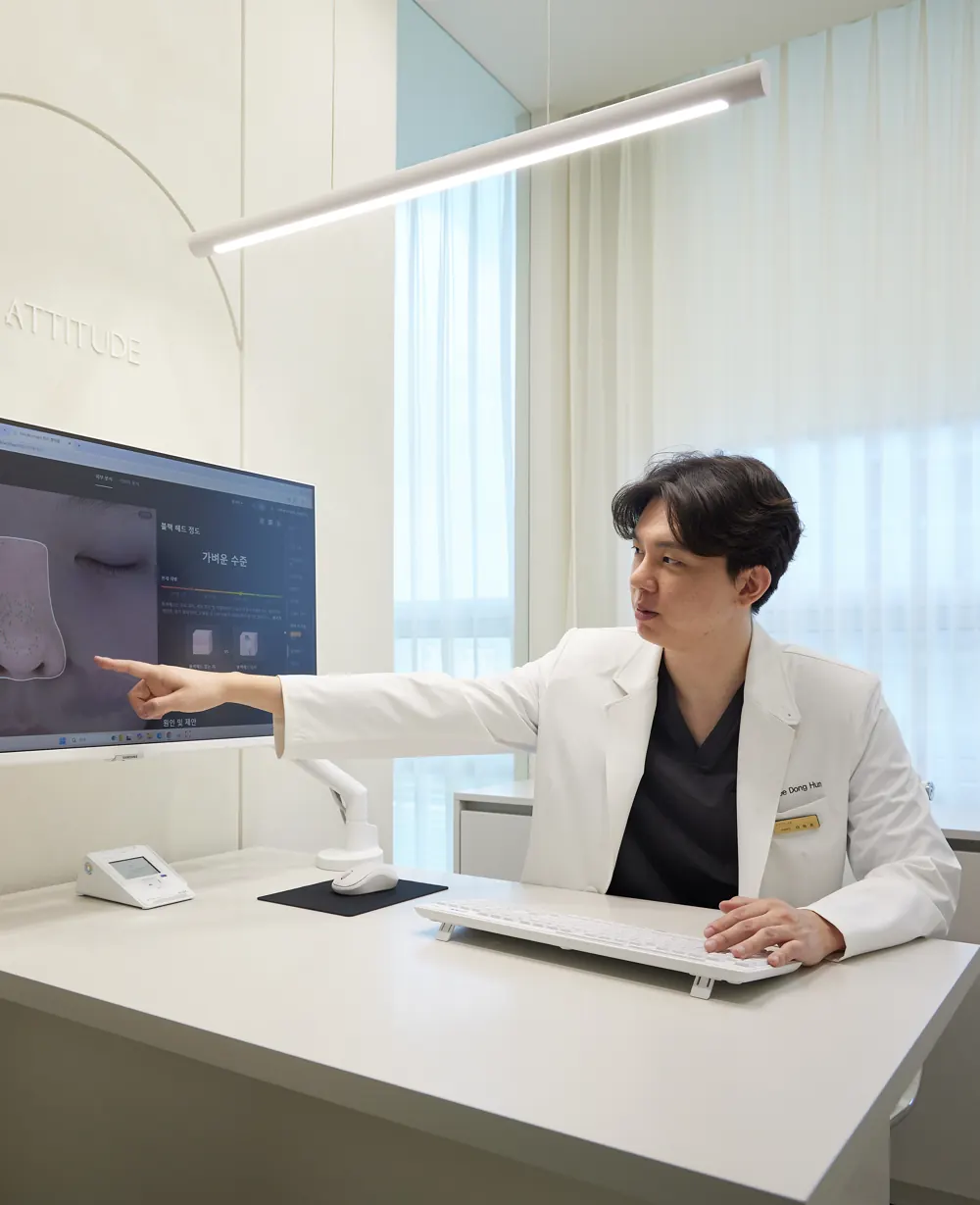
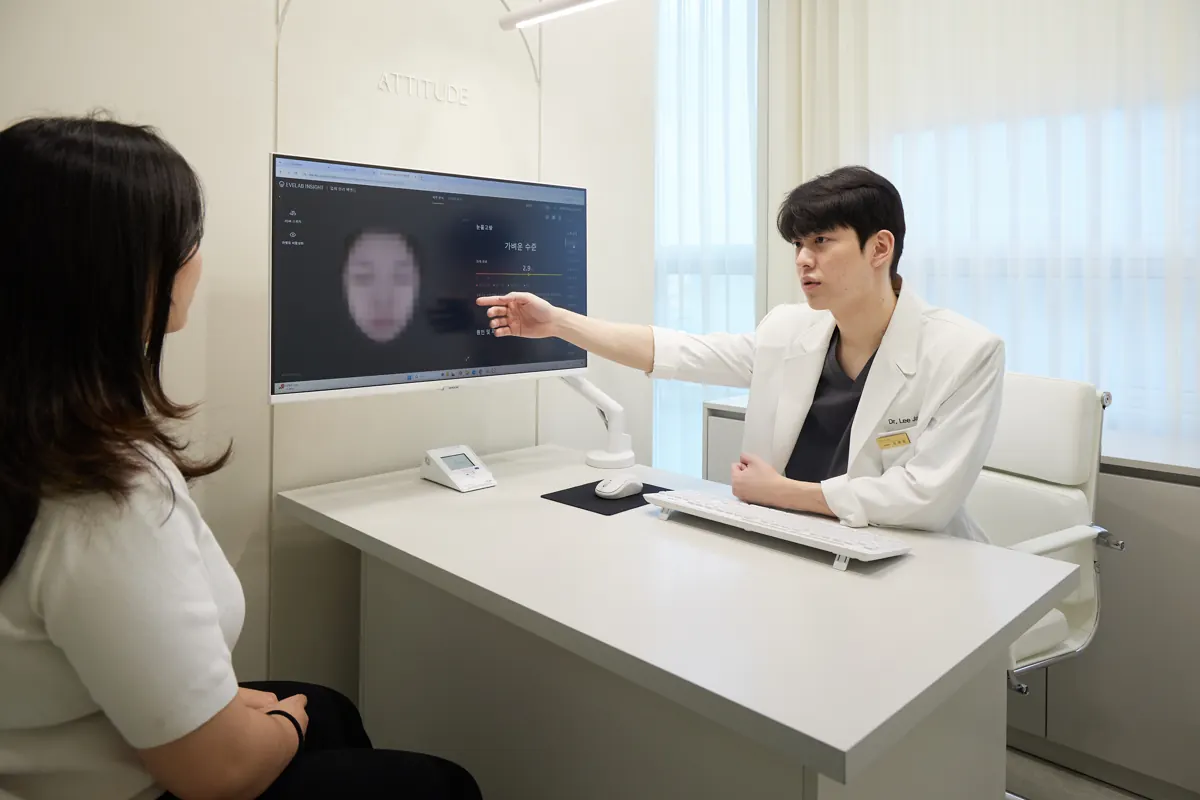
The doctor goes through your pore, pigmentation, wrinkle and firmness results with you on screen and explains what comes first.
03
One-to-one design
With your skin, the balance of your face, the change you want and your schedule in view, you decide the treatment and its extent together.
04
Treatment by your doctor
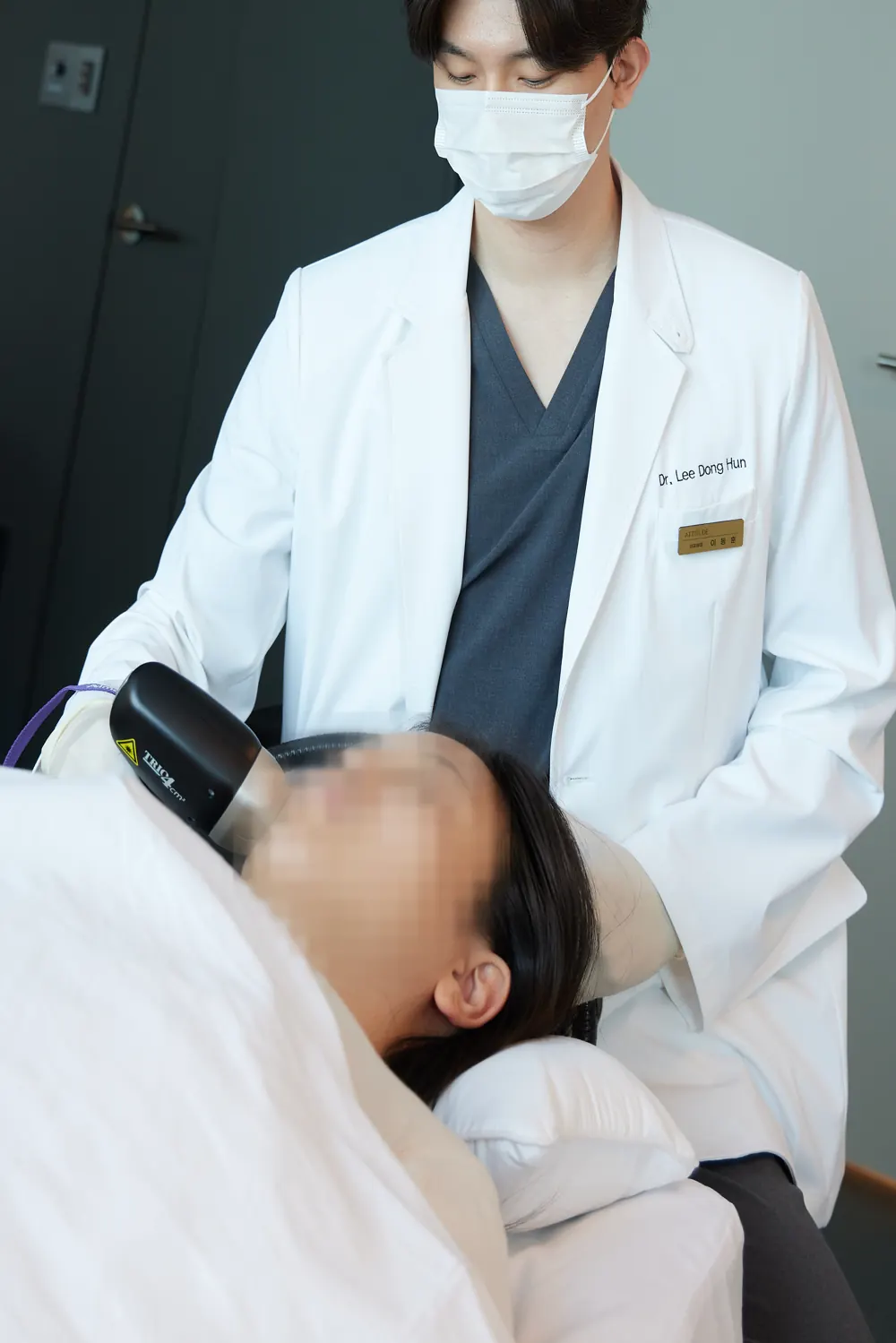
The doctor who consulted you performs the treatment from start to finish in a private treatment room. No one takes over halfway.
“I take injection pain seriously.”
Co-Director Dr. Lee Dong Hun
Many people hesitate over injection treatments because they hurt. So we went back over everything, from the anesthetic to the products used.
Careful numbing, unhurried timingWe allow plenty of time for a special numbing cream to take full effect, and add anesthetic injections for the treatments and areas that need them.
Fine needles, finished quicklyInjection treatments use fine needles, and the doctor finishes them personally in a short time, adjusting along the way by watching how you are doing.
Even the product formulation countsThe same treatment can feel more or less demanding depending on the product, so we take that into account too.
The anesthetic method and whether it is used are decided after an examination, according to the treatment, the area and your condition. How much it hurts varies from person to person.
The devices and treatments covered in this topic are microneedling RF such as Potenza, erbium fractional laser, and salmon injections. Exosomes are guided as a method combined after treatments that open the surface. Skin records kept with devices are materials for organizing your condition and do not replace diagnosis themselves.
Aftercare and side effects
Soothing Right after treatment, do not rub or irritate the skin vigorously, and use only products approved by the doctor. While redness and swelling are present, do not add new cosmetics.
Moisturizing Dryness and thin crusting can occur, so maintain moisturizing. If tightness lasts long, tell the clinic at consultation.
Sun protection Reduce UV exposure during recovery and use sunscreen. After treatments that open the skin, manage especially to reduce irritation.
Check progress Watch whether redness, swelling, and itching settle quickly. If you see inflammation that worsens or lasts long, lumps, or allergic reactions, contact the clinic without waiting.
Common reactions are redness, swelling, dot-like marks, dryness, or thin crusting from the treatment itself. Exosome products can cause redness, itching, swelling, irritation, and allergic reactions. Rarely, lumps (granulomas) or prolonged inflammation have been reported after applying products to skin opened by microneedling. Exosomes are a relatively new field, and long-term safety data are not yet sufficient. Salmon injections are injection treatments, so injection-site reactions and reactions to product ingredients are checked in consultation. If redness, swelling, or itching does not settle quickly or spreads, if you feel a lump, or if an allergic reaction is suspected, seek care without waiting for the next appointment.
FAQ
Is an exosome facial treatment injected or applied topically?
In ATTITUDE Clinic's column, exosomes are applied to the skin surface. It is believed they can be delivered deeper using temporary channels created right after microneedling or fractional ablative laser. Simply applying them on healthy skin makes it hard to reach deeper because of the outer layer. Products claiming to be injectable require separate confirmation of product name, approval, and delivery route, so they are not grouped as the same treatment. In consultation, confirm which product is used and how.
Are salmon injections and Rejuran the same treatment?
No. Salmon injections use PDRN, while Rejuran uses PN—different ingredients and products. ATTITUDE Clinic's collagen injection column also distinguishes PN and PDRN as different ingredients and products. Both are described as activating cell regeneration signals to help fibroblasts make collagen, but that does not mean they are the same ingredient. Do not swap effects or schedules between them without confirming product names and ingredients.
Can I get exosomes and salmon injections on the same day?
There is no fixed order that applies to all skin. Exosomes are often combined right after microneedling or ablative laser, so if done on the same day, the intensity of that treatment determines the recovery plan. To add salmon injections, skin response and schedule flexibility are considered together. If there is inflammation or infection at the treatment site, treatment comes first. Rather than focusing on whether it is the same day, it is more important to hear why that order was chosen.
How much downtime is there?
With exosomes, redness, swelling, dot-like marks, dryness, or thin crusting can occur depending on the treatment itself and the product. Recovery time varies with the intensity of the accompanying laser or microneedling and your skin condition, so it is difficult to give a single number. For salmon injections as well, injection-site reactions and the recovery plan are confirmed in consultation. If you have an important event, plan the date with recovery time in mind.
What should I ask when choosing a clinic?
First, ask for the name, source, concentration, and purification method of the product used. For exosomes, standards differ by product, so this information is the starting point for results and safety. For salmon injections, confirm the PDRN ingredient, product name, and injection site. Also consider who performs the treatment, what risks are explained, and where to contact if a problem occurs after treatment. Rather than comparing price alone, use the specificity of the explanation as your criterion.
At a glance
Table 2 At a glance
Item
Key point
Exosomes
Signal substances secreted by cells delivered to the skin surface; large differences between products
Salmon injection
PDRN ingredient injected; different ingredient and product from PN
Skin booster ("water glow") injection
HA attracts moisture; different purpose from salmon injections
Combining
Exosomes are mainly combined right after microneedling or ablative laser
Recovery
Redness, swelling, dryness, crusting possible; varies with intensity and skin condition
Check
Product name, ingredient, concentration, allergy or inflammation status, schedule flexibility
This article offers general health information. It is not a substitute for diagnosis or treatment based on your own condition, so please talk through your situation with a doctor.