Rejuran and Skin Boosters: When Results Appear and How Long They Last
Skin booster results depend on the ingredient. Learn when rejuran and other boosters start working, how long they last, what controls duration, and aftercare tips for visitors to Gangnam, Seoul.
Written by ATTITUDE Clinic Editorial Team
The first questions after a skin booster injection are usually when you will see a difference and how long that difference will stay. Some people look in the mirror the next day and feel underwhelmed; others say their skin changed gradually only after a few weeks. This article walks through what skin boosters do inside the skin, when results appear, what determines duration, and what to know before and after treatment.
The short answer
Skin booster is not the name of a single product but an umbrella term for injectables with different ingredients, so onset and duration differ from product to product. Water-binding ingredients give immediate hydration and volume, while collagen-stimulating approaches build over weeks. The American Academy of Dermatology filler guide notes that hyaluronic acid gels work immediately and poly-lactic acid takes 2–3 weeks. Duration depends on skin condition, lifestyle, and the number of sessions, and the usual pattern is several sessions followed by maintenance rather than a single treatment.
What do skin boosters do inside the skin?
Although the name is one, the ingredients inside are several. ATTITUDE Clinic treatments lists skin boosters including Rejuran Healer, Rejuran HB, Rejuran S, Rejuran Eye, Juvelook Skin and Volume, Sculptra, Re2O, SKINVIVE, Bellotero Revive, Radiesse, Gouri, Hilo Wave, skin booster ("water glow" injection), PDRN (salmon DNA) injection, and exosomes — all different ingredients. That is why it is hard to express skin booster results as a single number.
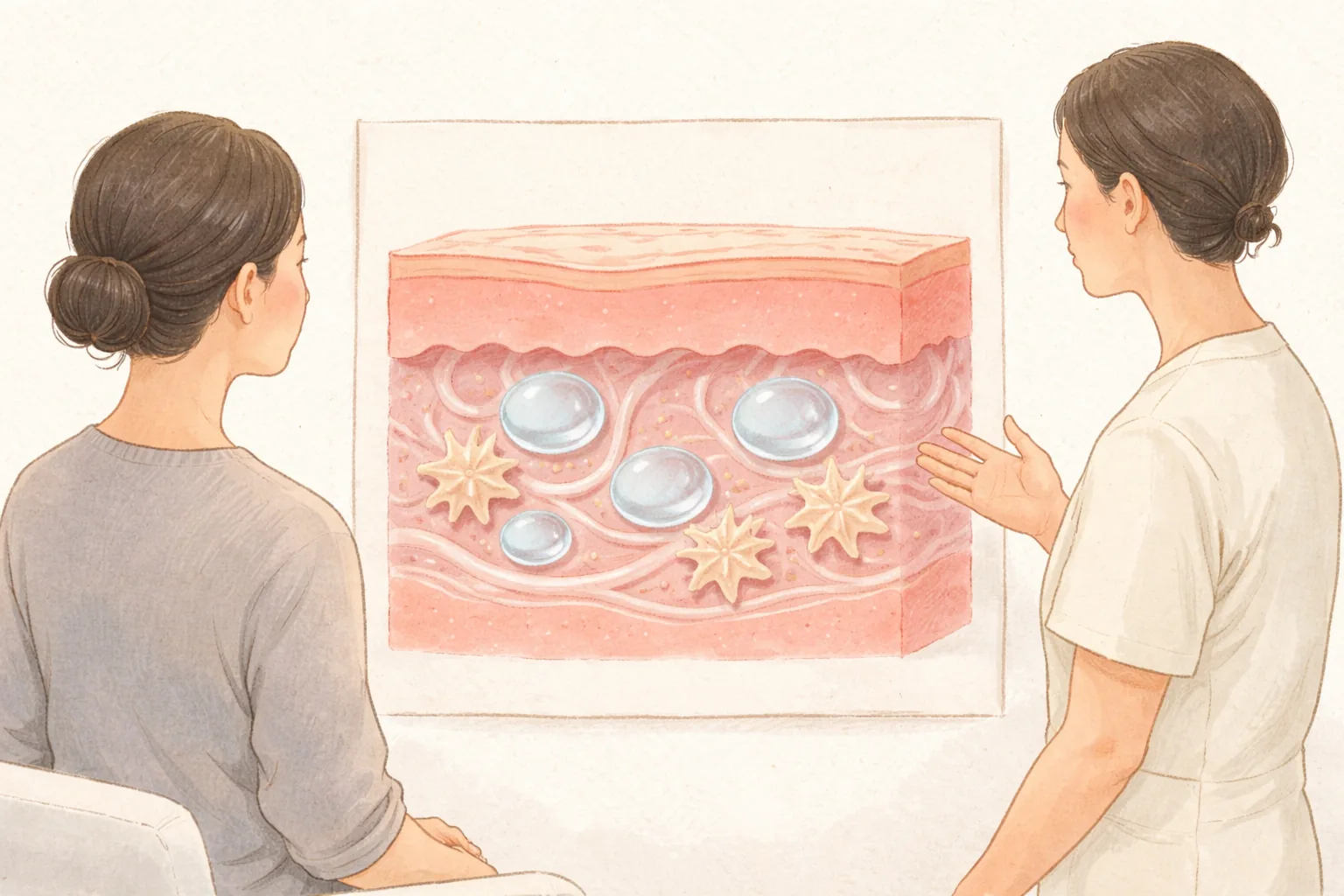
Mechanisms fall into two main groups. One sends signals for the skin to build on its own. According to an ATTITUDE Clinic column, PN (polynucleotide, a regeneration-signaling ingredient) and PDRN (polydeoxyribonucleotide, derived from salmon DNA) activate cell regeneration signals so fibroblasts produce collagen themselves, while hyaluronic acid (HA, a water-attracting ingredient) draws moisture into the skin for volume and hydration. The other group adds structural material directly. Re2O replenishes hADM (human-derived acellular dermal matrix, a skin support structure containing collagen, elastin, and hyaluronic acid) into the dermis. Even among skin boosters, the signaling type and the filling type cannot have the same timeline.
When do results appear?
The feeling right after treatment and the change weeks later are different phenomena. Why do the immediate sensation and the weeks-later change differ so much? With Re2O, for example, the plumpness right after injection is largely some swelling that settles over a few days. Any change after that appears gradually over weeks and varies widely between individuals (ATTITUDE Clinic column). PN and HA boosters also need a process of cell stimulation, so once the stimulation ends, the effect tends to fade gradually.
There is a common misunderstanding here. People say it looked better right after injection but returned to normal within a few days. If that early plumpness was mostly swelling, fading over time is a natural course. Conversely, if you feel nothing has changed and it is too early to judge, first distinguish whether the product fills immediately or acts gradually over weeks. As the AAD guide summarizes, collagen and hyaluronic acid gels show immediate results while poly-lactic acid takes 2–3 weeks — the same distinction applies here.
What determines how long results last?
First, how slowly the ingredient breaks down in the skin. For products that fill while the injected material is gradually absorbed, the breakdown rate drives duration; for collagen-stimulating approaches, how long the tissue change remains after stimulation ends is the key. The ATTITUDE Clinic column also states that when stimulation ends the effect gradually fades, and that Re2O duration varies greatly between individuals with long-term data still limited.
Second, skin condition, age, and lifestyle. Even with the same product and amount, skin thickness, regenerative capacity, UV exposure, hydration, and sleep affect how long changes remain. Third, the number and spacing of sessions. Splitting treatment across several sessions and continuing maintenance is considered better for prolonging changes than a single injection (ATTITUDE Clinic column). In other words, duration is not a value set by a product alone but the result of these three factors overlapping.
Is one session enough?
It depends on the scope of your concern and your skin condition. PN and HA skin boosters are usually planned as several sessions spaced 2–4 weeks apart, followed by maintenance (ATTITUDE Clinic column). Structural replenishment products like Re2O are also usually planned over several sessions, with the number depending on skin condition, area, and injection volume.
Sometimes one session is enough. If the goal is hydration in a specific area or a temporary condition boost, you might start with 1 session, observe, then decide the next plan. However, judging duration from the first session alone is premature. The first session is a stage for seeing how your skin responds; by the second or third session, the extent and duration of change become clearer. Some products, such as exosomes used alongside treatments that open the skin surface, still lack established data on onset and duration, so the criteria differ by product.
Table 1 Is one session enough?
Category
What it does in the skin
Concerns it suits
Points on onset and duration
PN·HA group (Rejuran etc.)
Regeneration signals induce collagen production and attract moisture
Skin texture, hydration, elasticity maintenance
Usually several sessions 2–4 weeks apart, then maintenance
HA boosters (SKINVIVE, Bellotero Revive etc.)
Injectables delivered directly into the skin base
Hydration and volume
Hyaluronic acid gels tend to show results immediately
Re2O (hADM)
Replenishes support structure directly into the dermis
Skin that feels thinner and less elastic
Early plumpness is partly swelling; changes build over weeks
Exosomes
Intercellular regeneration signaling
Recovery support after treatments that open the skin surface
No established data yet on onset or duration
Swipe sideways to see the whole table.
In summary the ingredient determines when a skin booster's effect appears, while breakdown rate, skin condition, and number of sessions together determine how long it lasts. To avoid mistaking early plumpness for the result, start by distinguishing whether it fills immediately or acts gradually over weeks.
If this applies to you
When a wedding or shoot date is set
Bruising and swelling are common reactions to injectable treatments, and bruising can take more than 1 week to fade (ATTITUDE Clinic column). If a date is fixed, start at least a few weeks ahead and adjust the schedule after seeing the first response. Plan with buffer rather than squeezing intervals to fit the date.
If you want ongoing maintenance
Maintenance intervals are set by the product and your skin condition. Since sun protection and hydration influence how long changes remain (ATTITUDE Clinic column), daily care between sessions is best seen as part of the plan. Recording your progress makes it easier to judge the next session timing.
Sensitive or redness-prone skin
Injectable treatments can cause bruising and swelling, and rarely nodules, infection, or allergic reactions (ATTITUDE Clinic column). If you have reacted to a treatment or product before, mentioning it first during consultation helps build the plan.
Short-stay visitors
A plan of several sessions 2–4 weeks apart may be difficult if your stay is short. In that case, discuss what change can be expected from a single session and how to manage after returning home, including the next visit.
Tell us before consultation Recent UV exposure (travel or outdoor activity), medications you take (including blood thinners), pregnancy and breastfeeding status, autoimmune conditions, exfoliating products or retinol used on the skin, any history of prolonged bruising or swelling from past treatments, and dates you absolutely want to avoid. Which product to use and how many sessions at what interval are decided based on this information.
How ATTITUDE Clinic proceeds
AI skin analysis record — Skin condition and items such as pores, pigment, and elasticity are recorded with photos. The analysis tool records and organizes information to support consultation; it is not a device that makes medical diagnoses (ATTITUDE Clinic column).
Doctor consultation — Records plus skin thickness, lifestyle, and past treatment experience are used to distinguish whether your concern is hydration, elasticity loss, or skin texture. This distinction changes the booster type and interval.
Doctor-performed treatment — The doctor personally injects the decided product and dose. The principle is not to recommend more treatment than needed (ATTITUDE Clinic column).
Recovery and care guidance — Aftercare precautions and the next session timing are explained, and progress is recorded and reflected in the next plan.
Skin booster listings include Rejuran Healer and HB, S, Rejuran Eye, Juvelook Skin and Volume, Sculptra, Re2O, SKINVIVE, Bellotero Revive, Radiesse, Gouri, Hilo Wave, skin booster ("water glow" injection), PDRN (salmon DNA) injection, and exosomes (ATTITUDE Clinic treatments). Which product suits you is decided in consultation based on skin condition and concerns, and genuine products at full dose are used at list price (ATTITUDE Clinic column).
Aftercare and side effects
Calm — On the day of treatment, avoid saunas, vigorous exercise, and alcohol, and do not rub the injection site. For structural products like Re2O, pressing hard or massaging the injection site is not advised (ATTITUDE Clinic column).
Follow product-specific instructions — Whether to massage differs by product. The AAD guide advises gently massaging poly-lactic acid filler about 5 minutes several times a day for 1–2 weeks. Since handling can be opposite depending on the product, follow the guidance for what you received.
Moisturize — Drink enough water and keep moisturizing. Prolonged dryness tends to make skin texture look rough and can affect how long changes remain.
Sun protection — Apply sunscreen carefully throughout the recovery period. UV exposure is one of the conditions that affect how long changes remain (ATTITUDE Clinic column).
Side effects from common to rare: bruising and swelling, mild redness and stinging, and tenderness when pressed. More rarely, nodules (small lumps), infection, or allergic reactions can occur (ATTITUDE Clinic column). Rarely, the injected product can block or damage a blood vessel, so if you have unusual or worsening pain, skin color at the injection site turning white, black, or blotchy, or any change in vision, do not wait — seek care immediately (ATTITUDE Clinic column). Also contact the clinic if swelling, pain, or heat persists.
Frequently asked questions
When does the effect start and how long does it last?
It depends on the product. Hyaluronic acid gels feel immediate, while collagen-stimulating ingredients like poly-lactic acid appear over 2–3 weeks (AAD guide). PN and HA skin boosters tend to fade gradually once stimulation ends, and usually continue with maintenance after several sessions (ATTITUDE Clinic column). Duration varies with skin condition, lifestyle, and number of sessions, so planning based on your own skin at consultation is more accurate.
Is one session enough?
Sometimes people start with one session and observe; sometimes a plan of several sessions is made from the start. PN and HA groups usually involve several sessions 2–4 weeks apart followed by maintenance (ATTITUDE Clinic column). If your concern is dryness and a condition boost, you can start with 1 session; if your skin feels thinner and less elastic, several sessions may be needed. Which applies is decided by skin condition, area, and injection volume.
How do I know which booster suits me?
It splits by whether your concern is hydration and texture or elasticity and skin thickness. For hydration and frequent maintenance, PN and HA groups fit; if your skin feels thinner or significantly less elastic, a structural replenishment product may be considered (ATTITUDE Clinic column). What to decide before the procedure name is the cause. Even the same phrase "dull skin" can come from dehydration or from elasticity loss, and the approach differs.
I am worried about allergic reactions.
Bruising and swelling are common across injectable treatments, while nodules, infection, and allergic reactions are rarely reported (ATTITUDE Clinic column). For human-tissue-derived products like Re2O, it is necessary to disclose autoimmune conditions, any prior reaction to tissue-derived products, other allergies, medications you take, and pregnancy or breastfeeding status in advance (ATTITUDE Clinic column). Sources and purification methods differ by product, so it is good to confirm which product is used during consultation.
What should I look at when choosing a clinic?
It is better to judge by consultation quality than by procedure names. Criteria include whether they explain the cause first, whether they tell you when a treatment is not needed for your current concern, and whether they explain side effects and recovery time specifically (ATTITUDE Clinic column). Whether they disclose the product type and dose is also worth checking. It also helps to see whether which product, how many sessions, and at what interval is recorded in your consultation notes.
At a glance
Table 2 At a glance
Item
Key point
Onset
Hyaluronic acid gels immediately; poly-lactic acid 2–3 weeks; PN and HA groups gradually over several sessions
Early plumpness
Can be largely swelling and settles over a few days
What determines duration
Ingredient breakdown rate, skin condition and lifestyle, number and spacing of sessions
Typical number
Usually several sessions 2–4 weeks apart, then maintenance
Reactions
Bruising, swelling, and mild redness are common; nodules, infection, and allergic reactions are rare
Care
Product-specific massage instructions, moisturizing, sun protection
This article offers general health information. It is not a substitute for diagnosis or treatment based on your own condition, so please talk through your situation with a doctor.