Pico Toning Benefits: When Results Show and What Decides How Long They Last
When pico laser treatment results appear and what decides how long they last — sessions, spacing, pigment depth and UV care, explained for visitors to Sinsa Station, Gangnam.
Written by ATTITUDE Clinic Editorial Team
When people search for pico laser treatment, two questions come up most often: when will I start to see a difference, and how long will the improvement last? Even with the same 1064nm toning, the timing you feel depends on the type and depth of the pigment, the number of sessions and the spacing between them — so there is no single date that applies to everyone. Here we look at how results unfold, what decides how long they last, and what to know before and after treatment.
The short answer first
Laser toning repeats low energy over many sessions to gradually calm the skin's pigment response, so it is rarely finished in a single treatment. In a study of melasma, pigment measures dropped significantly after 9 treatments and the reduced state was still maintained at 1-year follow-up (PubMed). That result is the average of the group in the study; for your skin, when you notice a change and how long it lasts depend on pigment depth, the number of sessions, UV protection and hormonal changes. Pigment that recurs easily, like melasma, needs ongoing care even after it improves.
What does laser toning do in the skin?
A laser is a treatment that gathers light of one wavelength and delivers it to a specific target in the skin. This principle is called selective photothermolysis. It is a way of concentrating energy on the target you want — pigment or blood vessels — while touching the surrounding normal skin as little as possible. The 1064nm wavelength used for toning is a representative wavelength that melanin pigment responds to. Because it is a low-power, multi-session approach that sweeps at low intensity many times, rather than burning pigment away in one go, it breaks pigment particles into smaller pieces and helps the body process them gradually (PMC review).
So why not use a strong laser on melasma? Melasma is a state in which the pigment-producing cells (melanocytes) are overactive, so strong energy can actually stimulate those cells and make the pigment darker. That is why the basic approach for melasma and wide-spread pigment is repetition at low energy. Toning is not a treatment that erases pigment in one go — it is a way of stacking low stimulation over many sessions to steady the pigment response. Using strong energy on melasma can make it look temporarily lighter, then darker.
From which session do results appear?
Results are usually not judged after only 1 or 2 sessions. Laser toning is not completed in 1 session, and the pigment needs time to be processed by the body. For melasma and wide-spread pigment, a plan of 8–12 sessions or more with at least 1 week between sessions is commonly given as an example. For pigment with relatively clear borders, such as sun spots, 1–3 sessions at 4–8 week intervals is a common example.
In the study, pigment measures fell after 9 treatments, and 70% of participants said it was a method that met their expectations (PubMed). You cannot copy those numbers directly onto your own session count, but the reason we look at "after sessions have accumulated" rather than "right afterwards" is clear. When judging whether pigment is fading, look at whether pigment rises again 4–8 weeks later and how even the tone looks, rather than at redness the day after treatment. The timing you feel changes as intensity is adjusted while keeping to the spacing.
Judge results by whether pigment rises again after sessions have accumulated, not by how it looks right after a single session.
Pigment treatment uses different lasers and session counts depending on the goal. Even on the same face, sun spots come from pigment, redness from blood vessels and rough texture from skin structure, so the approach differs.
In short when you notice toning results is not decided by "which session number" alone. The sessions needed differ by pigment type, and results can be gauged when intensity is adjusted while keeping to the spacing.
What decides how long results last?
There is a report that the reduced melasma state was maintained even at 1-year follow-up (PubMed). This does not mean toning immediately undoes an improvement, but it also does not mean everyone maintains results for 1 year. Melasma is a pigment disorder that recurs easily in response to UV, hormones and heat stimulation.
What decides how long results last is not only the intensity of the last session. How well you blocked UV afterwards, whether there were hormonal changes, and how long you avoided heat stimulation such as saunas or intense exercise all play a part. UV protection reduces a major trigger for the pigment-producing cells, so it matters both before and after treatment. After treatment, applying an SPF 50+ sunscreen for at least 2 weeks and reapplying about every 2 hours outdoors is recommended.
The reason for leaving at least 1 week between sessions is here too. Very frequent toning has been reported in connection with mottled hypopigmentation, so sessions are spaced at least 1 week apart. To keep an improvement for longer, rather than shortening the spacing, set maintenance sessions by watching how quickly pigment rises again.
How long results last is decided not by the date of the last session but by the UV, hormones and heat stimulation that follow.
Can I have it alongside other toning?
Whether toning and another laser can be done on the same day depends on the goal and how the skin responds. Sometimes pigment is addressed first and a fractional laser is added for texture and pores. The two approaches do not conflict, but overlapping strong stimulation on the same area can lengthen recovery, so the doctor sets the order and intensity.
Even when "toning" is in the name, the concern being targeted can differ. On the ATTITUDE Clinic price list, Pico toning is described as a treatment using a 1064nm picosecond laser that helps with pigment and brightening, and Genesis toning as a treatment using a 1064nm laser that helps with anti-aging (treatments and pricing). Conventional 1064nm toning and pico toning share a wavelength but differ in pulse duration. Picosecond delivers energy in a very short time, around one trillionth of a second, so even at the same 1064nm the settings and response are not the same.
Pricing depends on the type of treatment and the session package. The price list shows Pico toning at KRW 150,000 per session and Genesis toning at KRW 200,000 per session, all excluding VAT (treatments and pricing). In consultation, decide which treatment and how many sessions you will have, then check against the price list.
Even toning with the same name targets different concerns, so when results appear is hard to compare on the same basis.
If this sounds like you
If you have a ceremony or shoot coming up
A first-time treatment right before a ceremony can mean redness or sensitized skin overlapping with your schedule. The more lead time you start with relative to the date, the more options you have to adjust intensity and session count. If you tell us the ceremony date at consultation, we set the treatment type and start timing to match.
If you want steady maintenance
Rather than going strong all at once, periodic care that respects the interval your skin needs to recover puts less burden on the skin. Melasma commonly calls for a plan of 8–12 sessions or more, so maintenance sessions are adjusted by watching whether pigment rises again in between. It is better to set a goal and place only the treatments you need at the right times.
If your skin is sensitive or reddens easily
Even at the same intensity, redness can linger if the skin barrier is weak. If cosmetics sting or your skin has become unusually sensitive, tell us before treatment so intensity and spacing can be adjusted. If redness and heat after treatment last longer than expected, do not tough it out — come in so we can check.
If you are an overseas visitor on a short stay
If your stay is fixed, redness or dryness right after treatment can affect your plans. Tell us your return date and next commitments in advance, and we will discuss intensity and treatment type accordingly. Low-power toning often brings redness lasting from a few hours to the same day, but high-power spot removal can leave crusts for about 7–10 days, so schedule planning is needed.
Tell us before consultation Please mention recent UV exposure, medications you are taking and skincare ingredients you are using, any experience of sensitivity after previous treatments, and important dates such as ceremonies, shoots or travel. Even for the same treatment, timing and intensity change with this information.
How ATTITUDE Clinic proceeds
AI skin analysis record Your skin condition is recorded and organized with a device. The analysis tool is a recording aid that supports consultation and does not make a medical diagnosis.
Doctor consultation and pigment type assessment Lifestyle habits and concerns are added to the record, and the doctor assesses pigment type by examination. The approach differs depending on whether it is melasma or sun spots, and at what depth.
Treatment by the doctor The doctor selects the device suited to the pigment type from the clinic's equipment and personally adjusts intensity and combination. Picoplus, Vbeam, erbium YAG laser and Genesis toning are among those listed, and pricing is given at the list price based on genuine products and full amounts.
Follow-up and care Recovery and pigment response are checked and the next interval is adjusted. Together we decide what is needed now, what is not, and in what order.
Four steps your doctor sees to in person
From the diagnostic device to the treatment bed, the doctor you first consult takes care of everything.
01
Precision diagnosis
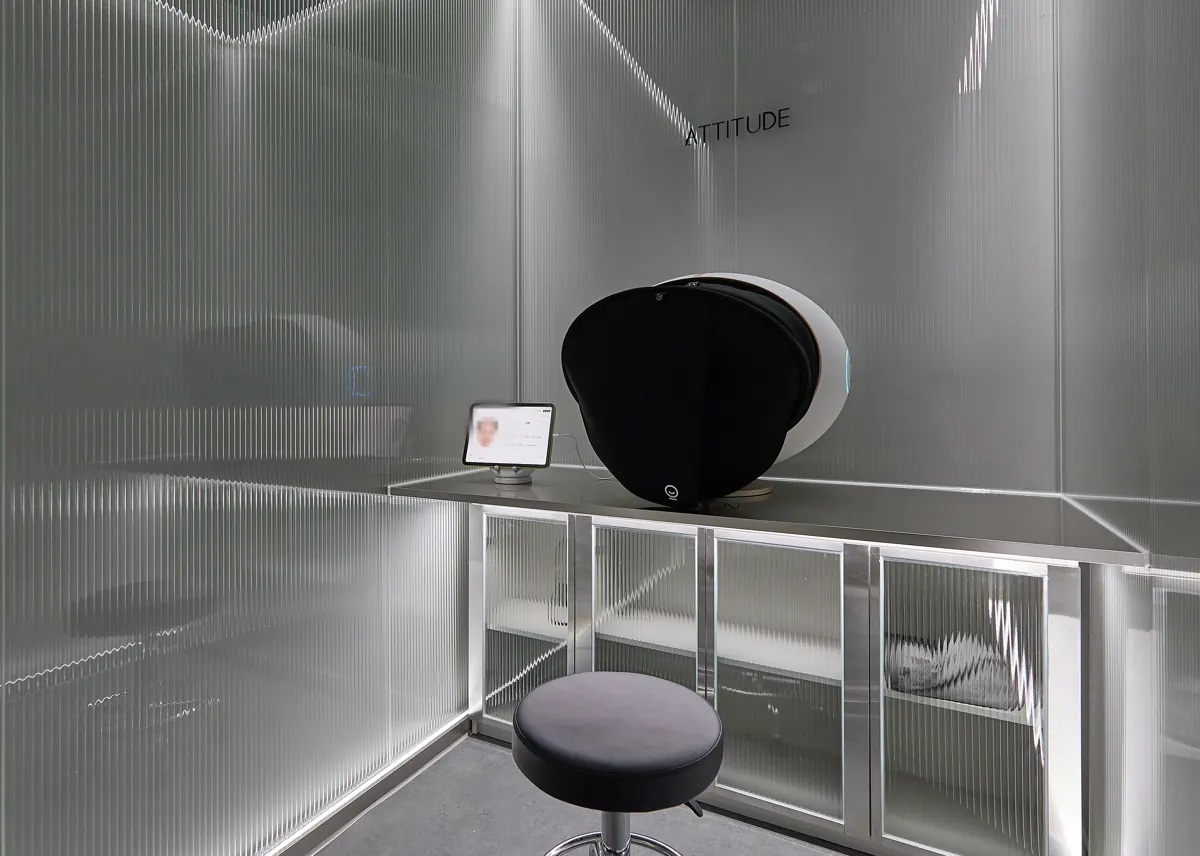
In a private diagnosis room the whole face is photographed, recording even skin conditions that are hard to see with the eye.
02
Skin analysis
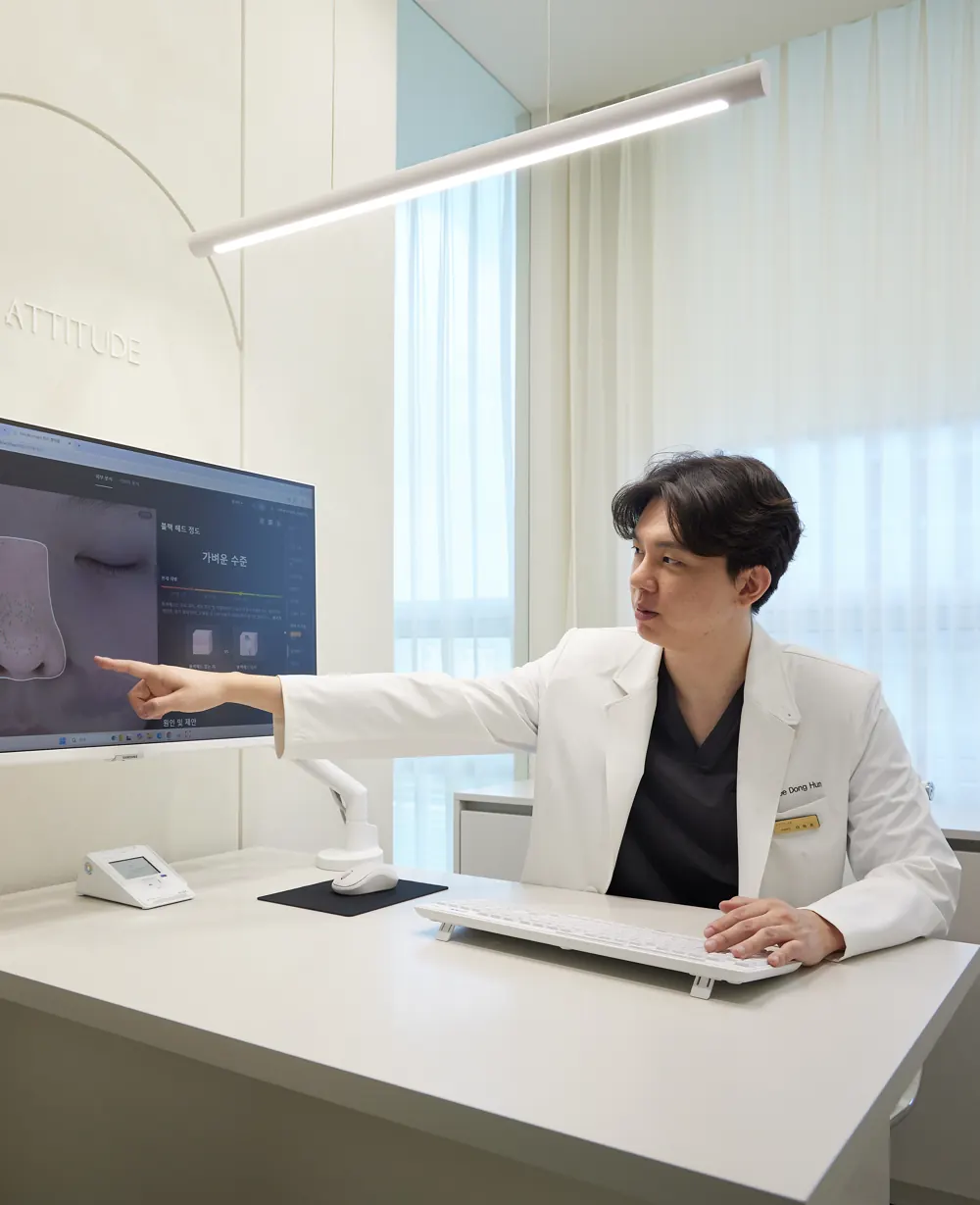
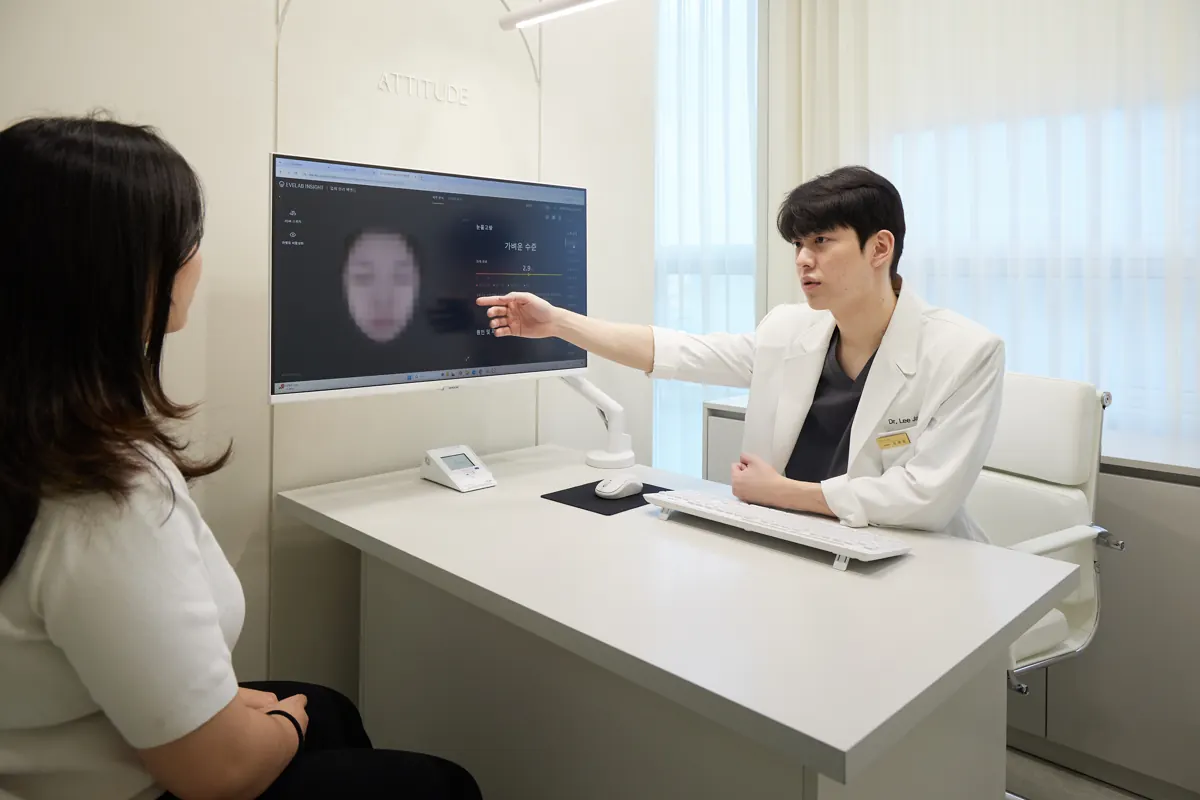
The doctor goes through your pore, pigmentation, wrinkle and firmness results with you on screen and explains what comes first.
03
One-to-one design
With your skin, the balance of your face, the change you want and your schedule in view, you decide the treatment and its extent together.
04
Treatment by your doctor
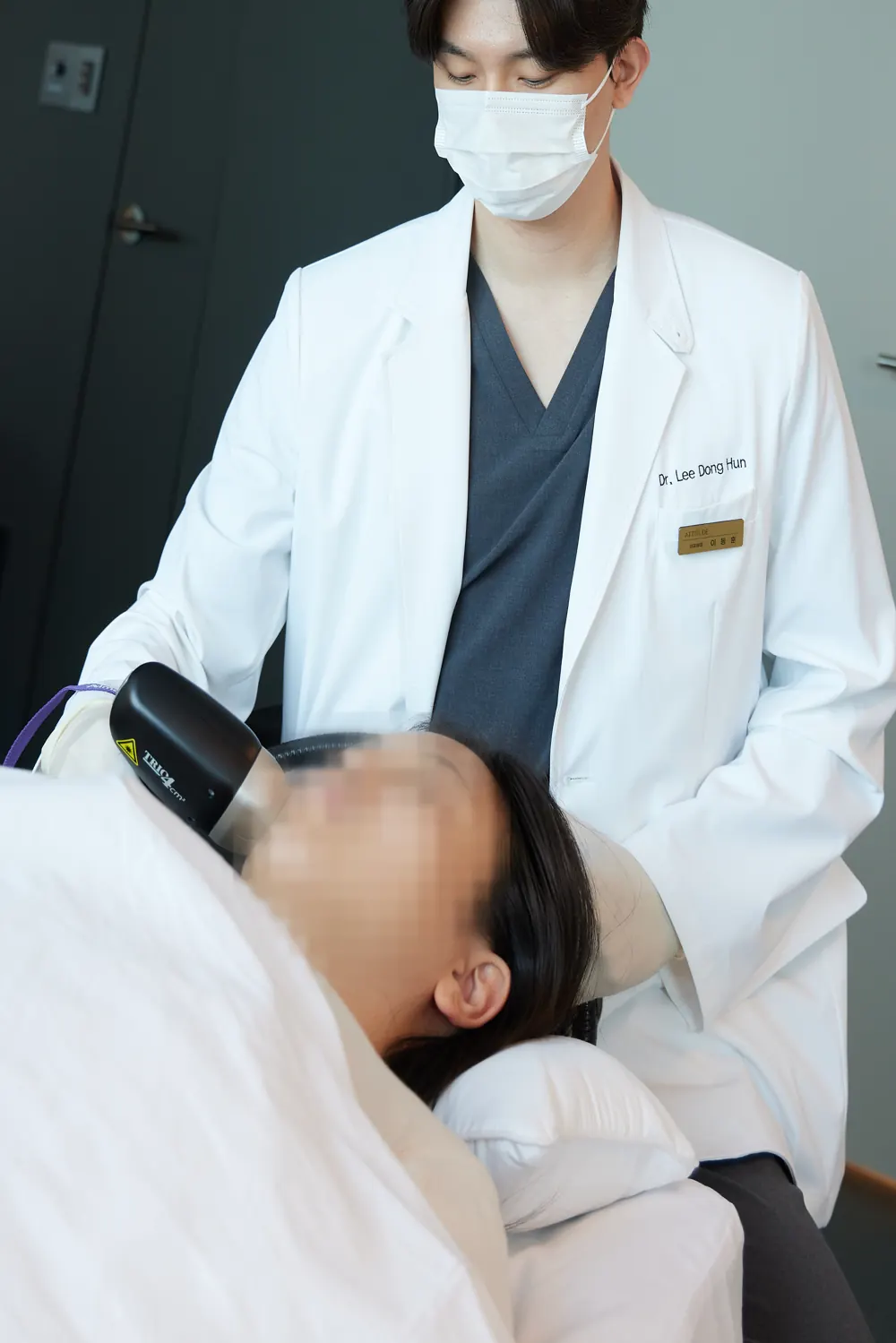
The doctor who consulted you performs the treatment from start to finish in a private treatment room. No one takes over halfway.
“I take injection pain seriously.”
Co-Director Dr. Lee Dong Hun
Many people hesitate over injection treatments because they hurt. So we went back over everything, from the anesthetic to the products used.
Careful numbing, unhurried timingWe allow plenty of time for a special numbing cream to take full effect, and add anesthetic injections for the treatments and areas that need them.
Fine needles, finished quicklyInjection treatments use fine needles, and the doctor finishes them personally in a short time, adjusting along the way by watching how you are doing.
Even the product formulation countsThe same treatment can feel more or less demanding depending on the product, so we take that into account too.
The anesthetic method and whether it is used are decided after an examination, according to the treatment, the area and your condition. How much it hurts varies from person to person.
Aftercare and side effects
Soothing If there is redness and heat right after treatment, wipe gently with lukewarm water and lower skin temperature with soothing care.
Moisturizing Dryness is common, so apply moisturizer often. Avoid exfoliation and saunas for the period you are advised.
UV protection Apply an SPF 50+ sunscreen for at least 2 weeks and reapply about every 2 hours outdoors. Avoid saunas, jjimjilbang and intense exercise for 1–2 weeks.
Follow-up If redness and stinging last more than 3 days or suddenly worsen, come in so we can check. Do not pull crusts off by force.
Common reactions are redness, heat, swelling, stinging, dryness and thin crusts. Temporary darkening of pigment (post-inflammatory hyperpigmentation) can occur, and rarely blisters, hypopigmentation, infection, scarring or pigment rising again can occur. Low-power toning often brings redness lasting from a few hours to the same day, while high-power spot removal can leave crusts for about 7–10 days. If pain becomes severe or blisters form, do not wait — come in.
Frequently asked questions
How many sessions of pico laser treatment does it usually take before I feel results?
For melasma and wide-spread pigment, a plan of 8–12 sessions or more is a common example; for sun spots, 1–3 sessions is a common example. In the study, pigment measures fell after 9 treatments and 70% said it was a method that met their expectations. That is the result of a study group, though, and cannot be copied directly onto when you will feel a change. Judge by whether the tone looks even as sessions accumulate and whether pigment rises again. Rather than concluding after 1 or 2 sessions, keep to the spacing and watch how things progress.
How long does the improvement last?
In the melasma study, the reduced state was maintained at 1-year follow-up. However, melasma is a pigment disorder that recurs easily in response to UV, hormones and heat stimulation, so the same period does not apply to everyone. How well you kept up UV protection, moisturizing and avoiding heat stimulation after treatment affects how long results last. If pigment rises again, spacing and session count are adjusted again.
Is 1 session enough to see results?
A single session may make your complexion look somewhat more put together, but it is hard to expect melasma or deep pigment to disappear. Laser toning needs time for pigment to be processed by the body, and it is rarely completed in 1 session. Multiple low-intensity sessions need to go together with UV protection and barrier recovery. If your schedule is short, adjust expectations toward "checking how the skin responds and light tone refinement" rather than "completing pigment treatment."
How far apart are sessions spaced?
Toning is usually spaced at least 1 week apart. Melasma and wide-spread pigment are commonly planned at 8–12 sessions or more, at least 1 week apart, and sun spots at 1–3 sessions, 4–8 weeks apart. Very frequent toning has been reported in connection with mottled hypopigmentation, so shortening the spacing is not advised. The next interval is set by watching skin response and pigment changes.
How do I choose a good place for pico toning?
Look at how the pigment is diagnosed and how intensity and spacing are designed, rather than at equipment names. AI skin analysis is a tool that helps with recording and organizing and does not make a medical diagnosis, so it matters whether the doctor assesses pigment type by examination. Also check whether side effects and recovery time are explained, and whether what is needed and what is not are distinguished. Compare pricing against the list price after the treatment and session count are decided.
At a glance
Table 2 At a glance
Item
Key point
When results start
Melasma and wide-spread pigment 8–12 sessions or more; sun spots 1–3 sessions are common examples
Judging results
Pigment rising again 4–8 weeks later and tone evenness, rather than redness right after
Maintenance
1-year follow-up maintenance has been reported, but depends on UV, hormones and heat stimulation
Spacing
Toning at least 1 week apart; too frequent raises hypopigmentation risk
Combining
Pigment and texture combined with order and intensity set
Consultation
AI analysis for records, doctor examination for pigment type
This article offers general health information. It is not a substitute for diagnosis or treatment based on your own condition, so please talk through your situation with a doctor.