Potenza and Fractional Laser Together: How the Order and Spacing Are Decided
When Potenza RF microneedling and erbium fractional laser are combined, what decides the order and the gap between them: which skin layer each works in, how recovery behaves, and aftercare.
Written by ATTITUDE Clinic Editorial Team
Many people hear that doing Potenza and fractional laser together is better for scars and ask whether they can book both in one day. Fractional and erbium fractional lasers use light to create tiny columns through the epidermis and dermis, while Potenza uses needles to deliver radiofrequency into the dermis. Which one comes first changes how long the crusting and redness overlap.
The short answer first
Combining the two is possible. DermNet's guide to fractional laser treatment explains that fractional lasers can be used alongside other skin procedures. That said, rather than layering both on the same area on the same day, splitting the order according to what is causing your concern and scheduling the next step after the first treatment's redness and crusting have settled makes recovery easier to read. The ATTITUDE Clinic column also recommends setting priorities rather than doing everything at once when causes overlap. The order and spacing are set by the doctor, taking into account skin thickness, how much crusting occurs, UV exposure and your upcoming schedule.
Where do Potenza and fractional laser work in the skin?
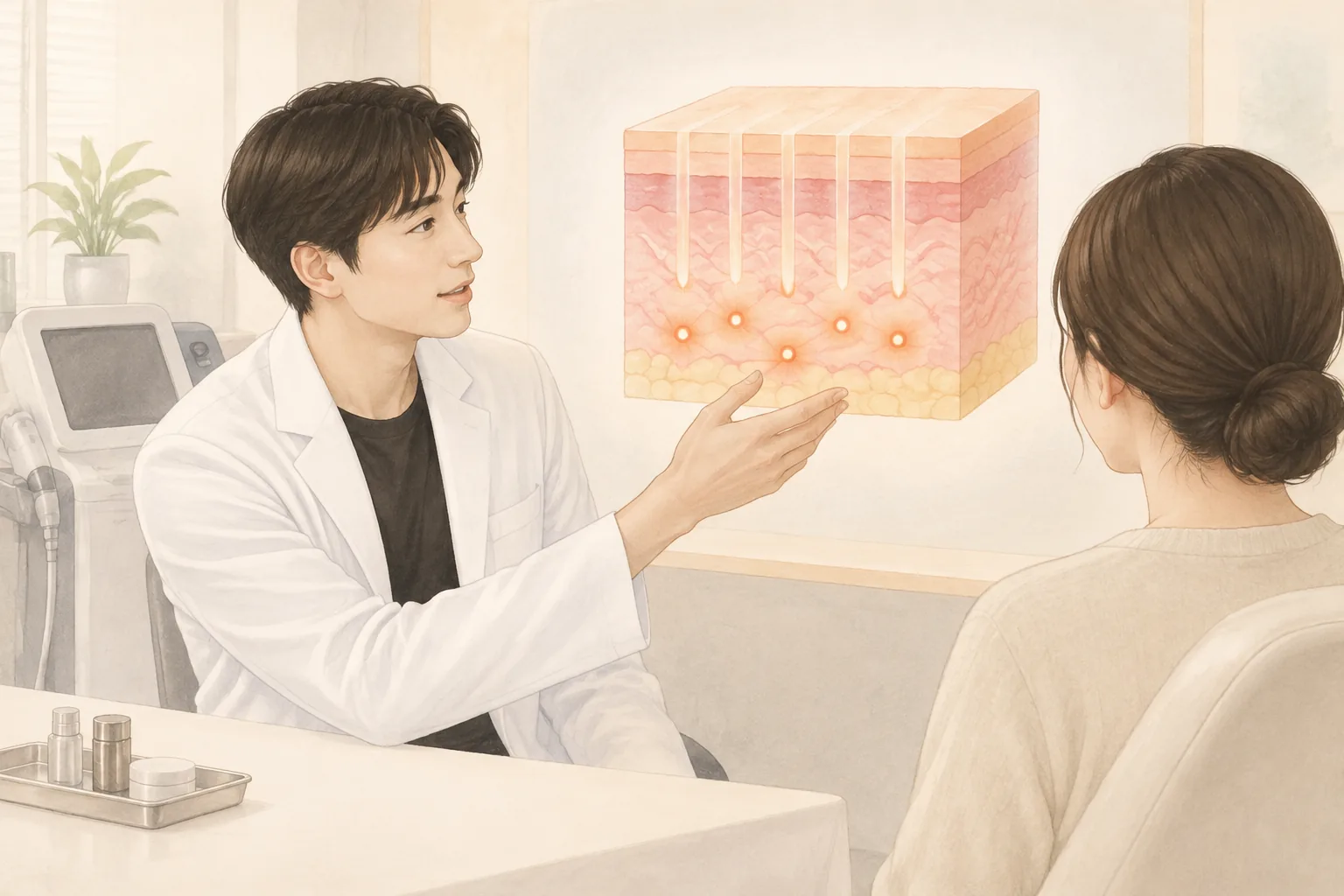
Skin is broadly divided into the epidermis, the dermis and the subcutaneous fat layer, and the dermis is made of collagen and elastin fibers that give skin strength and elasticity (DermNet). Fractional laser divides light into thousands of microscopic treatment zones (MTZ), treating only part of the skin instead of resurfacing all of it. Because the undamaged surrounding tissue helps with healing, recovery is faster than treating the entire skin at once. These tiny columns span both the epidermis and the dermis.
Erbium fractional laser applies this principle at the surface. Cleveland Clinic notes that erbium laser resurfacing addresses wrinkles and scars in the epidermis and at mid-depth, and because it damages less surrounding tissue, swelling, bruising and redness are less than with CO2 lasers. CO2-type lasers, by contrast, go deeper and carry more complex healing and higher scar risk. Even among fractional lasers, the burden on the skin differs with wavelength and depth.
Potenza uses radiofrequency instead of light. The ATTITUDE Clinic treatment guide describes Potenza as a treatment that delivers radiofrequency directly into the dermis with fine needles to help improve pores and scars, and lists erbium fractional as a treatment that helps pores and scars through fine peeling. Even though both address pores and scars, the point where the energy starts is different.
The layer where the two treatments meet is the dermis, and the amount of marking left on the epidermis differs. So when combining them, what matters is how much time you gave the epidermis to recover. Touching the same area again before it has recovered puts strain on the skin barrier.
Why is "better together" only half right?
There is some basis for the idea that more treatments mean better results. The two treatments stimulate different layers, and fractional laser triggers collagen remodeling and new collagen formation (DermNet). The problem arises when this principle is read as a reason to increase the amount.
The ATTITUDE Clinic laser column states plainly that laser is not a treatment where stronger and more frequent is better. Burden is reduced when you do only as much as needed, at a strength and interval suited to your skin condition. It also explains that when the strength is excessive for the skin or treatments are repeated without a recovery period, the risk of side effects such as burns or pigmentation increases.
The name "fractional" is also worth clarifying once. The first fractional laser to appear was a specific device emitting a 1550nm non-ablative wavelength (DermNet), and today devices with different wavelengths and methods share the same name. That is why it is hard to gauge strength and downtime from the name alone.
Cleveland Clinic considers laser resurfacing less suitable when acne is actively flaring, or when wrinkles are deep and the skin is significantly sagging (link). Rushing into scar treatment while acne is active means inflammation overlaps.
What determines the order?
The first thing to look at is whether your concern comes from the surface or from the dermis. The ATTITUDE Clinic column describes erbium YAG laser as suited to smoothing surface texture and improving shallow scar texture, and Potenza as suited to pores and scars in the dermis. If rough, sandpaper-like surface texture is the main concern, a surface laser is considered first; if pitted marks are the main concern, the treatment that works in the dermis comes first.
Even on the same face, pigmentation comes from pigment, redness from blood vessels and rough texture from the surface, so laser choice and combination differ depending on where the problem originates, the same column notes. If pigment is also present, the order shifts again. Melasma can actually darken when strong laser is applied heavily all at once, so dividing output and cycle is safer.
Skin tone is another variable. Cleveland Clinic notes that erbium laser is a better option for darker skin (link). Conversely, if your skin pigment easily, treatments with a stronger peeling character are pushed later or set at a lower strength.
Schedule and lifestyle also change the order. If you have an important engagement after a treatment that leaves crusting, the one with longer recovery is moved later. Recovery time ranges from being able to wear makeup the same day to 1–2 weeks of inconvenience going out, depending on laser type and strength, the column summarizes.
What determines the order is which layer the concern comes from.
How is the spacing set?
Spacing for fractional laser depends on the device, strength and indication. Seoul Asan Medical Center advises that fractional laser is usually performed 2–3 sessions at 3-week intervals. The 1550nm device cited by DermNet as an example is given at 1-month intervals for 4–5 sessions, with results appearing gradually over 3–4 months (link). The ATTITUDE Clinic column gives examples of 3–5 sessions at 4–6 week intervals for pores and skin texture, and 4–6 sessions at 4–8 week intervals for acne scars.
The numbers differ because the counting standards differ. Low output that only lightly smooths the surface means shorter intervals, while high output that causes crusting and oozing needs more time to recover. In the column's downtime table, fractional low output brings redness and sandpaper-like texture for 3–5 days, while high output brings swelling, oozing and crusting for 7–14 days.
The response after Potenza is a little different. Redness, swelling, dot-like marks, dryness and thin crusting are common and usually settle within a few days to 1 week, the ATTITUDE Clinic pore column notes. The next step is scheduled after these marks and crusting have cleared.
Table 1 How is the spacing set?
Item
Potenza
Erbium fractional
Energy
Radiofrequency delivered into the dermis with fine needles
Laser light creating microscopic columns in the epidermis and dermis
Main concerns targeted
Pores and scars in the dermis
Surface texture smoothing, shallow scar texture
Common reactions right after
Redness, swelling, dot-like marks, thin crusting for a few days to 1 week
Redness and sandpaper-like texture for 3–5 days; crusting and oozing for 7–14 days
What sets the spacing
How quickly marks and crusting settle
Examples range from 3 weeks to 8 weeks depending on output and indication
Swipe sideways to see the whole table.
In summary, the two treatments work in different layers and can be combined, but rather than layering them on the same day, it is easier to read recovery if the next step is scheduled after the first treatment's epidermal response has cleared. The order is set by whether the concern comes from the epidermis or the dermis, and the spacing by how quickly crusting and redness settle.
If this sounds like your situation
If you have a ceremony or photo shoot within two months
Counting backward from the date and adjusting treatment type, strength and start timing widens your options. Having a treatment that leaves crusting for the first time right before an event means redness overlaps with your schedule. It is easier to place the longer-recovery option earlier and finish the remaining period with something that causes less surface reaction.
If acne is still flaring
Cleveland Clinic lists active acne as a condition unsuited to laser resurfacing (link). Scar treatment makes sense when started in a state where new scars are not forming. It is better to calm inflammation first and then replan the order of Potenza and fractional.
If your skin reddens easily and is sensitive
If redness and heat tend to linger, start at a lower strength and leave generous spacing. Telling the clinic about a history of sensitivity or atopy before treatment helps with adjusting settings, the column notes. Even the same treatment feels sharper in some areas, so if you are uncomfortable it is better to say so right away during the procedure.
If you want treatment during a short stay
If you schedule a treatment that leaves crusting right before flying home, you will have to manage recovery on the plane. If you leave time for the surface reaction to clear and place the last treatment earlier in your schedule, you do not have to spend your remaining days on recovery.
Please tell us before your consultation your recent UV exposure (travel, outdoor activity, tanning), medications you take (aspirin, anticoagulants, isotretinoin), skin care you are using (retinol, exfoliants), any past experience of pigmentation or scarring after a previous treatment, and the dates of upcoming ceremonies and photo shoots. Seoul Asan Medical Center advises avoiding alcohol and aspirin or other drugs that affect blood clotting for 2 weeks after the procedure (link).
How ATTITUDE Clinic proceeds
Record with AI skin analysis Pores, skin condition and scar shape are recorded with a device. The analysis tool records and organizes information to support consultation; it is not a medical diagnosis.
Interpret the cause in a doctor consultation Skin condition, lifestyle habits, pain sensitivity and upcoming schedule are added to the analysis record to identify the main cause. Depending on which layer the problem comes from, the order, strength and timing of Potenza and erbium fractional are designed together.
Treatment performed by the doctor Topical anesthesia is used as needed to reduce discomfort, and the doctor performs the treatment directly. Treatments beyond what your skin condition needs are not recommended.
Recovery and aftercare check How the crusting and redness are settling is checked, and guidance on sun protection and moisturizing is given. The interval to the next treatment is adjusted based on this recovery process.
Four steps your doctor sees to in person
From the diagnostic device to the treatment bed, the doctor you first consult takes care of everything.
01
Precision diagnosis
In a private diagnosis room the whole face is photographed, recording even skin conditions that are hard to see with the eye.
02
Skin analysis
The doctor goes through your pore, pigmentation, wrinkle and firmness results with you on screen and explains what comes first.
03
One-to-one design
With your skin, the balance of your face, the change you want and your schedule in view, you decide the treatment and its extent together.
04
Treatment by your doctor
The doctor who consulted you performs the treatment from start to finish in a private treatment room. No one takes over halfway.
“I take injection pain seriously.”
Co-Director Dr. Lee Dong Hun
Many people hesitate over injection treatments because they hurt. So we went back over everything, from the anesthetic to the products used.
Careful numbing, unhurried timingWe allow plenty of time for a special numbing cream to take full effect, and add anesthetic injections for the treatments and areas that need them.
Fine needles, finished quicklyInjection treatments use fine needles, and the doctor finishes them personally in a short time, adjusting along the way by watching how you are doing.
Even the product formulation countsThe same treatment can feel more or less demanding depending on the product, so we take that into account too.
The anesthetic method and whether it is used are decided after an examination, according to the treatment, the area and your condition. How much it hurts varies from person to person.
The devices used for this topic are Potenza (radiofrequency microneedling) and erbium fractional, and if pigment or redness is also present, PicoPlus and Vbeam enter the sequence (treatment guide). What is looked at before device names is which layer of your concern that device addresses.
Aftercare and side effects
Calming Right after treatment, focus on cooling heat and redness. Avoid saunas, jjimjilbangs and strenuous exercise for the period you are advised (Seoul Asan Medical Center).
Moisturizing Apply a cream that supports regeneration and moisture thinly and often. Wash with lukewarm water, patting gently rather than rubbing (Seoul Asan Medical Center).
Sun protection Apply SPF 50+ sunscreen 30 minutes before going out and reapply every 2–3 hours. DermNet advises using SPF 50 or higher sunscreen together with hats and long clothing during recovery and for several months after treatment (link).
Checking progress Let crusts fall off on their own and do not pick them. Picking a crust can injure the new skin coming up and leave pigmentation or a scar.
Common reactions are redness and heat, swelling, stinging, dryness, dot-like marks and thin crusting. They usually settle within a few days to 1 week. Peeling-type treatments such as pigment spot laser or erbium YAG laser can leave crusting, and temporary pigmentation occurs especially if the skin is dark or tanned.
Rarely, blisters, hypopigmented patches, infection, scarring or pigment recurrence can occur. Seoul Asan Medical Center lists acute complications such as erythema and edema, crusting, bruising, microbleeding, burns and blisters, along with pigmentation, keloids or hypertrophic scars, and secondary bacterial infection (link).
There are signals that mean you should come in rather than wait. Redness or heat lasting longer than expected, pain getting worse, oozing continuing under a crust, or blisters forming (Seoul Asan Medical Center).
Frequently asked questions
Can I get Potenza and fractional laser on the same day?
The combination itself is possible, and DermNet notes that fractional lasers can be used alongside other skin procedures (link). However, layering both on the same area on the same day brings redness and crusting all at once, making it hard to read which treatment a reaction came from. ATTITUDE Clinic chooses to proceed by setting priorities when causes overlap. If you want both on the same day, dividing the areas or lowering the strength of one side is discussed in consultation. Which is right for you depends on your skin condition and schedule.
When can I wear makeup and wash my face after Potenza?
Seoul Asan Medical Center advises that after fractional laser, washing and makeup are possible from the day of treatment (link). After Potenza, dot-like marks and thin crusting remain for about a few days to 1 week. In between, avoid rubbing cleansers and exfoliation, and keep makeup light rather than layering it thickly over the marks. Applying sunscreen once more before makeup makes it easier to hit your reapplication count.
For acne scars, which comes first, Potenza or fractional?
The shape of the scar is the standard. Scars caused by depressed dermis, such as pitted marks, are considered first for Potenza, which works in the dermis, while rough surface texture and shallow scar texture are considered first for erbium fractional. Deeply pitted scars are hard to fill completely with laser alone, so other methods may be combined, the pigment, redness and scar column notes. If active acne is present, calming inflammation comes before scar treatment (Cleveland Clinic). The order is set after looking at scar shape in consultation.
How many Potenza sessions, and at what intervals?
The number of sessions is set based on the scope of the concern and your skin's response. The next appointment is set based on how quickly redness, dot-like marks and thin crusting settle, usually after confirming they clear within a few days to 1 week. Repeating the same area before it has recovered strains the skin barrier, so shorter intervals are not an advantage. How many sessions to divide it into is set after checking your skin condition at the first consultation.
What should I check when choosing a clinic?
Look at what the consultation points out rather than the device list. The standards are whether they first check whether your concern comes from the epidermis or the dermis, whether they explain which treatment will be done in what order and why, and whether they tell you about side effects and recovery time in advance. It is also good to check whether it is a place where you can be checked again if you are uncomfortable after treatment. ATTITUDE Clinic proceeds through analysis records and a doctor consultation under the principles of genuine products, exact dosing and fair pricing.
At a glance
Table 2 At a glance
Item
Key point
Can they be combined
Yes. But rather than layering on the same area the same day, splitting the order makes recovery easier to read
Difference between the two
Potenza uses radiofrequency in the dermis; erbium fractional uses laser light in the epidermis and dermis
What sets the order
Whether the concern comes from the epidermis or dermis, and whether pigment is also present
What sets the spacing
How quickly crusting and redness settle. Fractional laser examples range from 3 weeks to 8 weeks
Key aftercare
Moisturizing and sun protection; do not touch crusts
When to come back
When redness and pain linger, or blisters or oozing occur
This article offers general health information. It is not a substitute for diagnosis or treatment based on your own condition, so please talk through your situation with a doctor.