
03 — Pigment & Redness
Pico laser
Ultra-short pulses of light that break pigment into finer particles

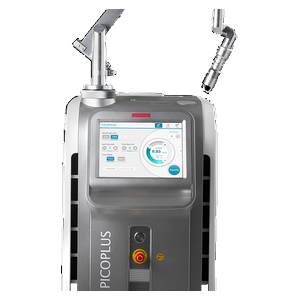
Pico laser fires light in pulses lasting trillionths of a second to break up pigment in the skin. Widespread dullness and melasma are treated with Pico Toning, while well-defined spots are treated individually with the Pico Spot laser.
From KRW 99,000 · excl. VAT
- Method
- Picosecond laser (1064 · 532 nm)
- Treatment time
- Toning, about 10–20 min
- Numbing
- Usually none; cream for spots
- Back to routine
- Toning: the same day
What it is
What is Pico laser?
We use Lutronic's PicoPlus. Pico Toning passes evenly over the whole face at low energy with the 1064 nm wavelength, while the Pico Spot laser targets small spots one by one with 532 nm.
Melasma can react to irritation, so we first examine the type and depth of pigment before choosing the method and intensity. Spot treatment is quoted after consultation based on size and number.
How it works
How it works

Very short pulses deliver a shock to pigment particles before heat can spread, splitting them into smaller fragments that the body clears gradually. Toning therefore aims for a more even tone over several sessions.
Is it right for you
Is it right for you?
A good fit when
- Your whole face looks dull and uneven
- You have melasma and want a gentler approach
- You want to clear freckles or well-defined spots
- You want steady care without downtime
Talk to your doctor first if
- Your skin is recently tanned
- You have a mole or patch that needs checking first
- You take medication that makes skin sensitive to light
- You are pregnant or have inflammation in the area
Pricing
Pico laser pricing
Pico ToningPicoPlus · LUTRONICPico SpotPico SpotAll prices exclude VAT.
The process
How a visit works
Consultation & AI skin analysis
An AI skin analysis records where your skin is today; one of our co-directors then examines you and decides whether to treat, how strongly and where.
Preparation
After cleansing, the pigment is examined; numbing cream is applied for spot treatment.
Treatment
Toning passes evenly over the face several times, while spots are targeted one by one. It can feel like a rubber band snap.
After your visit
After a calming finish you go home; spot areas are given repair tape or ointment.
Aftercare
Recovery & aftercare
- Mild redness after toning usually settles within a few hours.
- Treated spots may darken for a few days and flake off as thin scabs — do not pick them.
- Careful sun protection reduces the chance of pigment coming back.
Sessions & spacing
Toning is usually planned as five to ten sessions one to two weeks apart; spots are treated once and reviewed before deciding on more.
Your doctors
Seen by our two co-directors
At ATTITUDE, co-directors Dr. Lee Jae Min and Dr. Lee Dong Hun examine you themselves and decide with you what is needed, what is not, and in what order.

Dr. Lee Jae Min
Co-Director
Dankook University College of Medicine
Korean Aesthetic Surgery and Laser Society (ASLS) · Korean Association for Laser Dermatology and Trichology (KALDAT) · Korean Academy of Facelift & Contouring (KAFC)

Dr. Lee Dong Hun
Co-Director
Kyungpook National University School of Medicine
Korean Aesthetic Surgery and Laser Society (ASLS) · Korean Association for Laser Dermatology and Trichology (KALDAT) · Korean Academy of Facelift & Contouring (KAFC)
Questions
Frequently asked questions
How many Pico Toning sessions will I need?
Usually five to ten, one to two weeks apart, adjusted to the type of pigment and your response. It varies from person to person.
Does it help melasma?
Melasma involves hormones, UV and other factors, so it needs steady management. We use a gentler intensity and also advise on daily habits.
Can I wear make-up after spot treatment?
Spots may scab, so repair tape or a few gentle days are best. We give specific instructions after treatment.
How is it different from Genesis toning?
Pico Toning breaks up pigment, while Genesis toning focuses on texture, redness and overall skin condition. They are sometimes planned together.
Journal
Further reading from our Journal


Explore