Salmon DNA Injection Side Effects: Normal Reactions to Wait Out and Warning Signs to Act On
Which salmon DNA injection side effects settle on their own (redness, swelling, bruising, bumps) and which need a call right away, plus what to tell the clinic before treatment about pregnancy, breastfeeding and allergy history.
Written by ATTITUDE Clinic Editorial Team
When your face is red or has raised marks after a PDRN injection, it's hard to tell whether that's simply the expected reaction or a sign something is wrong. Some reactions settle within a few days; others are signals you should not ignore. The line between the two is simpler than it seems.
The short answer
Most reactions after a salmon DNA injection stay at the injection site. Redness, swelling, soreness when pressed, bruising and small raised bumps are common and usually fade within a few days. The American Academy of Dermatology notes in its filler guidance that mild reactions typically clear within 7–14 days (AAD filler guidance). Pain that keeps getting worse, the injection site turning white, mottled, or bluish-grey, or changes in your vision are not things to wait out — get medical attention right away. If you are pregnant or breastfeeding, have an autoimmune condition, or have a history of allergic reactions, say so before treatment.
Why does a salmon DNA injection cause redness and bumps?
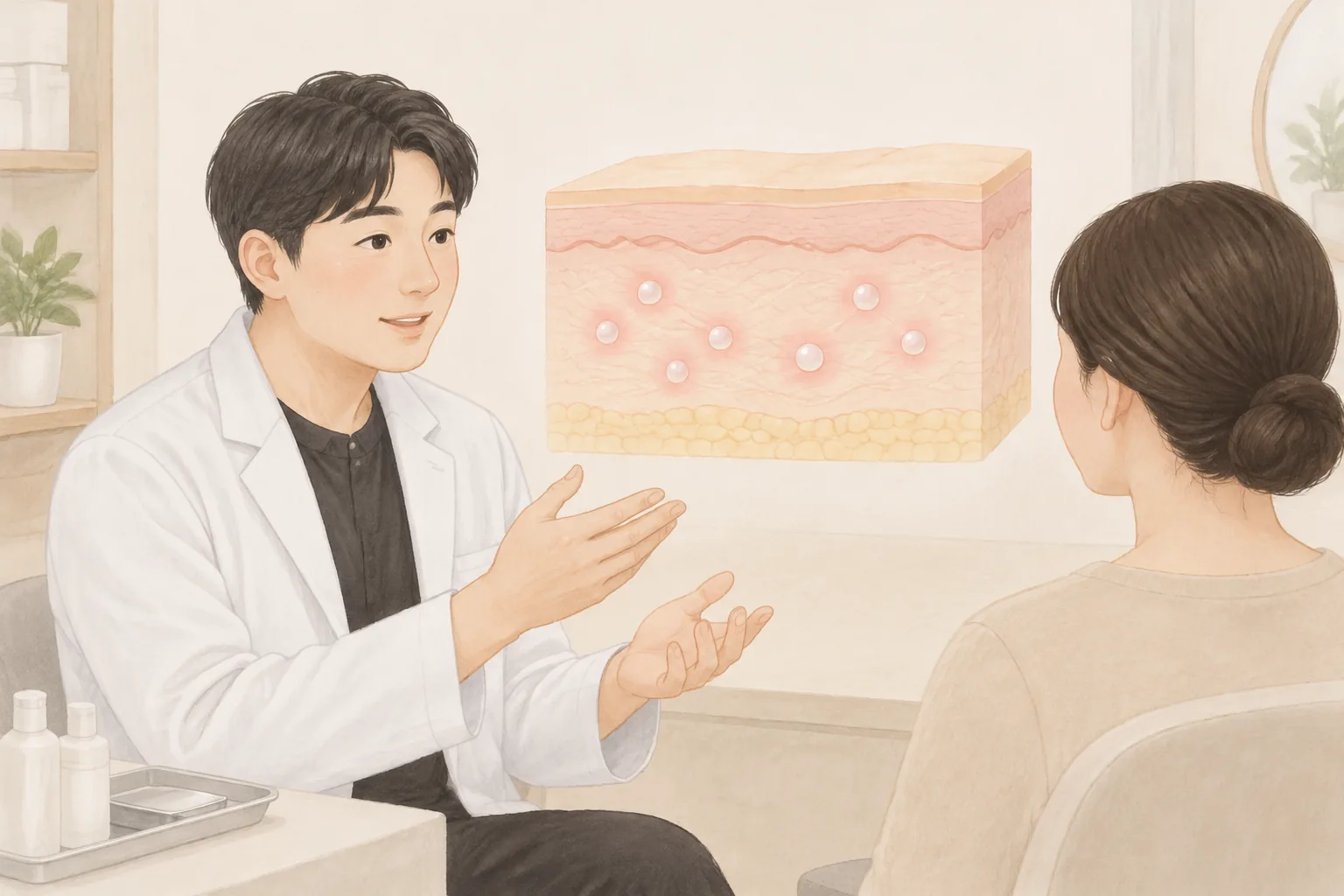
The key ingredient in a salmon DNA injection is PDRN (polydeoxyribonucleotide, nucleotide fragments obtained from salmon DNA). An ATTITUDE Clinic column explains that PN-type ingredients extracted from sources such as salmon, once placed in the dermis, are known to support the tissue's repair response and stimulate the cells that produce collagen. Separate from what the ingredient does, the injection itself leaves marks. A fine needle passes through many points, and as the liquid spreads through the dermis it creates small swelling and redness at those spots.
The raised bumps work the same way. The liquid briefly pools at each injection point, creating a bump that settles within a day to a few days as the ingredient is absorbed. During this window the skin's barrier is temporarily weakened, so sun protection needs more attention than usual to recover without pigmentation.
So why do some people barely show anything while others bruise heavily? Bruising depends on blood vessel distribution and injection technique. The same product in the same amount can leave marks of very different sizes depending on where on the face and how it is placed.
Redness and bumps right after treatment are marks left as the ingredient spreads, and usually settle within a few days
Which reactions are common, and where does that change?
The distinction we draw most often in clinic is between injection-site marks and everything else. Injection-site marks are redness, swelling, tenderness, bruising and bumps. The ATTITUDE Clinic column also lists small bumps, redness, swelling, soreness when pressed and bruising as common side effects, noting that bumps settle within a day to a few days while bruising can take more than a week to fade. Reactions to the product itself can be added on top: redness, itching, swelling, irritation and allergic reactions, and rarely there are reported cases of nodules (granulomas) or prolonged inflammation after applying a product to open skin. This is where the choice of product affects safety.
Less common reactions are infection, allergy, inflammation and small nodules. The collagen injection column likewise separates common from uncommon reactions, noting that infection, allergic reactions, foreign-body reactions and small nodules occur rarely. The one we watch for most is the rare vascular problem, where the injected material blocks or damages a blood vessel — in that case, skin color change and pain appear together.
If redness or swelling spreads and itching joins in, that is a different signal from a site reaction
If warmth or a rash is spreading, contact the clinic rather than waiting for your next appointment.
Table 1 Which reactions are common, and where does that change?
Reaction
How common
Usual course
When to contact the clinic
Redness, swelling, tenderness
Common
Hours to a few days
When it isn't improving and warmth or pain is added
Bumps (raised marks)
Common
A day to a few days
When the same spot remains after a week
Bruising
Common
Can take more than 1 week
When the area widens or darkens
Small nodules
Uncommon
Gradually settles or may persist
When what you can feel grows or hurts
Infection, allergy
Uncommon
Rash, itching, warmth
When it spreads or itching worsens
Vascular problem
Uncommon
Immediate
Skin color change, vision changes
Swipe sideways to see the whole table.
In short Injection-site marks tend to fade within a few days, while bruising lasts a little longer. If the course departs from that — color changes or pain intensifies — contact the clinic instead of waiting. If you're unsure, taking photos from the same angle makes it easier to compare progress.
What determines recovery speed and reaction size
Even with the same product and the same amount, the size of the marks and how fast they settle vary. Location comes first. The forehead, eye area and around the lips are close to bone with thin tissue, so injections feel more sensitive there, while thicker areas like the cheeks and jawline are relatively less so. The delivery tool matters too. Placing many closely spaced points with a fine needle means repeated brief stinging, while threading a thin tube with a rounded tip (cannula) and spreading from inside stings only on entry.
The practitioner's hands are another variable. The American Academy of Dermatology states that serious filler complications are reported more often when treatment is performed by people without sufficient medical training and experience (AAD filler guidance). The same source notes a large rise in reports from cases where inexperienced practitioners in non-medical settings injected filler. Medications matter as well. If you take a drug that affects blood clotting, bruising can be larger or last longer, so mention it at consultation.
Spacing and number of sessions are a question of planning, not recovery. The ATTITUDE Clinic column advises that skin booster treatments are usually done several times at 2–4 week intervals, after which the intervals are widened for maintenance sessions. That is why it is approached as ongoing care rather than a one-off, and the number and spacing are set after seeing the skin.
The scale of recovery depends on the area, the tool, the volume injected and the practitioner's hands
What to mention before treatment
There are items that must not be left out of the medical questionnaire: pregnancy or breastfeeding, autoimmune disease, any history of reacting to cosmetics or medications, medications you are taking, infection at the treatment site or cold sores on the lips, and inflammatory acne. The ATTITUDE Clinic column also advises telling the doctor these items before treatment. The collagen injection column adds whether you have ever reacted to tissue-derived products and which medications you take, including blood thinners.
If you are pregnant or breastfeeding, the conversation turns to adjusting the timing, because safety data on how skin booster ingredients affect a fetus or infant has not accumulated sufficiently. If you are planning a pregnancy, say so at consultation so the timing can be set accordingly.
Telling the clinic about important dates also helps. The American Academy of Dermatology advises that asking about risks, recovery time, preparation and aftercare at a cosmetic consultation is a way to reduce risk (AAD consultation guidance). If you have a fixed date such as a wedding or a shoot, it's better to mention it first.
What you mention in advance changes the volume and the areas treated on the day
If this applies to you
When your wedding or a shoot is 2 weeks away
Bruising and swelling usually settle within a few days, but bruising can last more than a week. If the date is fixed, the consultation adjusts toward treating earlier or limiting the areas. Avoiding saunas, alcohol and strenuous exercise before and after treatment helps recovery.
When you're having treatment during a short stay from abroad
It's better to leave a few days before your flight home. You need time to judge for yourself how much redness and swelling there is, and you should know in advance where to contact if things differ from what you expected. Noting the product name and volume used and the treatment date helps if you need care elsewhere.
When your skin is thin and prone to redness
Injection feels more sensitive on the forehead, eye area and around the lips than on the cheeks. If you tend to flush easily or have areas where acne flares, tell the clinic at consultation so the injection sites can be adjusted. If redness tends to linger, allow a generous recovery period.
When you are preparing for pregnancy or breastfeeding
At this stage, the consultation moves toward postponing treatment. That is because safety data is not sufficient, and if you are planning a pregnancy, you discuss the timing together.
Please tell us before consultation Whether you are pregnant or breastfeeding and whether you are planning a pregnancy, autoimmune disease, any history of reacting to cosmetics or medications, medications you take (including blood thinners), infection at the treatment site or cold sores on the lips, recent sun exposure and the skin care products you use, and fixed dates such as a wedding or a shoot.
How ATTITUDE Clinic proceeds
Skin records and questionnaire Redness, dryness and thin areas are recorded with a device, alongside pregnancy or breastfeeding status, medications, allergies and reactions to past treatments. Recording is a way of organizing information and does not replace a diagnosis.
Consultation with the doctor and planning The plan is set based on the product and ingredients to be used, injection depth and volume, and sensitivity by area. Recovery time and when to contact the clinic are explained here as well.
Treatment performed by the doctor Treatment follows the delivery method and anesthesia decided at consultation, adjusting pace based on your response during the session.
Recording progress and next appointment Reactions after treatment are recorded again and the next visit is scheduled.
Four steps your doctor sees to in person
From the diagnostic device to the treatment bed, the doctor you first consult takes care of everything.
01
Precision diagnosis
In a private diagnosis room the whole face is photographed, recording even skin conditions that are hard to see with the eye.
02
Skin analysis
The doctor goes through your pore, pigmentation, wrinkle and firmness results with you on screen and explains what comes first.
03
One-to-one design
With your skin, the balance of your face, the change you want and your schedule in view, you decide the treatment and its extent together.
04
Treatment by your doctor
The doctor who consulted you performs the treatment from start to finish in a private treatment room. No one takes over halfway.
“I take injection pain seriously.”
Co-Director Dr. Lee Dong Hun
Many people hesitate over injection treatments because they hurt. So we went back over everything, from the anesthetic to the products used.
Careful numbing, unhurried timingWe allow plenty of time for a special numbing cream to take full effect, and add anesthetic injections for the treatments and areas that need them.
Fine needles, finished quicklyInjection treatments use fine needles, and the doctor finishes them personally in a short time, adjusting along the way by watching how you are doing.
Even the product formulation countsThe same treatment can feel more or less demanding depending on the product, so we take that into account too.
The anesthetic method and whether it is used are decided after an examination, according to the treatment, the area and your condition. How much it hurts varies from person to person.
The regular price for 1 salmon DNA injection session is KRW 200,000, with VAT separate (treatments and pricing). Within the same skin booster category, Rejuran, skin booster ("water glow") injections and exosomes are also offered, and when combining microneedling-type devices that assist delivery, whether to do them on the same day and in what order is decided after assessing the skin.
Aftercare and side effects
Calming On the day of treatment, do not press or rub the injection sites hard. Check with the medical staff before cold compresses, and avoid saunas, strenuous exercise and alcohol that day.
Cleansing and makeup Cleanse gently from 4–6 hours afterward, and apply makeup from the day after the injection marks have closed.
Sun protection Apply sunscreen carefully throughout the recovery period. During this time the skin's barrier is weakened, making pigmentation more likely.
Checking progress Watch whether redness and swelling are decreasing and whether bumps or bruising remain. If the course differs from what you expected, contact the clinic rather than waiting for your next appointment.
Side effects, starting with the common ones: redness, swelling, tenderness, bruising and bumps are common and usually fade within a few days. Next are infection, allergic reactions, inflammation and small nodules. Rarely, the injected material can block or damage a blood vessel, in which case pain and skin color change appear together.
The signals not to wait on are clear: pain that is unusual for you or keeps getting worse, the injection site turning white or mottled and shifting to a bluish or black tone, or changes in your vision. Contact the clinic also if swelling, pain or warmth persists. These are not the kind of signal that improves if you simply give it time.
Frequently asked questions
What are the side effects of a salmon DNA injection?
The most common are injection-site marks: redness, swelling, soreness when pressed, bruising and small raised bumps. Bumps settle within a day to a few days, while bruising can take more than a week. Less commonly there is infection, allergic reaction, inflammation or small nodules, and rarely a vascular problem. Itching or a rash can also appear as a reaction to the product, so if an unusual reaction is spreading, contact the clinic rather than waiting for your next appointment.
When do bruising and swelling settle?
Swelling usually settles within a day to a few days, and bumps fade over the same period. Bruising can take more than a week to fade, and the wider the area, the longer it lasts. The American Academy of Dermatology advises that mild reactions after injection usually clear within 7–14 days. If swelling, pain or warmth persists, or is worse on one side only, that is outside the expected course and you should seek medical care.
Can I have it if I'm trying to conceive or breastfeeding?
Skin boosters are generally not recommended during pregnancy or breastfeeding, because safety data on how the ingredients affect a fetus or infant has not accumulated sufficiently. If you are preparing for pregnancy, mention the timing at consultation first, and the treatment schedule is adjusted accordingly. The simplest approach is to postpone until breastfeeding has ended.
Can I have it together with Rejuran?
If the purposes don't overlap, a combination can be considered. Rejuran is a PN-type product and the salmon DNA injection is a PDRN-type product, so the ingredients and concentrations differ within the same skin booster category. Whether to do them on the same day, and in what order and spacing, is decided after assessing your skin and recovery speed. If you are planning several treatments, it's better to map out the whole schedule first rather than booking each one separately.
What should I look for when choosing a clinic?
The American Academy of Dermatology lists the practitioner's training and experience, and their ability to explain risks, as things to check at consultation. Also look at which product is used, how volume and injection depth are decided, and whether they explain recovery time and how to reach them. The note that serious filler complications are reported more often with inexperienced practitioners is also worth weighing. Rather than choosing on price alone, look at how thorough the questionnaire and the explanation are.
At a glance
Table 2 At a glance
Item
Key point
Common reactions
Redness, swelling, tenderness, bruising, bumps. Usually fade within a few days
Less common reactions
Infection, allergy, inflammation, small nodules
Contact the clinic right away
Worsening pain, skin color change, vision changes, persistent warmth
Tell the clinic before treatment
Pregnancy or breastfeeding, autoimmune disease, allergy history, medications, skin infection
Aftercare
Calm the area on the day, makeup from the next day, sun protection, check progress
Spacing and number of sessions
Usually several sessions at 2–4 week intervals, then maintenance
This article offers general health information. It is not a substitute for diagnosis or treatment based on your own condition, so please talk through your situation with a doctor.